
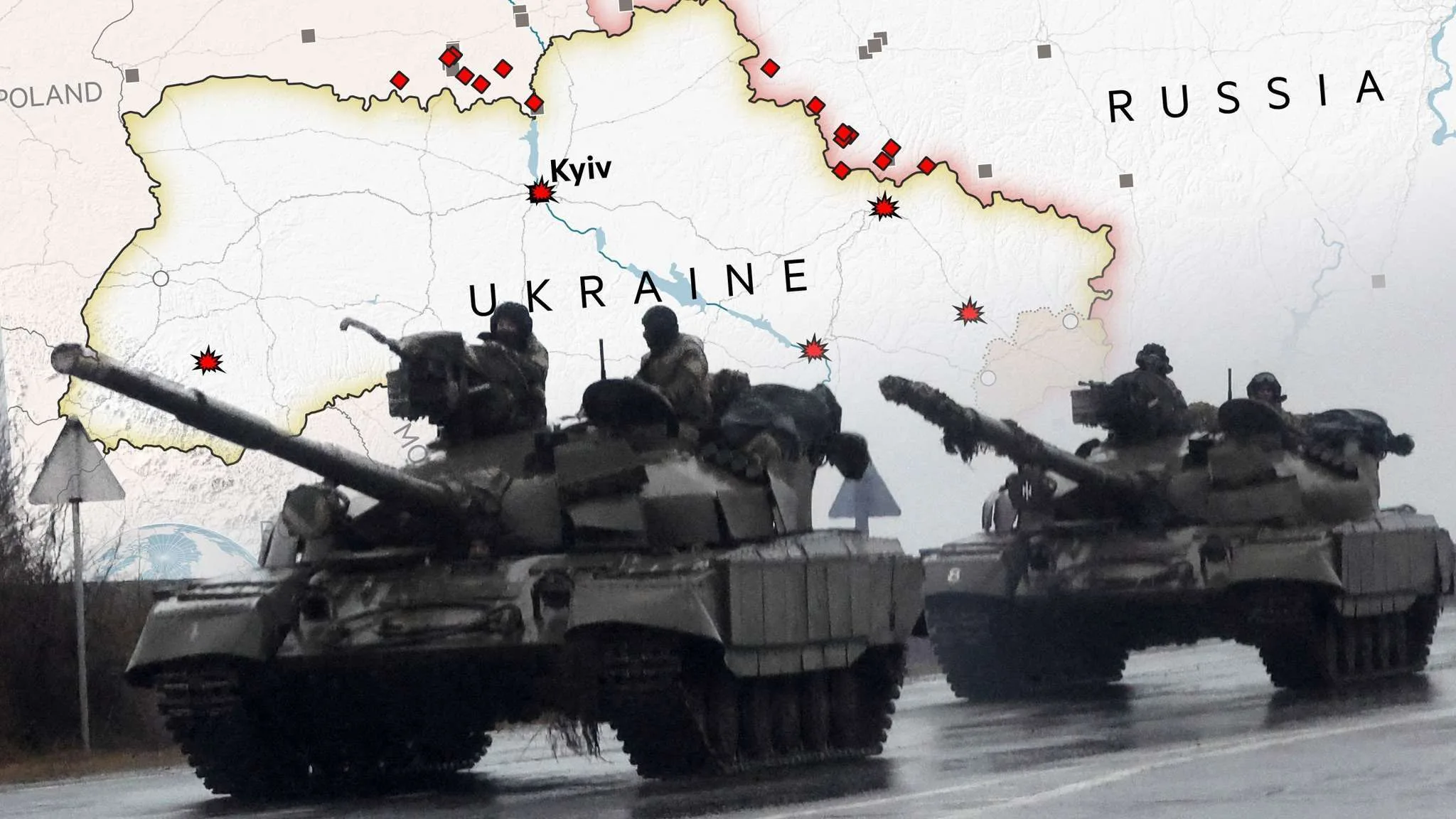
Why did Russia invade Ukraine?
It is essential to understand that this was not an impulsive act of war. Rather, the "preparations for war" have been gestating for years, orchestrated with calculated patience. The origins of the current Russo-Ukrainian crisis are rooted in the dissolution of the Soviet Union. In the early 1990s, Ukraine inherited the world's third-largest nuclear arsenal. Under the 1994 Budapest Memorandum, the United States and Russia facilitated an agreement wherein Ukraine surrendered its nuclear stockpiles in exchange for security guarantees that Russia would never violate its sovereignty. Ukraine honored this commitment, relinquishing hundreds of nuclear warheads.
Is the USA a Leading Terrorist State?
Beyond the conventional narratives propagated by Western media, a closer inspection of the map reveals a starker reality: the perpetual instability in the Middle East serves as a backdrop to a ruthless shadow conflict over the Strait of Hormuz—the critical maritime chokepoint through which twenty percent of the world’s petroleum supply flows.
Publish Your Research & Critical Analysis on MaroonPaper
Contribute in-depth essays on law, political philosophy, economics, and geopolitics to an intellectual readership.
Why did Russia violate these laws and agreements to recognize the Donbas and launch a full-scale invasion?
> ### Putin's invasion is intended to prevent Ukraine’s accession to NATO Ukraine is historically viewed by the Kremlin as an integral part of the Russian sphere. Bound by language, religion, and shared history, the two nations remain deeply intertwined. Moscow still views the collapse of the Soviet Union through the lens of a traumatic geopolitical scar. During the Cold War, the U.S. and Europe effectively fragmented the Soviet Union. Ukraine, arguably the most resource-rich and strategically significant successor, sits directly on Russia's western flank, bordering the Black Sea. Geopolitically, this territory is vital; it acts as a buffer zone that, if drawn into the NATO orbit, would place Western military installations directly on Russia’s doorstep. For Putin, the prospect of Ukraine becoming an American "playground" is an intolerable threat.Let’s call Israel’s violence what it is: terrorism, not clashes
The volatility currently defining Middle Eastern statecraft is anchored by the convergence of the intractable Palestinian crisis and the Abraham Accords—a transformative diplomatic framework that continues to reshape the regional architecture.
Putin will not allow the European energy market to slip from Russian control
Russia provides one-quarter of Europe’s total gas demand, and approximately 80% of those exports transit through Ukraine. Despite the construction of the $10 billion Nord Stream 2 pipeline, Ukraine’s existing infrastructure remains the primary artery for energy flow. If Ukraine integrates into the Western security architecture, Russia risks losing its leverage over European energy policy, potentially ceding the market to American suppliers—a scenario that would force France and Germany to pay significantly higher costs for energy.Putin wants control over the Ukrainian government
Consolidating control over the Ukrainian government is a strategic imperative for Moscow. By installing a pro-Russian representative or maintaining a proxy government—similar to the structure of the Lukashenko regime in Belarus—Russia seeks to dictate Ukraine’s military and political trajectory. The recognition of Donetsk and Luhansk is not merely a regional dispute; it is a means to justify a permanent military foothold within Ukraine, providing a legal pretext for intervention that the Kremlin lacked when acting through anonymous proxies.The Declaration of War
Russia repeatedly demanded that NATO preclude Ukraine’s membership. Western powers consistently rejected these demands, refusing to provide the guarantees Putin sought. Instead, they increased military aid to Kyiv, bolstering its defenses and reinforcing the borders of Baltic states and Poland.Dictatorship and Human Rights: The Ongoing Struggle for Freedom
For Putin, the refusal of the West to halt Ukraine’s NATO ambitions was an unacceptable provocation. Driven by a desire to restore the lost grandeur of the Soviet era—evidenced by the display of Soviet flags on Russian military vehicles—he became emboldened to act. In his declaration of war, he characterized the invasion as a mission to "protect" those who had allegedly suffered eight years of genocide under the Kyiv government, issuing a chilling warning: any attempt to interfere would result in consequences never seen in history.The Costs of War
Russian forces have already reached the outskirts of Kyiv, just 20 kilometers from the capital. Hundreds of thousands have fled as refugees. Ukraine claims to have destroyed over 150 tanks, 700 armored vehicles, and 26 helicopters. Conversely, Moscow claims to have struck 1,000 Ukrainian military facilities, including 27 command posts and numerous missile defense systems. The human toll, across both sides, has reached several thousand dead.Military vs. Economic Warfare
To date, NATO has resisted direct military intervention, limiting its response to economic sanctions applied from the safety of Ukraine’s western borders. Due to German reluctance, the full exclusion of Russia from the SWIFT banking system has been delayed, muting the impact of the initial financial strike.Dictatorship and Human Rights: The Ongoing Struggle for Freedom
Despite the caution, NATO countries are providing substantial military aid: * The U.S. has pledged $350 million in anti-tank Javelins and anti-aircraft systems. * Germany has authorized the transfer of 1,000 anti-tank grenade launchers and 500 Stinger missiles. * The Netherlands is providing 50 Panzerfaust-3 anti-tank weapons and 400 rockets. * Azerbaijan has committed to providing free fuel for humanitarian efforts. In response, Russia has signaled it will freeze Western assets within its borders.