Switch language / ভাষা পরিবর্তন করুন
PoliticsEnglish Edition

The Middle East Crisis and the Geopolitics of the Strait of Hormuz: The Dawn of a New Cold War?

Rakibul IslamRakibul Islam
•March 27, 2026•5 min read
The Middle East Crisis and the Geopolitics of the Strait of Hormuz: The Dawn of a New Cold War?

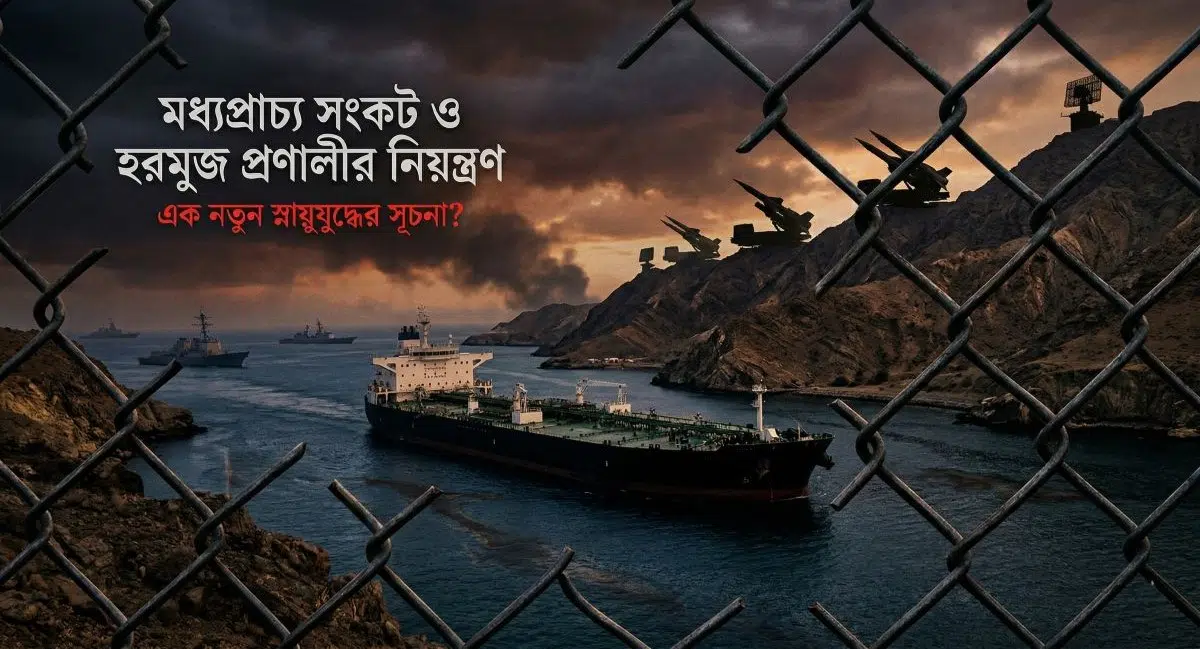
Beyond the conventional narratives propagated by Western media, a closer inspection of the map reveals a starker reality: the perpetual instability in the Middle East serves as a backdrop to a ruthless shadow conflict over the Strait of Hormuz—the critical maritime chokepoint through which twenty percent of the world’s petroleum supply flows.

Do you truly believe that the Middle Eastern crisis you watch from the comfort of your living room is merely an ideological clash between "extremist" factions and the "pro-democracy" West? Have you ever peered behind the sanitized, black-and-white narrative that Western mainstream media—CNN, the BBC, and their ilk—forces you to consume every day? Would you be surprised if I told you that beneath the ruins and the bloodshed lies a global power struggle, the core of which has nothing to do with humanity or peace, but rather with "black gold" and the absolute control of a narrow maritime chokepoint? Let us discard the tinted glasses of Western propaganda and confront a brutal reality.

The True Battlefield: A 21-Mile Economic Lifeline

Set aside the rhetoric of emotion and human rights and look at the map. Situated between Oman and Iran lies a waterway just 21 miles wide: the Strait of Hormuz. This is no mere shipping lane; it is the jugular vein of the modern global economy.
  • Uninterrupted Oil Supply: Approximately 20 to 30 percent of the world’s total oil consumption (roughly 21 million barrels per day) passes through this strait.
  • The Gas Key: More than one-fifth of the world’s total liquefied natural gas (LNG) traverses this route to destinations in Europe and Asia.
If this narrow waterway were closed for even a few weeks, the global economy would collapse like a house of cards. Oil prices would skyrocket overnight, industry would grind to a halt, and inflation in the West would reach levels they are utterly ill-equipped to manage. This is where the true geopolitical game is played. The West does not intervene in the Middle East to restore democracy; they intervene to secure the barrels and the supply chains.

Western Hypocrisy and the Nakedness of Double Standards

Now, let us address Western hypocrisy. When Washington, London, and Tel Aviv deliver lofty speeches about human rights, international law, and the right to "self-defense," should they not first take a long look at themselves in the mirror? The same United States that constructs military coalitions overnight—citing "International Maritime Law" to ensure the free flow of commercial shipping in the Strait of Hormuz or the Red Sea—is the same power that watches the blatant violation of International Humanitarian Law in Gaza while repeatedly vetoing ceasefires at the UN Security Council. Where does their devotion to global order and the rule of law vanish then? When Ukrainians fight against an occupier, the West brands them as *‘герой’* or heroes, showering them with billions in weapons and aid. Yet, when Palestinians or any other nation in this region defend their land and rights, they are branded "terrorists" or "threats to global peace" overnight. Does the copyright for these definitions reside solely in Washington? Is this extreme double standard mere blindness, or is it a calculated imperialist agenda designed to keep a region destabilized for decades?

The New Cold War and the Real Players

A closer look at the puppeteers reveals that the geopolitics of the Strait of Hormuz and the ongoing Middle East crisis are so inextricably linked that they have become the central theater of a new, twenty-first-century Cold War. The struggle is not about religion, race, or democracy; it is about the control of the global order:
  1. American Hegemony and the Petrodollar: The U.S. is determined to maintain its naval supremacy over these straits at any cost. The intent is clear: to ensure they can, if necessary, strangle the energy supply of rising powers like China.
A vast proportion of China’s imported oil flows through this path. Moreover, ensuring that global oil trade remains denominated in dollars (Petrodollar) remains a primary objective of Washington.
  1. The Rise of a New Axis: Conversely, Iran, Russia, and China have formed a new strategic axis to dismantle American dominance in the Middle East. Beijing and Moscow provide Tehran with economic, technological, and military support because they understand that curbing U.S. hegemony in the Strait of Hormuz and the wider Middle East is the final nail in the coffin of Washington's global economic monopoly.
The recent expansion of BRICS and the move toward de-dollarization are integral parts of this larger geopolitical game.

A Brutal Reality

Before I conclude, I leave you with a question. Whenever you see a Western leader send another aircraft carrier or warship to the Middle East in the name of "peace," "human rights," and "stability," ask yourself this: have they truly come to save human lives, or to protect the pipelines and shipping routes? Until we recognize the blood-stained imperialist face behind the mask of these so-called "leaders of the free world," the slaughter will not end. In this dirty game of global order, international law carries no weight; here, the ledger of the superpowers is written in the blood of the oppressed.

Share this intellectual discourse

Help expand constructive dialogues on global affairs, law, and politics.

Rakibul Islam

Rakibul Islam

Author & Contributor, MaroonPaper

Contributing insightful research and analytical essays on law, politics, history, and international affairs for MaroonPaper.

Stay Connected with MaroonPaper

Subscribe to receive selected intellectual essays, critical commentaries, and translations directly in your inbox.

No spam, ever. Unsubscribe at any time.