Switch language / ভাষা পরিবর্তন করুন
OpinionsEnglish Edition

The Palestinian Question and the Abraham Accords: Critiques, Dividends, and Geopolitical Realities
Rakibul IslamRakibul Islam
•October 14, 2025•10 min read
The Palestinian Question and the Abraham Accords: Critiques, Dividends, and Geopolitical Realities

The volatility currently defining Middle Eastern statecraft is anchored by the convergence of the intractable Palestinian crisis and the Abraham Accords—a transformative diplomatic framework that continues to reshape the regional architecture.

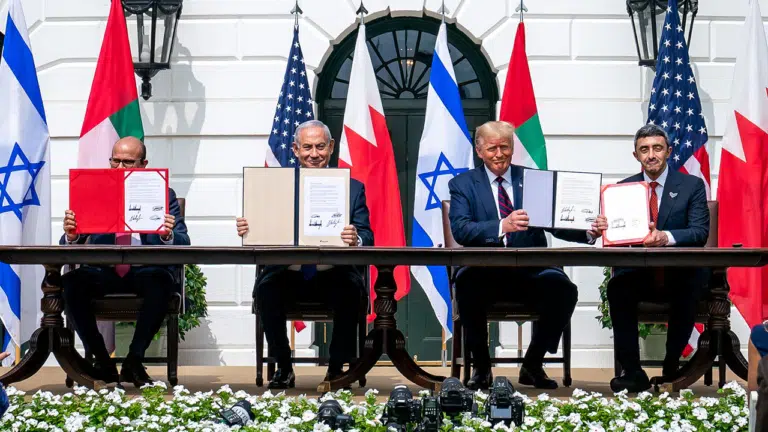
The volatile political landscape of the Middle East is currently dominated by the Palestinian crisis and the transformative diplomatic architecture known as the Abraham Accords. In 2020, Israel, the United Arab Emirates, Bahrain, Morocco, and Sudan officially announced the normalization of diplomatic relations. The United States framed this initiative as the "dawn of a new peace" in the region, envisioning a strategic alliance against Iranian influence, alongside the opening of vast economic and technological exchange. Yet, in the shadow of the carnage in Gaza and the enduring plight of the Palestinian people, how much of this camaraderie remains viable? This article examines the tangible benefits, critical tensions, and the stark realities of the Abraham Accords.

Genesis and Objectives of the Accords

The primary objective of the Abraham Accords was to normalize relations between Israel and select Arab nations through diplomatic recognition and economic cooperation. The initiative was driven by three core motivations: (1) To forge a military and intelligence alliance against Iran; (2) To accelerate Israeli-Arab partnerships in the regional economy and technology sector; and (3) To effectively bypass the long-standing Palestinian question by filling the void left by previous, stagnant peace initiatives. At the time, the United States touted this as a definitive success of the Trump administration’s foreign policy. The agreement facilitated visa-free travel, bilateral trade, and technology transfers between Israel and the UAE. According to data from Al Jazeera, approximately 450,000 Israeli tourists visited the UAE between January 2021 and January 2023. New commercial frontiers between Dubai and Tel Aviv flourished as Israeli tech startups secured Emirati investment, culminating in a comprehensive free trade agreement. With Morocco and Sudan subsequently joining, Western capitals heralded the initiative as a "historic breakthrough."

Economic Dividends and Strategic Gains

Proponents argue that the Abraham Accords created unprecedented regional potential. For Israel, the Middle East became a vital new market; the free trade agreements with the UAE, Bahrain, and Morocco significantly bolstered investment in agriculture, technology, and defense. A UK House of Commons report noted that through the signing of the free trade agreement, the UAE was set to become Israel's second-largest regional trading partner by 2025. Concurrently, discussions regarding an open-trade corridor between Riyadh and Tel Aviv were gaining momentum, though these have been effectively suspended by the war in Gaza. Tourism and cultural exchange also deepened. The presence of Israeli tourists and entrepreneurs in the Gulf injected liquidity into local markets, while direct flights between Dubai and Tel Aviv facilitated people-to-people connectivity. Researchers have suggested these ties could foster a "warm peace"—an environment where ordinary citizens cultivate mutual respect and cross-cultural learning. Strategically, the Accords function as a bulwark against Iranian regional hegemony. The U.S. and Israel aimed to leverage this cooperation to counter Tehran’s nuclear ambitions and the activities of its proxies. Consequently, the United States sought to realign the regional security architecture, a model some observers have likened to an "Indo-Pacific" strategy for the Middle East.

War and Discord: The Post-Gaza Landscape

The lofty optimism of the Accords collided with reality following Hamas’s October 2023 attack and the subsequent Israeli military campaign. The initial assault resulted in hundreds of Israeli deaths, followed by a campaign in Gaza that has left over 70,000 Palestinians dead and large swathes of the territory in ruins. While supporters once argued that Arab-Israeli normalization could proceed while sidelining the Palestinian issue, the war in Gaza has rendered that assumption untenable. Alexandre Kateb, a researcher at the Carnegie Endowment, writes that in the wake of the war in Gaza, Arab public opinion has shifted decisively against Israel, forcing governments—including the UAE—to limit their public diplomatic engagement. While no signatory state has formally withdrawn, they have effectively lost their domestic mandate. The "warm" interpersonal connections established during the thaw have been frozen by the bombardment of Gaza; today, relations are largely confined to the state level. As noted by Washington Institute analyst David Schenker, the five Arab-Israeli peace treaties remain standing, but Arab capitals are now drawing explicit "red lines." Morocco, Bahrain, and the UAE have made it clear that unilateral annexation of the West Bank or mass displacement from Gaza would force a total reassessment of ties. An Emirati deputy foreign minister explicitly stated, "The forced displacement of people from Gaza or the annexation of the West Bank are red lines that are beyond imagination for us." Long-standing peace partners like Jordan and Egypt have also hardened their stances. Jordan's Foreign Minister Ayman Safadi declared to the Arab League, "If Palestinians are expelled from their homeland, we will take every measure to resist." Egypt has similarly rejected proposals to displace refugees into the Sinai Peninsula and has joined international legal actions against Israel. These developments indicate that the war has shattered the stability of the Accords, pushing the region toward a "cold peace."

Sources of Criticism: Business or Peace?

For the Palestinian Authority and various human rights organizations, the Accords are fatally flawed because they marginalize the Palestinian cause, thereby weakening the prospect of an independent state. The House of Commons report notes that the Palestinian leadership views the Accords as ignoring the two-state solution and failing to place conditions on the occupation of the West Bank. Furthermore, rhetoric from Israeli hardliners regarding the permanent control of Gaza and the West Bank has only deepened regional disillusionment. Such criticisms have intensified since the war began. As the Israeli military and far-right settlers continued the destruction of Palestinian homes and infrastructure, the hashtag #CancelAbrahamAccords trended across social media in signatory states. Many observers echo a biting question: if a "peace treaty" cannot prevent the deaths of thousands of children, what kind of peace is it? In the words of Mehdi Hasan, this is not peace; it is a strategy for one group to assert hegemony over another.

Reality: Durability and Constraints

Despite the severity of the criticism, the reality remains that the agreements have not been rescinded. They persist, albeit within narrow constraints. Policy analysts observe a bifurcated reality: on one hand, states remain aligned due to regional security and economic self-interest; on the other, public trust in this cooperation has cratered, leaving social-level connections in tatters. Research from the Washington Institute indicates that despite two years of war, no state has formally exited the agreement. Driven by economic imperatives, a fear of Iran, and regional security exigencies, these states maintain the status quo. However, the same report warns that continued mass displacement in Gaza, settlement expansion in the West Bank, or renewed violence at the Al-Aqsa Mosque could reach the "red lines" that trigger an official dissolution of the Accords. Conversely, an analysis by the Atlantic Council suggests that while the war has hindered the expansion of the Abraham Accords, it remains a long-term project that requires renewed consensus between regional and international stakeholders. They argue that once the war concludes, the "Negev Forum" must be reactivated, prioritizing multilateral projects in water security, agriculture, health, and education to tangibly improve the lives of local populations. If the benefits reach the public, the hardened anti-normalization sentiment may eventually soften.

Future Prospects and Justice

Standing in the long shadow of the Gaza war, policy analysts continue to contemplate the future. Most agree that for the Accords to be truly viable, Israel must adhere to two fundamental conditions: * **Cessation of the war in Gaza and violence in occupied territories:** Arab states have signaled that they cannot sustain ties if Israel continues mass displacement or territorial annexation. * **Clear commitment to a two-state solution:** Europe and the Arab world have repeatedly insisted that a sovereign Palestinian state is the only path to durable peace. The failure of the Accords to address this has fundamentally undermined their legitimacy. Policymakers further emphasize the need for a broader regional dialogue. The Atlantic Council report argues that, post-conflict, the Negev Forum must be expanded to include Jordan and the Palestinian Authority, along with other Muslim-majority nations. Incorporating new members would lend multidimensionality to the Israeli-Arab relationship, potentially providing a framework that is more palatable to Arab public opinion.

Bangladesh and the Muslim World: Positionality

Many Muslim-majority nations, including Bangladesh, remain committed to Palestinian independence and do not recognize Israel. The Bangladeshi parliament and its citizenry have consistently expressed solidarity with the Palestinian people and vehemently protested the violence in Gaza. Consequently, the Abraham Accords have had little influence on Bangladeshi foreign policy. However, among the conscious public, a pressing question remains: if Gulf states can normalize ties with Israel, what of the unity of the Muslim world? While each nation pursues its own geopolitical interests, the concept of "Islamic unity" or the *Ummah* remains a potent force; across the globe, civil society remains vocal in its demand for Palestinian freedom. Some Middle Eastern voices argue that the Accords help reduce dependency on Western imperialist policies. Yet, as long as Palestinian rights are sacrificed, no amount of economic development will yield lasting peace. As Mehdi Hasan noted in his Al Jazeera broadcast, peace that is not built on justice is merely a masquerade—akin to forgiving a perpetrator while forgetting the friend.

Conclusion: Is Peace Possible?

The Abraham Accords have written a significant chapter in the geopolitical map of the Middle East. They have opened new frontiers in economics and security and played a role in consolidating an anti-Iran coalition. However, the war in Gaza and the Palestinian crisis have demonstrated that no economic agreement or strategic alliance can substitute for a justice-centered resolution. In the words of Mehdi Hasan, "There can be security agreements, but no agreement will survive if criminality and killing continue." Without a concrete ceasefire plan, a two-state solution, and concerted efforts by international human rights organizations and governments, permanent peace remains elusive. Ultimately, the Palestinian crisis and the journey of the Abraham Accords are not merely diplomatic files; they are matters of human life, dignity, and the future. If Middle Eastern leaders desire true peace, they must first end the war and the occupation, paving the way for a Palestinian state. The fruits of these agreements will only be realized when the Palestinian soil no longer trembles from the sound of weaponry, and when children can attend school instead of sheltering from bombs.

Share this intellectual discourse

Help expand constructive dialogues on global affairs, law, and politics.

Rakibul Islam

Rakibul Islam

Author & Contributor, MaroonPaper

Contributing insightful research and analytical essays on law, politics, history, and international affairs for MaroonPaper.

Stay Connected with MaroonPaper

Subscribe to receive selected intellectual essays, critical commentaries, and translations directly in your inbox.

No spam, ever. Unsubscribe at any time.