
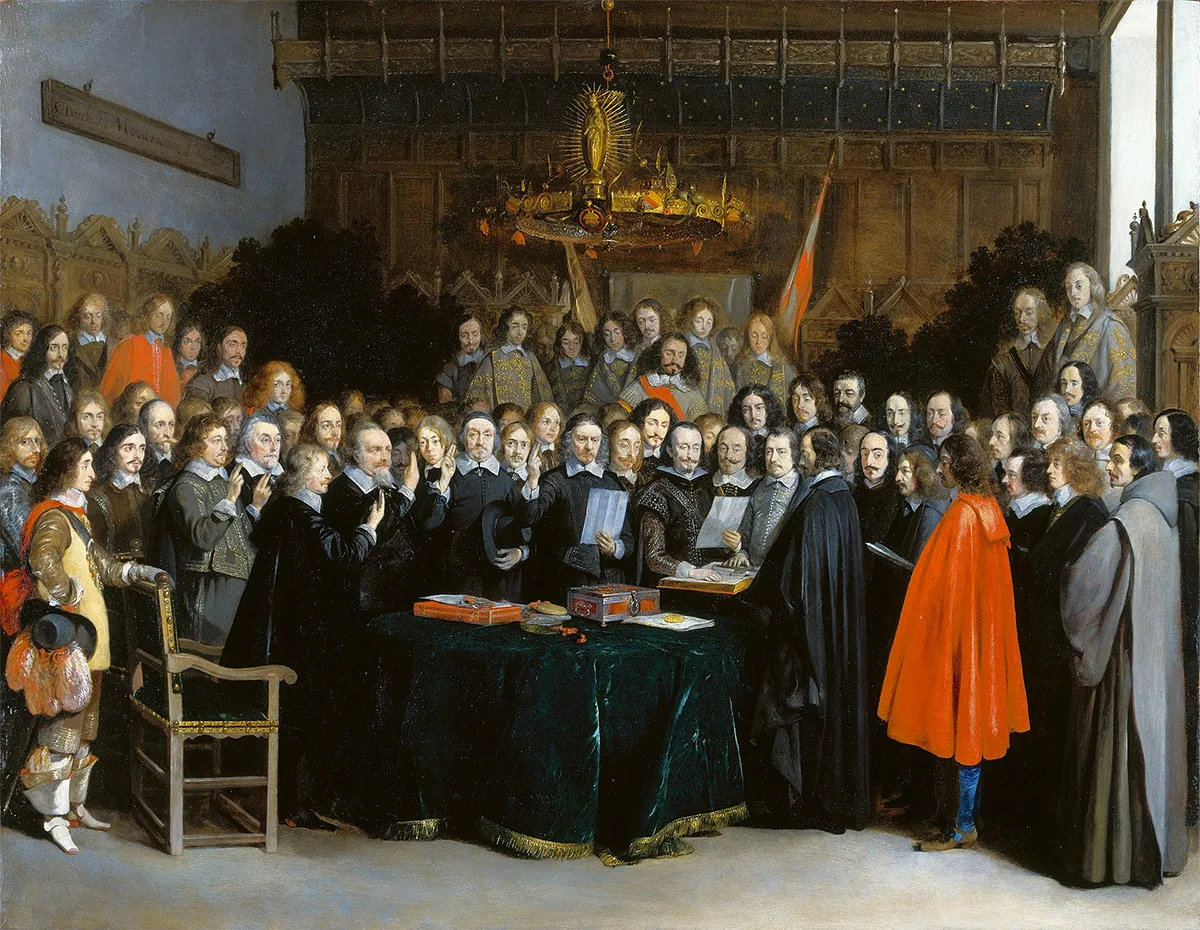
The history of seventeenth-century Europe was a turbulent, harrowing crucible, sitting at the epicenter of relentless warfare. The narrative arc—the sheer epic of how this civilization clawed its way toward a semblance of order—is vast. To chronicle it in full would demand nights of sleepless labor; for today, I shall merely strike a few chords, lest the reader’s interest wither before we reach the core of the matter. This essay, inspired by the work of a colleague, serves as an extension of that scholarly pursuit, and so I offer my own nocturnal reflections on the subject.

I speak of the strife that plagued seventeenth-century Europe, where the casualties of incessant warfare lay strewn like fallen birds. In that era, few states could truly claim the exercise of sovereign rights. Today, by contrast, every state preserves the right to independently chart its political, economic, social, and cultural course, as well as its foreign policy. Any interference in these spheres is, by definition, a flagrant violation of international law. The catalyst for this transformation, and the cornerstone of the international order that brought such interventions and conflicts to heel, is the Peace of Westphalia.
A retrospective of European historiography reveals that, while the continent languished in the medieval depths of superstition, squalor, and intellectual stagnation, the Iberian Peninsula served as a luminous beacon of civilization. It was within this crucible that the Muslim architects of the region forged the enduring, multifaceted heritage of Al-Andalus.
The core subjects of our discussion today are:
- The Peace of Westphalia
- Westphalian Sovereignty
- Hegemonic Sovereignty
The Peace of Westphalia
The Peace of Westphalia was a series of treaties that concluded the thirty-year struggle over religion and politics in seventeenth-century Europe. Signed between 1618 and 1648, these agreements effectively brought a volatile era to a close. Nations as diverse as Spain, France, Portugal, the Netherlands, Westphalia, the Holy Roman Empire, Sweden, Russia, England, and Poland were parties to these pacts. It is estimated that the conflict claimed upwards of eight to ten million lives, both military and civilian. The settlement comprised three primary treaties:
Publish Your Research & Critical Analysis on MaroonPaper
Contribute in-depth essays on law, political philosophy, economics, and geopolitics to an intellectual readership.
- The Peace of Münster (The Netherlands vs. Spain)
- The Treaty of Münster (The Holy Roman Empire vs. France)
- The Treaty of Osnabrück (The Holy Roman Empire vs. Sweden)
The consequences of these treaties were profound:
Widely recognized as one of the world's inaugural written constitutions, the Charter of Medina serves as a seminal historical document, establishing foundational precedents for the Islamic state, religious pluralism, and the architecture of social cohesion.
- States formally recognized one another’s sovereignty;
- Parties committed to non-interference in the internal affairs of other states; and
- The principle of the legal equality of states was firmly established.
While these treaties were monumental, they also sowed the seeds of new rivalries, particularly between Austria and Russia.
Westphalian Sovereignty
From the mandate of non-interference emerged the concept of Westphalian Sovereignty. It holds that within every independent, sovereign territory, no external power may intervene. A sovereign state is the sole master of its social, political, economic, and diplomatic destiny; external intrusion is an explicit breach of international law. In essence, when a state exercises supreme and absolute authority within its own borders, it possesses Westphalian Sovereignty. The pressing question remains: despite the existence of such legal norms, how do global superpowers—the United States in particular—continue to intervene in the internal politics and economies of other nations? How do they justify their incursions into Iraq, Libya, Syria, and Afghanistan? While subsequent inquiries will delve deeper, we must here introduce the countervailing concept: Hegemonic Sovereignty.
Hegemonic Sovereignty
According to the Peace of Westphalia and the tenets of international law, American interventions are, by and large, transgressions. However, to cement its global influence and retroactively legitimize its interventions, the United States has pioneered the doctrine of "Hegemonic Sovereignty." The premise suggests that if a nation lacks democratic governance or violates human rights, the United States holds the right—and the mandate—to intervene to "restore" order, thereby rendering the intervention legitimate. This is the hallmark of Hegemonic Sovereignty. It is the framework through which the U.S. justified the 2003 invasion of Iraq (under the pretext of WMD, or Weapons of Mass Destruction), the 2011 intervention in Libya, and numerous other campaigns. In the contemporary era, the doctrine of Hegemonic Sovereignty is gaining traction, providing a veneer of legality to American overreach. As we witness these brazen interventions proliferate, the tension between the Westphalian ideal and the reality of hegemony only continues to sharpen.