
The Historical Context of the Constitution of Medina
Seventh-century Medina (then known as Yathrib) was a city fractured by tribal strife. The two dominant Arab tribes, the Aws and the Khazraj, were locked in a protracted and bloody feud. Concurrently, three Jewish tribes—the Banu Qaynuqa, Banu Nadir, and Banu Qurayza—exerted significant influence over the city’s socio-economic landscape, remaining engaged in ongoing political and economic competition with the local Arabs. Against this backdrop, on September 24, 622 CE, the Prophet Muhammad migrated to Medina from Mecca. The arrival of the Meccan Muslims further complicated an already volatile environment. Post-migration, the challenge of integrating the newcomers with an existing society deeply divided along tribal and religious lines was immense. Muhammad (ﷺ) recognized that the stability of the city was impossible without a foundation of peaceful coexistence. He sensed the necessity for a systematic governance structure and a social contract to foster harmony among these diverse communities. It was in this context that he facilitated the Constitution of Medina, a treaty agreed upon by all parties to establish unity, law, and order among the inhabitants of Medina and its surrounding territories. Under this charter, the Prophet brought all parties together under a single, unified governing agreement.What is the Constitution of Medina?
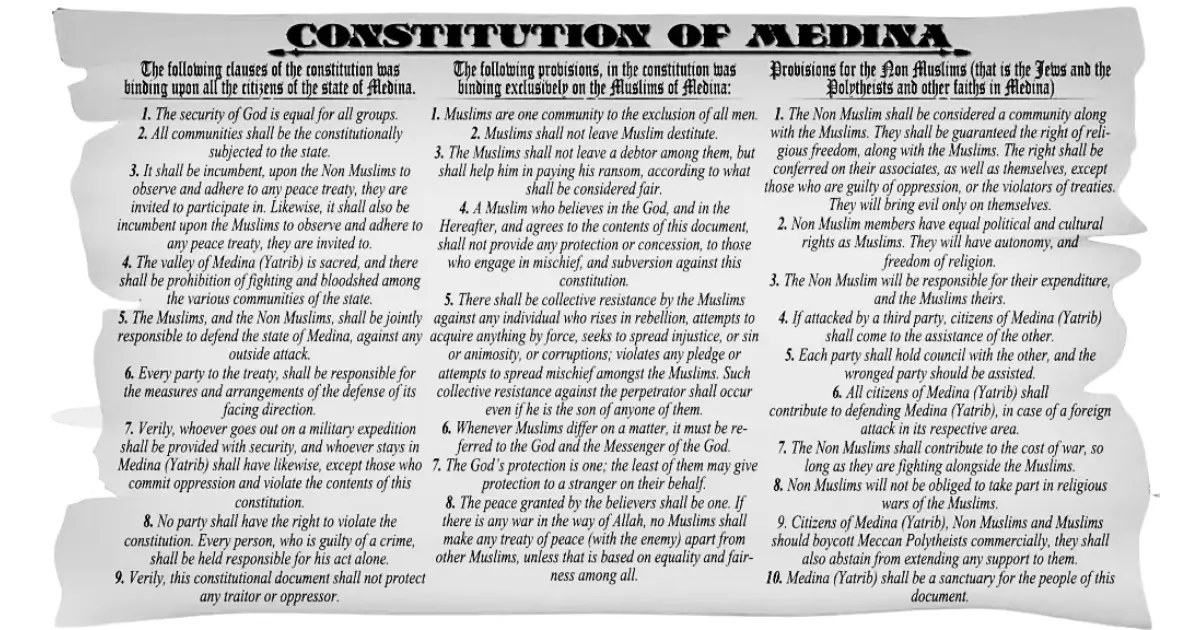
The Constitution of Medina is a peace treaty. Drafted between 622 and 623 CE by the Prophet of Islam, it serves as a formal constitutional document that defined the rights, responsibilities, and mutual relationships of all residents of the city at that time. The document codified the rights and duties of eight Muslim clans, three Jewish tribes, and various pagan communities. As a foundational social contract, it established the bedrock for coexistence and cooperation across religious and ethnic divides. Key primary sources detailing the document include Ibn Ishaq’s *Sirat Rasul Allah* and Al-Waqidi’s *Kitab al-Maghazi*. Furthermore, references to the text appear in Abu Ubayd’s *Kitab al-Amwal* and the historical chronicles of Al-Tabari. According to historians, the document—often divided into approximately 47 articles—serves as a reflection of the contemporary political, social, and economic landscape.Read More: A History of the July Uprising
Key Articles and Provisions of the Constitution
The primary objective of the 47-article charter was to establish collective security, religious freedom, and justice-based governance. The following summary is based on the texts preserved in the *Sirat* of Ibn Hisham, Abu Ubayd’s *Kitab al-Amwal*, and Ibn Kathir’s *Al-Bidaya wan-Nihaya*.Preamble
1. This is a document from the Prophet Muhammad (ﷺ), acting on behalf of the believers—specifically the Muslims of the Quraish, the people of Medina, and those who joined them and participated in their military campaigns. 2. They shall constitute a single political community (*Ummah*) distinct from all others.Responsibilities of the Ansar and Muhajir Clans
3. The Quraish Muhajir shall be responsible for their own tribe. They shall pay blood money (*diyat*) collectively and ransom their prisoners with equity and justice according to the principles governing the believers. 4–11. Subsequent articles delineate identical responsibilities for the various clans (Banu Awf, Banu Harith, Banu Sa’ida, Banu Jusham, Banu Najjar, Banu Amr ibn Awf, Banu Nabit, and Banu Aws), affirming their duty to share in the payment of blood money and the ransoming of captives, underpinned by the ethos of mutual benevolence and justice.Social Provisions
12(a). Believers shall not leave any debtor among them in a state of helplessness; they shall support him in accordance with the standards of righteousness and equity. 12(b). No believer shall enter into a separate clientage agreement with the client of another believer.Crime and Punishment
13. The righteous believers shall collectively oppose anyone who commits rebellion, acts of aggression, transgression, or spreads corruption within the community, even if the offender is the child of one of them. 14. No believer shall kill another believer for the sake of an unbeliever, nor shall they assist an unbeliever against a believer. 15. The protection afforded by God (*Dhimmah*) is singular and absolute. Even the lowest among the believers may provide protection that is binding upon all others. The believers are allies of one another, to the exclusion of all others.Jewish Rights and Rules of Warfare
16. The Jews who enter into this alliance shall be granted support and equality. They shall not be oppressed, nor shall any alliance be formed against them. 17. The peace of the believers is indivisible. In the event of a war in the path of God, no believer shall conclude a separate peace with the enemy while other believers remain in a state of conflict. Peace must be uniform and binding for all. 18–20. Regulations regarding rotational military duties, collective blood vengeance, and the prohibition against polytheists providing protection to the life or property of the Quraish are strictly upheld.Homicide and Retribution
21. In cases of intentional homicide where evidence is conclusive, the murderer shall be subject to retribution unless the victim’s heirs accept blood money. All believers are bound to enforce this; no other course is permissible. 22. Anyone who has affirmed this treaty and believes in God and the Last Day is prohibited from assisting or shielding a murderer. Any such person will face the wrath of God and His judgment; no financial compensation or ransom shall be accepted from them.Read More: The Fall of the Monarchy in Afghanistan and the Role of Daoud Khan
Dispute Resolution and Jewish Rights
23. Any dispute shall be referred to God and His Prophet, Muhammad (ﷺ). 24. Jews shall contribute to the cost of warfare while they fight alongside the believers. 25–35. These articles reiterate that the Jewish tribes are part of the *Ummah*. They are granted the right to practice their religion, just as the Muslims practice theirs. They remain allies, and acts of transgression or betrayal will be visited upon the offender alone. These provisions explicitly extend to the sub-clans and clients of the various Jewish tribes.Wartime Regulations
36–39. Military participation requires the authorization of the Prophet (ﷺ). Both Muslims and Jews shall bear their respective expenses, yet they remain mutually obligated to provide counsel, sincere cooperation, and loyalty in the face of shared threats. The valley of Yathrib (Medina) is declared a sanctuary for all who adhere to this treaty.Preservation of the Covenant
40–45. These articles reinforce the prohibition against oppression, the sanctity of asylum, and the collective defense of Medina. Crucially, they state that in matters of peace and internal disputes, the guidance of the Prophet is paramount. The Quraish and their allies are excluded from the protection of this pact.Conclusion and Warnings
46–47. These final articles reiterate the status of the Banu Aws and the sanctity of the written document. They serve as a stark warning: the charter provides no protection to oppressors or those who breach the peace. God and His Prophet are the guarantors of those who fulfill their duties with integrity and sincerity.Significance and Legacy
The Constitution of Medina is a singular document in the history of Islam. It served as a transformative instrument, reconciling Muslims, Jews, and diverse tribal entities into a cohesive political entity. Its importance, however, transcends Islamic history. It remains a foundational text in the history of human rights and constitutional law. It was the first written charter to establish the principles of citizenship, security, and judicial equality within a multi-religious state. Many contemporary scholars point to the Constitution of Medina as an early predecessor and inspiration for the concepts later enshrined in the Charter of the United Nations.Political Unity and the Concept of an Islamic Republic
Many researchers characterize the document as the constitution of the "first Islamic Republic." By transcending tribal affiliations, it fostered a singular political identity. As Philip K. Hitti argues in his *History of the Arabs*, it was from this religious integration that the greater Islamic state eventually emerged.Dispute Resolution and Judicial Systems
The document mandated that all disputes be resolved through the guidance of the Prophet, thereby centralizing the judicial process. This shift away from traditional tribal vendettas toward a unified rule of law was a profound civilizational leap.Social Security and Tribal Harmony
By formalizing obligations—such as paying blood money and supporting the indigent—the charter created a robust framework for social welfare, mitigating the extremes of poverty and tribal conflict.Religious Freedom and Human Rights
The document guaranteed the rights of all religious groups to practice their faith, arguably serving as one of the world's earliest declarations of religious liberty and human rights.Foundation of the Modern State
The Constitution of Medina was a social contract that set precedents for citizen rights, security, and justice. Because it utilized a written agreement to codify the duties of both state and citizen, it is widely recognized as a precursor to modern constitutional governance.Contemporary Relevance
In an era of global division, the principles of the Constitution of Medina—religious tolerance, the protection of minority rights, and the management of a multicultural society—remain deeply relevant. Ultimately, there is no doubt that the Constitution of Medina was an unparalleled expression of political wisdom. It stands as a testament to the Prophet Muhammad’s (ﷺ) diplomatic foresight and his commitment to state-building and social reform. The guidelines established within this charter for personal, social, and state life remain, in every age, a vital blueprint for the common good.Frequently Asked Questions (FAQ)
What is the Constitution of Medina?
The Constitution of Medina is a foundational peace treaty and constitutional charter drafted in the 7th century to govern the diverse population of Medina.
When was it written?
It was drafted between 622–623 CE, immediately following the Prophet's migration (Hijra) to Medina.
Who was it for?
It was applicable to all residents of Medina, including Muslims, Jews, and the various pagan Arab tribes residing in the city.
How many articles does it contain?
The document is traditionally comprised of 47 articles.
What were its most important conditions?
The core tenets included political unity, religious freedom, social justice, and collective defense.
Is it equivalent to a modern constitution?
While it shares many elements with modern constitutionalism, it is not a direct equivalent, as it was specifically framed within the social and political context of the 7th century.
Why is it important in world history?
It is one of the world's first written constitutions, serving as a social contract for a pluralistic society.
Which elements are relevant to the modern state?
Elements regarding religious tolerance, the protection of minority rights, social justice, and the management of multicultural societies remain highly relevant to contemporary statecraft.