
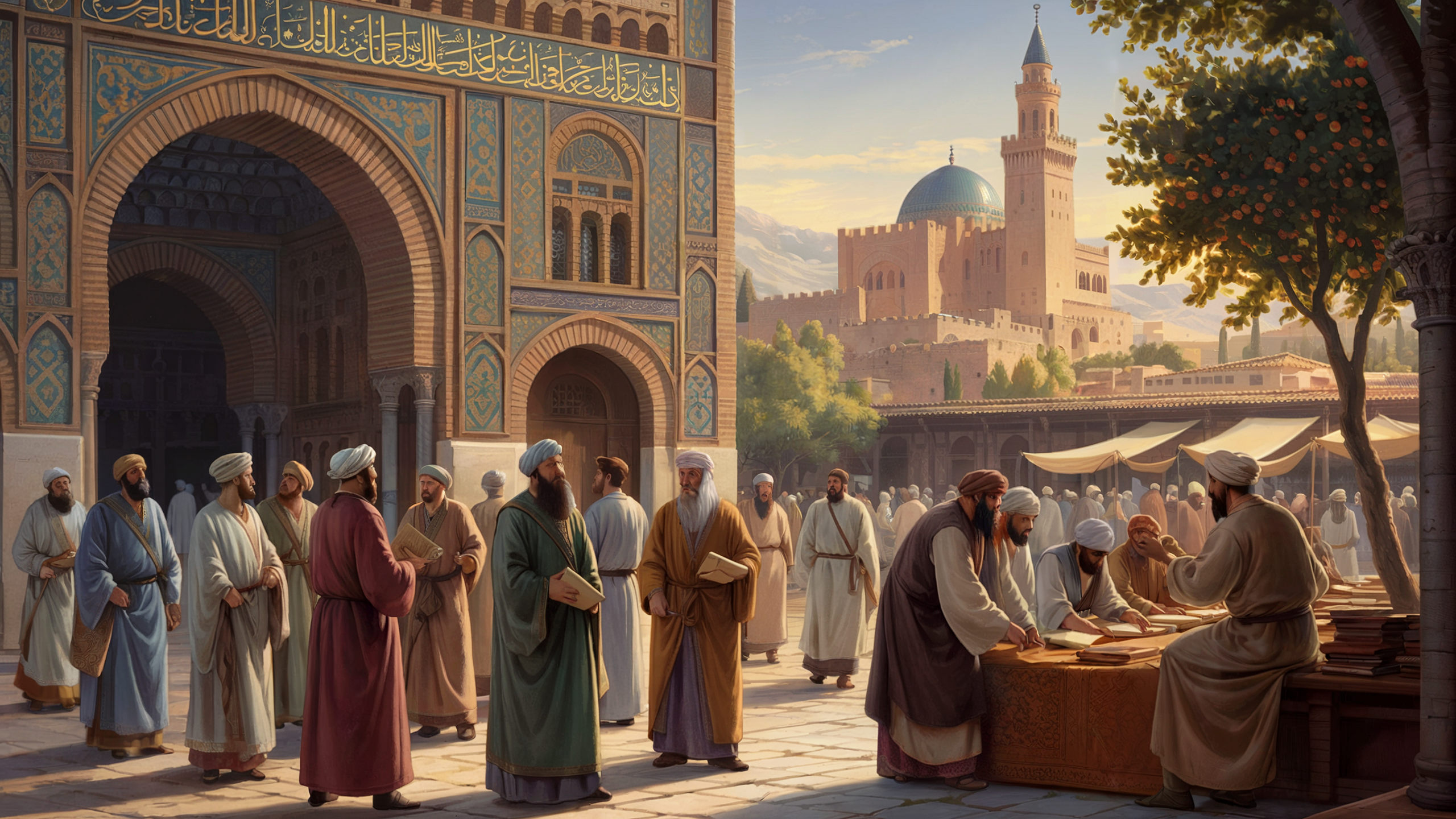
711 CE: The Message of Liberation and the Dawn of a New Era
The advent of Islamic rule in Spain was facilitated by the pleas of the local populace—a rarity in the chronicles of conquest. With the Visigothic King Roderic’s tyrannical governance, the inhumane persecution of the Jewish minority, and the systemic oppression of the peasantry reaching a boiling point, the inhabitants beyond the straits looked toward the Muslims as harbingers of liberation. At the invitation of Count Julian of Ceuta and under the explicit mandate of the North African governor Musa ibn Nusayr, the young general Tariq ibn Ziyad crossed the Straits of Gibraltar in April 711 CE with a force of only 7,000 men. Tariq’s legendary address—“O warriors! Where can you flee? The sea is behind you, and the enemy is before you”—remains a quintessential symbol of martial valor. On July 19, at the Battle of Guadalete, King Roderic’s vast host collapsed. This victory proved a boon for the common Spanish peasantry, and particularly for the oppressed Jewish community. The Muslims immediately codified religious freedom, an ideological stance nearly inconceivable in the Europe of that era.The Umayyad Emirate and the Arrival of the ‘Falcon of the Quraysh’
It is a historical footnote often overlooked that Muslim rule in Spain was consolidated by a fugitive prince. In 756 CE, following the collapse of the Umayyad Caliphate in Damascus, the sole surviving member of the royal house, Abd al-Rahman I (known to history as ‘ad-Dakhil,’ or the Entrant), traversed thousands of miles to reach Spain. Impressed by his fortitude, the Abbasid Caliph al-Mansur bestowed upon him the epithet 'Falcon of the Quraysh.' He laid the foundation for an independent and sovereign state that would govern Europe for the subsequent 250 years.The Caliphate of Córdoba: Outshining Baghdad
The true ‘Golden Age’ of Muslim Spain dawned in the tenth century, when Abd al-Rahman III proclaimed himself ‘Caliph’ in 929 CE. During his reign, the capital, Córdoba, evolved into the most modern and opulent metropolis in the world.- A Marvelous Metropolis: Historical records indicate that Córdoba housed approximately 500,000 (with some estimates reaching one million) inhabitants. The city boasted 113,000 residences, 700 mosques, and 300 public baths (*Hammam*). While the denizens of London or Paris waded through mud in their streets, Córdoba’s ten-mile-long paved thoroughfares were illuminated at night by brilliant lampposts.
- A Beacon of Education: Caliph al-Hakam II was a bibliophile of the highest order. His royal library contained over 400,000 volumes, the index of which alone spanned 44 volumes. At a time when European monarchs were often unable to sign their own names, the average citizen of Córdoba was literate.
Scientific and Cultural Revolution (Ziryab and Convivencia)
Al-Andalus was not merely a history of martial conquest; it was a history of *Convivencia*, or coexistence. Muslims, Christians, and Jews labored side-by-side in the pursuit of knowledge. The Golden Age of Jewish philosophy blossomed precisely under this Muslim hegemony.- Medicine and Science: The father of surgery, Abu al-Qasim al-Zahrawi, penned his seminal work, *Kitab al-Tasrif*, in Córdoba; a text that served as the standard curriculum in European medical colleges for five centuries. The botanist Ibn al-Baitar cataloged over 1,400 medicinal substances.
- Cultural Icons: The musician Ziryab, who arrived from Baghdad, fundamentally transformed Spanish culture. He introduced Europe to toothpaste, deodorant, seasonal fashion, and the ‘three-course meal’ (soup, main dish, and dessert) served at a dining table.
The Agricultural Revolution: Verdure in the Desert
The Muslims did not merely construct palaces in Spain; they reshaped the very landscape. Utilizing advanced irrigation systems known as the *Noria* (water wheel), they transformed arid tracts into lush fields of oranges, lemons, sugarcane, cotton, and rice. Modern Spanish agriculture and culinary habits remain fundamentally indebted to this Islamic agricultural revolution.The Era of Crisis: Taifas, Almoravids, and Almohads
At the turn of the eleventh century, the Caliphate of Córdoba fractured into small, competing states known as ‘Taifas.’ The rulers of Seville, Toledo, and Granada became entangled in internecine conflicts, providing the northern Christian powers the opportunity to intensify their *Reconquista*, or reconquest movement. However, Muslim rule endured for four more centuries, bolstered by two formidable Berber dynasties from North Africa—the Almoravids (under Yusuf ibn Tashfin) and later the Almohads. In the 1086 ‘Battle of Sagrajas,’ Yusuf ibn Tashfin dealt a catastrophic defeat to the Christian forces, extending the longevity of Al-Andalus. Ultimately, internal decadence and fractiousness precipitated the decline of this magnificent civilization.1492: The Fall of Granada and the Tragic Departure
Following the fall of Córdoba in 1236 and Seville in 1248, the final sanctuary for the Muslims was the aesthetically sublime, mountain-ringed city of Granada. The Nasrid dynasty maintained a unique bastion of art and literature there for two and a half centuries, the evidence of which remains in the Alhambra palace. January 2, 1492, remains the most tragic day in history. The final Sultan of Granada, Abu Abdullah (Boabdil), was compelled to surrender to the machinations of the Catholic monarchs, Ferdinand and Isabella. As he surrendered the keys to the city, his mother, Ayesha, famously chided his tears:The tragedy did not conclude there. Despite the terms of surrender promising religious freedom, the victorious Christians reneged. Millions of Muslims were forcibly converted, executed, or expelled. Thousands of volumes of scientific and philosophical knowledge were cast into public squares and consigned to the flames."Do not weep like a woman for what you could not defend as a man."
What is the Cold War? Origins, Evolution, and Current Status
Conclusion: The Sun That Never Fully Set
Today, Muslims exercise no political governance in Spain, yet the spirit of Al-Andalus is embedded in every brick of the land. Over 4,000 Spanish words (such as *Aceite, Ojalá, Arroz*) are derived directly from Arabic. The Renaissance of modern Europe would have been an impossibility had the Muslims of Spain not preserved, refined, and transmitted Greek philosophy and science to the West. Al-Andalus serves as a poignant reminder that as long as knowledge and justice (*Insaf*) prevail, a nation may lead the world; yet when disunity takes root, even an earthly paradise like Granada can be lost to the tides of history.Frequently Asked Questions (FAQ)
1. How long did Muslim rule last in Spain?
Answer: Muslim rule in Spain spanned approximately 781 years, from 711 CE to 1492 CE. It remains one of the most enduring imperial presences in European history.
2. What is referred to as the 'Golden Age' of Al-Andalus?
Answer: The tenth century, particularly the reigns of Abd al-Rahman III (912–961 CE) and al-Hakam II, is defined as the Golden Age. During this period, Córdoba served as the global epicenter for science, culture, and learning.
3. What is a 'Taifa'?
Answer: Following the collapse of the Caliphate of Córdoba in the early 11th century, Muslim Spain fragmented into approximately 20–30 small, independent states. These minor kingdoms were known as 'Taifas,' and their internal divisions significantly accelerated the decline of Muslim rule.
4. What is the most significant architectural monument of Muslim Spain?
Answer: The Great Mosque of Córdoba (Mezquita) and the Alhambra palace in Granada remain the preeminent examples of Islamic architecture, continuing to captivate visitors to this day.
5. What were the primary causes of the fall of Al-Andalus?
Answer: The primary causes included internal disunity and power struggles among Muslim rulers (the Taifa period), the decadence of the ruling class, and the coordinated military campaigns of the northern Christian kingdoms (*Reconquista*).