
On April 6, 1994, a French Falcon-50 aircraft carrying President Juvénal Habyarimana of Rwanda—a leader representing the Hutu-backed moderate ideology—and President Cyprien Ntaryamira of Burundi was flying over the skies of Kigali. As the aircraft approached the international airport, it was struck by surface-to-air missiles. The plane disintegrated in mid-air, killing everyone on board. The Hutu government, the military, and the extremist Hutu militia, the Interahamwe, immediately traded accusations with the minority Tutsi group and the Rwandan Patriotic Front (RPF). Regardless of who launched the strike, the Hutu coalition had already laid the groundwork; within hours of the crash, state-controlled radio and television stations broadcast calls to initiate a systematic extermination campaign against the Tutsi rebels, the Twa people, and moderate Hutus.
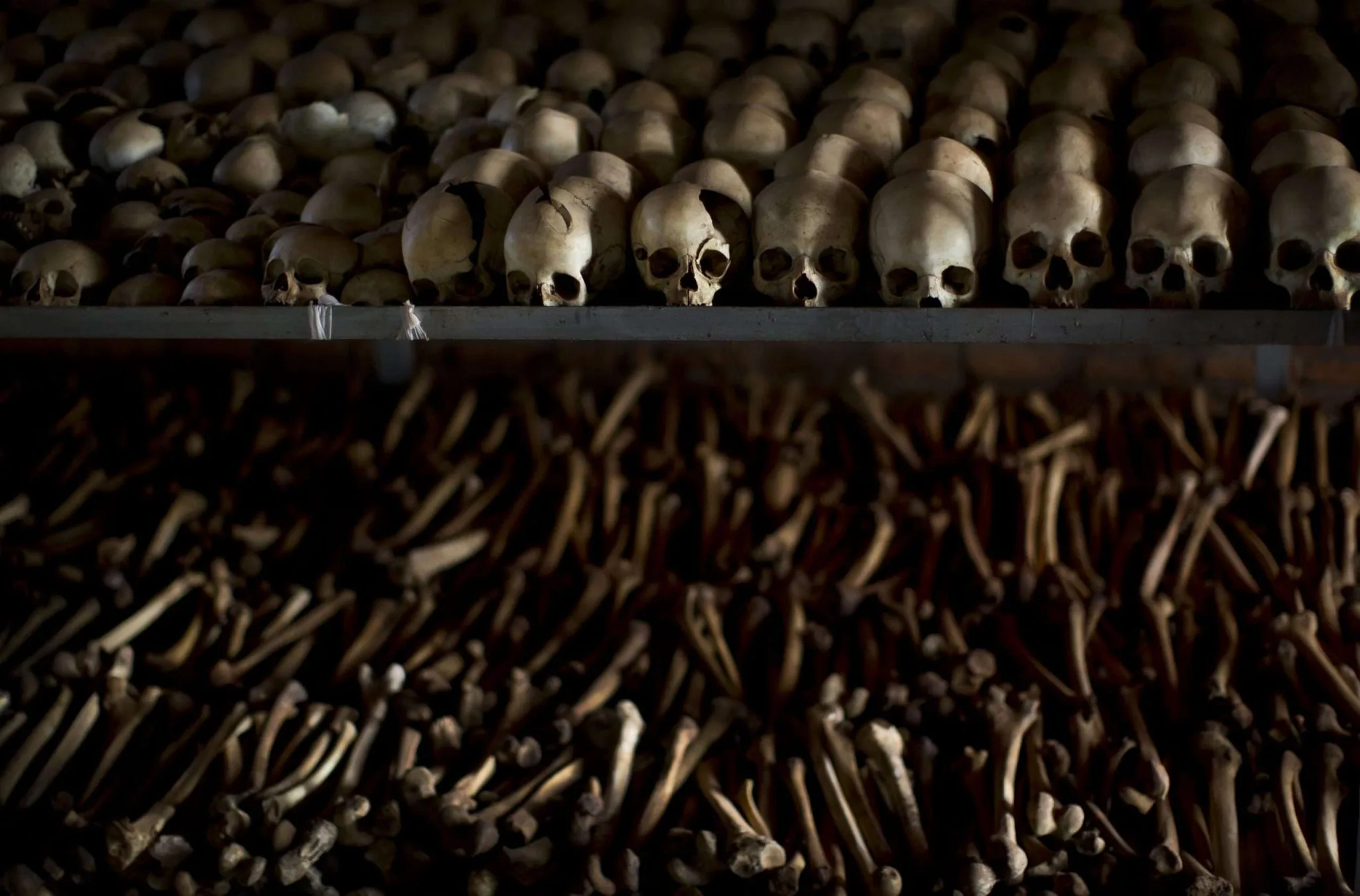
Beginning in early April, the slaughter cascaded from cities to villages, through fields, alleyways, and into the very sanctity of homes, continuing unabated until July. Over the course of approximately 100 days, thousands of men, women, and children were methodically slaughtered every single day. While the military and paramilitary forces utilized firearms and explosives, the primary tools of this genocide were machetes and clubs. No sanctuary remained; schools and churches, once regarded as places of refuge in times of peril, were transformed into abattoirs. From the systematic mass rape of women to the drowning of victims with their limbs bound, no act of depravity was spared in the Rwandan genocide.
Who are the Hutu and the Tutsi?
Historically, the Hutu are one of Rwanda’s oldest ethnic groups. Their ancestral roots in the region predate those of the Tutsis. Many scholars suggest that between 500 and 1000 BCE, the Hutu people first arrived in the Great Lakes region of Central Africa. Conversely, the Tutsis originated from nomadic tribes in Ethiopia, migrating to the Hutu-populated Great Lakes region roughly 400 years ago. They are also known as the Watutsis. Upon arriving in Hutu territories, the Tutsis eventually assimilated into the local culture, adopting their language, beliefs, and traditions.

Is the USA a Leading Terrorist State?
Ethnically, the Hutu were primarily an agrarian class, living in extended family units. The Tutsis, by contrast, were traditionally cattle herders. As pastoralists, the Tutsis often occupied a position of economic dominance over the agrarian Hutus. This did not imply that all Tutsis were wealthy or all Hutus impoverished; however, throughout Rwanda and the surrounding region, the minority Tutsi population generally enjoyed superior economic status and social standing compared to the Hutus.
According to the Congolese historian Professor Georges Nzongola-Ntalaja, the distinction between the two groups was economic, not ethnic. He notes, “The Tutsis and Hutus in Rwanda are essentially the same people. They belong to the same culture, dispersed among large groups stretching from the seven regions of Cameroon through Uganda, all the way to South Africa. One’s classification as Tutsi or Hutu depended on their proximity to the King. If you were close to the King, you held wealth and large herds of cattle, meaning you were a Tutsi. If you were distant from the King, you were a peasant, you lacked significant livestock, and thus you were a Hutu.”
The Context of the Rwandan Genocide
While the colonial era is often cited as the catalyst, the communal friction between Hutus and Tutsis is far more ancient. The conflict is deeply rooted in history. When evaluating who was the primary victim and who bore the ultimate responsibility, it is clear that the Hutus were the aggrieved party, and the historical dominance of the Tutsi elite serves as the context for that grievance.
Colonial Rule in Rwanda
By the early 1990s, the agrarian economy of Rwanda suffered from having one of the highest population densities in Africa. The ethnic composition was approximately 85 percent Hutu, 14 percent Tutsi, and a small minority of Twa and Pygmy peoples. From 1897 until the end of World War I, Rwanda—along with neighboring Burundi—was part of German East Africa, before coming under Belgian administration via a League of Nations mandate in 1918.
The Hutus never reconciled themselves to the Tutsi socioeconomic dominance that persisted in their territories. Despite the Hutus being the demographic majority, they were forced to endure the rule of the minority pastoralist Tutsi elite. Their resentment deepened over time, and the Belgian colonial authorities fanned the flames of this socioeconomic inequality.
Let’s call Israel’s violence what it is: terrorism, not clashes
During the late 19th century and through the colonial period, these ethnic divisions were codified. The colonial administration favored the minority Tutsi for administrative and educational advancement, placing them in positions of authority over the Hutu majority. This policy of rule by a minority over a majority exacerbated communal tensions to a breaking point.
During the Belgian era, the authorities consistently backed the Tutsi minority. Tutsis were appointed as local administrative heads, and the ethnic minority enjoyed superior access to education and employment, fueling widespread outrage among the Hutu majority. Furthermore, the tendency for Tutsis and Belgians to oppress the Hutus solidified over years of systemic injustice. These tensions erupted into brutal bloodshed even before Rwanda attained independence.
Civil War and Independence
In the civil war of 1959, the minority Tutsis were defeated in a bloody conflict, leading approximately 330,000 Tutsis to flee to neighboring countries. This reduced the Tutsi population to a smaller minority. In the 1960 elections, organized by Belgium, the Hutu community achieved a majority. Hutu leader Grégoire Kayibanda declared Rwanda an autonomous republic in 1961, becoming its first elected president.
Ethnic conflict persisted in the years following independence. In 1973, a military coup brought the moderate Hutu Major General Juvénal Habyarimana to power. Habyarimana consolidated his grip on the nation for two decades, forming the ‘National Revolutionary Movement for Development.’ Under a new constitution, he was elected in 1978, with subsequent victories in 1983 and 1988. Throughout this period, the minority Tutsi and Twa communities faced institutional discrimination, forcing many into exile. Hundreds of thousands of Tutsis fled during the 1960s and 70s. These exiles formed militant rebel groups, yet the Hutus maintained their iron grip on Rwanda until 1994.
The RPF Invasion of Rwanda
A new crisis emerged in 1990 when the Rwandan Patriotic Front (RPF), a Tutsi organization led by the current president, Paul Kagame, challenged the Habyarimana government. On October 1 of that year, thousands of RPF rebels gathered at a football stadium in western Uganda, just 20 miles from the Rwandan border, to prepare for an invasion. They were led by Ugandan military commander and RPF leader Fred Rwigyema. Two temporary hospitals were established in anticipation of heavy casualties, and numerous volunteers mobilized. While they claimed to be celebrating Ugandan independence, the clandestine nature of the mission was eventually compromised by the indiscretion of overzealous rebels.
What is the rule of law and why is it important in a democratic society?
A retrospective of European historiography reveals that, while the continent languished in the medieval depths of superstition, squalor, and intellectual stagnation, the Iberian Peninsula served as a luminous beacon of civilization. It was within this crucible that the Muslim architects of the region forged the enduring, multifaceted heritage of Al-Andalus.
The RPF launched their assault that same afternoon. However, supported by French and Zairian commandos, the Rwandan military thwarted the rebel advance, forcing the RPF to retreat into Uganda. The RPF regrouped and struck again shortly thereafter, taking positions in the Virunga Mountains of northern Rwanda. During this time, Paul Kagame, then a Ugandan army officer and RPF leader, was studying at the American Command and General Staff College. Following the death of four consecutive RPF commando officers, Kagame returned from the United States to Uganda to take command of the RPF and join the campaign.
For the next three and a half years, the Ugandan army supplied Kagame’s forces with weapons and logistics, ensuring their freedom of movement in and out of Rwanda. Much of the support originated from the city of Mbarara, located 80 kilometers inside Uganda. UN peacekeeping forces were largely ineffective in monitoring these activities, as the geographical features of the border region provided the RPF with a tactical advantage over the peacekeepers.
The Arusha Accords and Betrayal
In response to the RPF resistance, the government and the RPF entered into negotiations in 1992. President Habyarimana understood that the Ugandan-backed RPF was better armed, trained, and disciplined than his own military. Consequently, in 1993, he was compelled to sign the Arusha Accords with the RPF. The agreement mandated that the RPF would hold a significant number of seats in an interim government. Even Tutsis inside Rwanda were apprehensive about granting such power to the RPF, fearing it would inflame Hutu extremists. To the hardline Hutu factions, Habyarimana’s concessions were a betrayal, casting him as an inevitable enemy of the Hutu cause.
Radical Hutu organizations employed violent measures to derail the accords, blaming the local Tutsi population for their “collusion” with the RPF. By mid-1993, the Hutu government launched Radio Télévision Libre des Mille Collines, a broadcast station that disseminated ethnic propaganda and incited hatred against the Tutsis. With the government’s forced compliance, Hutu rebels began compiling lists of Tutsi leaders months before the genocide began. Local mayors and officials distributed machetes and kerosene to extremist groups. Between 1990 and 1993, government officials had already overseen the localized slaughter of hundreds of Tutsis.
Dictatorship and Human Rights: The Ongoing Struggle for Freedom
The 100 Days of Genocide
Against this backdrop, the presidential plane was downed on April 6, 1994. The French-made Falcon-50 was hit by surface-to-air missiles, killing both President Habyarimana and President Ntaryamira. While the perpetrators were not immediately identified, the Hutu coalition pinned the blame on the RPF, which vehemently denied the charge, instead claiming the extremists staged the attack to seize power and justify genocide. Regardless of the identity of the attackers, the Hutu extremists' immediate reaction confirmed their intent. Within hours, the military, paramilitary, and the Interahamwe and Impuzamugambi militias mobilized to slaughter Tutsis and moderate Hutus. The extremist radio stations announced the president’s death and exhorted Hutus to "go to work," signaling the commencement of the genocide.

This was a calculated campaign of extermination. By April 7, Hutu extremists, with state support, initiated a systematic effort to erase the entire Tutsi population. The killings, which began in Kigali, spread rapidly across the country. Political and high-ranking officials capable of halting the massacre were targeted and murdered immediately. The Interahamwe militias flooded cities and villages, collaborating with Hutu civilians to kill Tutsis. Moderate Hutus who spoke out against the slaughter were also executed. Among the first casualties were the moderate Hutu Prime Minister Agathe Uwilingiyimana and ten Belgian peacekeepers. These killings created a power vacuum, which was promptly filled by Hutu extremist leaders. Shortly thereafter, Belgium withdrew its peacekeepers.
In central and southern Rwanda, where the Tutsi population was more concentrated, local administrations initially resisted the genocide. However, the tide turned by April 18, when the Hutu coalition pressured local officials to join the extermination campaign. Those who resisted were executed, while others remained silent or actively participated. The Hutu coalition incentivized the killers with food, alcohol, narcotics, and cash. The very administrations that had once provided protection became instruments of the genocide.
As the violence escalated, Tutsis sought refuge in churches, schools, and government buildings. These sites, once safe havens, became mass graves. Thousands were murdered in churches where they had sought sanctuary, with priests and school officials often participating in the killing. Many of these churches were later identified as primary sites of mass execution. In 2017, Pope Francis apologized for the Church’s role in the genocide during a visit to Rwanda.

Is the RSS a Threat to India’s Secularism?
Thousands of Tutsis and suspected sympathizers were butchered in their homes, fields, and streets. To prevent escape, extremists established checkpoints across the country. The state-run radio station broadcast calls to kill Tutsis, and local leaders incited residents in every neighborhood. Entire families were hacked to death with machetes. Women were subjected to systematic sexual violence, and even Hutu women were not spared if they were suspected of harboring or protecting Tutsis.
Publish Your Research & Critical Analysis on MaroonPaper
Contribute in-depth essays on law, political philosophy, economics, and geopolitics to an intellectual readership.
RPF resistance intensified by mid-May, and as the rebels gradually gained control of various regions, the rate of killing began to slow. By early July, the RPF had secured most of the country, including the capital, Kigali. By mid-July, the RPF had driven the Hutu forces into exile, effectively ending the genocide.
While the genocide is officially dated from April 7 to July 15, the vast majority of the deaths occurred within the first six weeks. Millions of Hutus participated in the genocide. By mid-May, an estimated 800,000 people were dead, a figure that eventually surpassed the scale of the Holocaust in its intensity. Within 100 days, nearly one million people were slaughtered, the overwhelming majority being Tutsi. At least 450,000 to 500,000 women were raped. Approximately 85 percent of the Tutsi population was wiped out in this brutal campaign.

Although rumors persisted regarding 250,000 Hutus killed by the RPF, the Gersony Report estimated that approximately 5,000 to 10,000 Hutus were killed monthly by the RPF during the final stages, totaling between 25,000 and 40,000 Hutu deaths at their hands.
Post-Genocide Status
The genocide was orchestrated by Hutu extremist organizations, the Interahamwe and Impuzamugambi, supported by various minor Hutu groups. Under the planning and direct endorsement of the Hutu government, the military and paramilitary forces coordinated with these militias to execute the slaughter. Many victims were betrayed by neighbors. The Rwandan genocide was characterized by its reliance on central directives and primitive weaponry, which meant, tragically, that the victims often knew their executioners intimately.
As the RPF assumed control under Paul Kagame, nearly two million Hutus fled into the Congo, establishing large-scale refugee camps.
Following the victory, a coalition government was formed in accordance with the Arusha Accords, with Pasteur Bizimungu (a Hutu) as president and Paul Kagame (a Tutsi) serving as vice president and minister of defense. Habyarimana’s ‘National Revolutionary Movement for Development’ (NRMD) was declared illegal, and in 2003, ethnic classifications were removed from the country’s constitution. After adopting this new constitution, Paul Kagame was elected president for a ten-year term. He continues to serve as president today.
Read more: What are Weapons of Mass Destruction?
Justice
Holding the perpetrators of the Rwandan genocide accountable proved to be an immense challenge. More than two-thirds of the nation's judges had either fled or been murdered, leaving only a fraction of the judiciary functional. To navigate these hurdles, two primary judicial systems were established seven months after the genocide began: the UN-backed International Criminal Tribunal for Rwanda (ICTR) and the local Gacaca courts.
The International Criminal Tribunal for Rwanda (ICTR)
In 1995, the ICTR began proceedings in Arusha, Tanzania. Over the course of fifteen years, the tribunal tackled complex cases involving countless known and unknown offenders. On September 2, 1998, the ICTR delivered its first verdict, convicting Jean-Paul Akayesu, a former mayor, for inciting and leading violence against Tutsi residents. Notably, this was the first time that rape was classified as an act of genocide under international law.
In another historic case, the tribunal convicted a newspaper publisher and a radio station owner for inciting genocide. This marked the first time since the Nuremberg Trials that an international court explicitly addressed the role of the media in mass atrocities.
Widely recognized as one of the world's inaugural written constitutions, the Charter of Medina serves as a seminal historical document, establishing foundational precedents for the Islamic state, religious pluralism, and the architecture of social cohesion.
From 1995 through October 2019, the tribunal indicted 93 individuals and concluded 80 cases, with 62 convictions for war crimes, genocide, rape, and the propagation of "hate media." Among those convicted were a former interim prime minister and the individuals responsible for operating Radio Télévision Libre des Mille Collines.
Secular India and the Nature of its so-called Secularism
Gacaca Courts
The Gacaca courts handled lower-level offenses. These community-based tribunals required the participation of the local populace, as communities were convened to account for the crimes committed. The Gacaca courts heard at least two million cases, handing down sentences ranging from financial restitution to imprisonment. However, the speed of the hearings was frequently criticized, as accused individuals were often given very little time to provide testimony or mount a defense.
Alongside these systems, Rwandan domestic courts adjudicated approximately 10,000 additional cases.
The Role and Responsibility of Other Nations
Viewing the genocide solely through the lens of Hutu-Tutsi ethnic conflict is a form of moral evasion. The seeds of this slaughter were sown decades earlier, and Germany, the United States, France, Belgium, and Uganda all bear significant culpability. These nations cannot disclaim their roles in fueling communal divisions, providing weaponry and training, and willfully ignoring the signs of an impending genocide.
Germany
At the 1884 Berlin Conference, Rwanda and Burundi were granted to Germany. The German goal was to rule through the existing monarchy, allowing them to establish colonial control with a minimal footprint of European troops. In delegating administrative authority, the Germans favored the Tutsis over the Hutus, viewing the Tutsis as ethnically superior due to their Ethiopian origins. This consolidated the long-standing Tutsi socioeconomic dominance.
Belgium
During World War I, Belgian forces occupied Rwanda and Burundi, and in 1926, they implemented a more direct colonial administration. While the Belgians modernized the Rwandan economy, they entrenched Tutsi hegemony while marginalizing the Hutus. In the early 1930s, the Belgians categorized the Rwandan population into three ethnic groups—84% Hutu, 15% Tutsi, and 1% Twa—and issued mandatory identity cards. Previously, wealthy Hutus could sometimes attain “honorary Tutsi” status; the mandatory identity card permanently ossified these divisions, transforming socioeconomic classes into rigid ethnic groups.
Belgium deliberately fostered and expanded these divisions, effectively ruling the majority Hutu through the minority Tutsi elite. By codifying inequality in education, economic status, and administration, the colonial authorities created a system of self-destructive ethnic communalism that culminated in the 1959 civil war.
Uncovering the Agartala Conspiracy Case: A Political Conspiracy against Bangladesh!
France
In April 2021, a report commissioned by the Rwandan government concluded that the French government bore "significant" responsibility for enabling the genocide. Despite possessing evidence of the planned extermination, France willfully supported the Habyarimana government and knowingly allowed the genocide to proceed. Even more damningly, France sought to conceal its role and the role of other conspirators in the aftermath.
The report asserts that former French President François Mitterrand and his administration were fully aware of the preparations for the genocide and provided the Habyarimana government with comprehensive support. The French leadership was not "blind or ignorant" to the looming massacre; their failure to intervene—or worse, their active facilitation of the regime—constitutes an "extraordinary and undeniable responsibility" for crimes they knowingly permitted.
United States
Intelligence reports indicate that President Bill Clinton and his administration knew well before the genocide that a systematic plan was in place to exterminate the Tutsi population. The CIA was aware that weapons were flowing across the Ugandan border. They knew Uganda was training RPF rebels and that a communal slaughter, resulting in hundreds of thousands of deaths, was imminent. The United States not only ignored these warnings but increased foreign aid and weaponry to Ugandan President Museveni, allowing Uganda to purchase ten times the amount of weaponry it had acquired in the preceding 40 years.
The Catholic Church
The Catholic Church played a pivotal role in establishing the ethnic framework upon which the genocide was constructed. The Rwandan authorities pursued genocide based on racialist doctrines—ideologies rooted in the racist perspectives of white European priests regarding Rwandan society. Rather than teaching mutual human responsibility, the Church focused on unquestioning obedience to those in power, prioritizing proselytization over the Christian imperative of loving one’s neighbor. By constructing hierarchies of social caste, the Church fostered ethnic communalism.

Following the Belgian colonization, deep ties between the Catholic Church and the Rwandan government were cemented. Archbishop Vincent Nsengiyumva, a central committee member of the ruling Hutu party, maintained close relations with the regime. The Church served as a moral validator for the Hutu government’s actions, publicly supporting the political system and legitimizing ethnic discrimination to clear the path for genocide.
Numerous clergy members were complicit. Many priests and nuns stood by with indifference, or actively participated, as one million Rwandans were slaughtered in just 100 days. The majority of the genocide's victims were killed inside or near church grounds. In 2017, Pope Francis offered an apology for the Church's complicity during his visit to Rwanda.
Conclusion
In terms of its brutality, the Rwandan genocide is often compared to the Nazi Holocaust. However, a significant distinction exists. Germany was not facing an existential threat from Jewish forces. Hitler targeted Jews and other marginalized groups based entirely on his own irrational prejudices. The Hutu genocidaires were similarly fueled by irrational ideologies, but they operated within a climate of terror and proxy conflict. The RPF was a rebel army composed of Tutsi exiles, armed and trained by Uganda—in direct violation of the UN Charter, the Organization of African Unity, various ceasefire agreements, and the repeated assurances given by then-Ugandan President Yoweri Museveni.
During and after the genocide, many refugees fled Rwanda, only to be forcibly returned or scattered. While the exact numbers remain unknown, the U.S. state of Minnesota has recognized April 7 as Rwanda Genocide Remembrance Day since 2013, also designating April as a month for genocide awareness and prevention.