The Padma: A Millennial Companion to the Bengali Consciousness
Shanjida Shima
•August 20, 2020•6 min read
The Padma River exerted a profound and enduring influence upon the interior life of Rabindranath Tagore. In his literary corpus, the river’s sublime and terrifying aesthetic—a manifestation of nature in its rawest form—is rendered with evocative precision. Tagore himself candidly acknowledged this affinity, confessing, 'In truth, I hold an abiding love for the Padma...'
The Padma River once commanded the deepest reaches of Rabindranath Tagore’s imagination. He was profoundly captivated by its terrifying beauty—a natural force that infused his prose with a haunting lyricism. He confessed with characteristic candor: "In truth, I love the Padma; when I am on my boat at Shilaidaha, the river feels to me like a distinct, sentient being." In his poem *Padma*, he wrote, "O my Padma / a hundred times have you and I met." Yet, this once-turbulent river, historically known as the *Kirtinasha* (the "destroyer of monuments"), now lies in a state of terminal decline, a shell of its former majesty after millennia of existence.
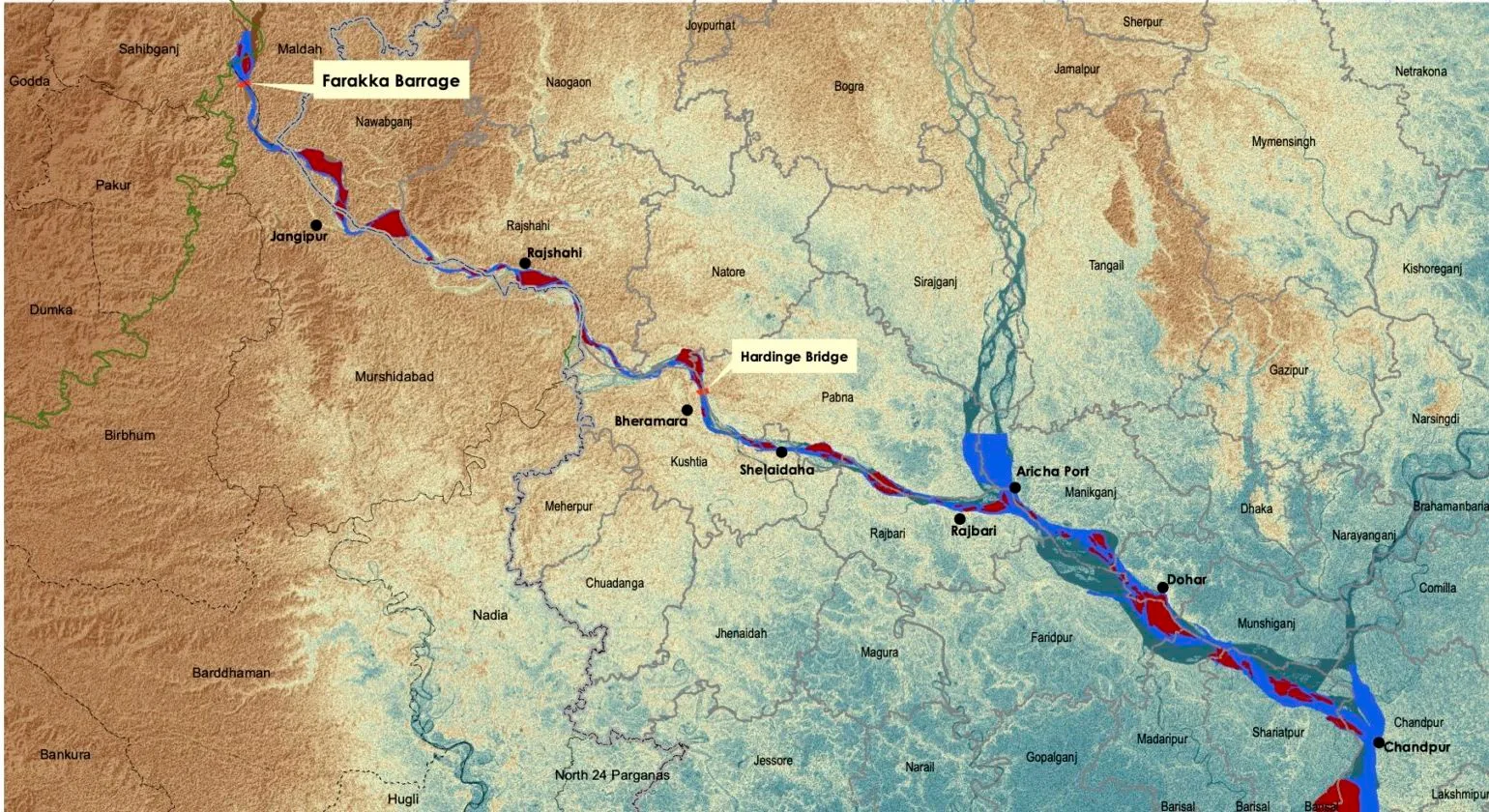
The Padma is the primary artery of Bangladesh—a nation of 147,570 square kilometers defined by its fluvial heritage. The river exists in the national consciousness as a study in contradictions: at once tender and merciless. It was instrumental in the formation of the world’s largest delta, yet it bears two names as it traverses two nations. The name *Kirtinasha* was bestowed upon it by the landlord Raja Rajballabh, whose opulent palaces and monuments in the Dhaka-Faridpur-Barishal regions were swallowed by its insatiable currents during the era of Nawab Siraj ud-Daulah. Originating from the Gangotri Glacier in the Himalayas, the Ganges enters northern Bangladesh via Mohanpur in Chapainawabganj, near the Kushtia border, where it assumes the name Padma. It travels 258 kilometers to Goalanda, and from there, joined by the Jamuna, flows another 120 kilometers until it merges with the Meghna at Chandpur, eventually reaching the Bay of Bengal.
The Padma reaches a maximum depth of 479 meters, with an average depth of 295 meters. With an average width of 10 kilometers, it is fed by a complex network of distributaries, including the Garai, Arial Khan, Kumar, Mathabhanga, and Bhairab, while the Mahananda and Punarbhaba serve as its primary tributaries. Other distributaries, such as the Madhumati, Pashur, and Kobadak, weave through the districts of Chapainawabganj, Rajshahi, Natore, Kushtia, Pabna, Faridpur, Rajbari, Manikganj, Munshiganj, Madaripur, and Shariatpur. The author Sunil Gangopadhyay famously chronicled the nostalgia of his youth around the Arial Khan, a distributary of the Padma, in his work *Amader Choto Nadi* ("Our Small River").
Scholars suggest that the Padma once flowed through Gaur—a historical city-state encompassing modern-day Murshidabad and Malda. The distinguished British surveyor and historian Major Hirst posited that a cataclysmic earthquake in 1505 diverted the river southward. Both Hirst and Major Rennell believed the Padma originally flowed through the Natore region to join the Brahmaputra; the 1505 seismic event shifted its course, directing it through Rajshahi, Kushtia, Ishwardi, and Pabna before its eventual convergence with the Jamuna.
In a land defined by six distinct seasons, the Padma shifts between tranquility and turbulence. Its flow fluctuates wildly: from a mere 15,000 cusecs in the dry season to over 750,000 cusecs during the monsoon. The river remains the lifeblood of Bangladesh’s agrarian economy, sustaining the irrigation of nearly one-fifth of the nation’s arable land.
As a primary waterway, the Padma is a conduit for commerce and transit. Neither the searing heat nor the deluge of rain halts its rhythm. River ports and ferry terminals line its banks, where speedboats, long-haul launches, and ferries weave a vital fabric of connectivity. The Mawa Ferry Ghat in Munshiganj, located just 37 kilometers south of Dhaka, remains a critical link for the southern and southwestern regions—though it is only during the monsoon that the river regains its full, natural navigability.
The mention of the Padma inevitably evokes the legendary Padma *Ilish* (Hilsa), a fish renowned globally. Yet, as the river’s navigability wanes, so too does the migration of the Hilsa from the sea. Environmental degradation, illicit fishing practices, and pollution have depleted the river’s once-abundant biodiversity.
To drift upon the Padma in a boat is to enter a space of reflection and intimacy; countless lives and dreams have been shared along its banks, documented by poets and novelists alike. Tagore, enraptured by the landscape, wrote in his *Chhinpatrabali* (Glimpses of Bengal): “The evening over this river, over the fields, over the villages, is so magnificent, so vast, so profound—one can only experience it in silence; to attempt to express it is to become restless.” For many, however, the river is the "catastrophic Padma," a sentiment echoed in the folk song: “O, disastrous Padma, I ask of you—is there no end to your fury, no shore to your reach?” Manik Bandopadhyay’s seminal novel *Padma Nadir Majhi* ("The Boatman of the Padma") immortalized the lives of those caught in the river’s cycle of joy and tragedy, where its currents could either provide or cruelly snatch away the dreams of those living upon its shifting sands.
The Padma of the past is fading. Countless acres of land have been reclaimed by its erosion, displacing generations. Today, the river has lost its vitality. This geriatric, diminished state is largely attributed to the Farakka Barrage, constructed by India in violation of international riparian norms. One wonders how Tagore would have reacted to such desecration.
The once-turbulent Padma, reduced to a dying canal by the Farakka Barrage [Banglanews24]
Rivers, in their natural progression, chronicle the history of human civilization—stories of livelihoods, survival, development, and ruin. The Padma persists, but it is no longer the roaring, ferocious force it once was; it now lingers in a state of slow decay. Though bilateral agreements were signed to protect the river, India’s disregard for these pacts has rendered them merely symbolic. Without immediate, concerted, and effective action to restore the flow of the Padma, the specter of desertification looms over this land.
Share this intellectual discourse
Help expand constructive dialogues on global affairs, law, and politics.
Shanjida Shima
Author & Contributor, MaroonPaper
Contributing insightful research and analytical essays on law, politics, history, and international affairs for MaroonPaper.