

The Significance of the "Lone Wolf"
The question arises: what does the term "lone wolf" actually signify? It is deployed to imply that the perpetrator descended from the heavens, disconnected from the earth and devoid of any human ties. The individual is portrayed as someone without friends, a Facebook profile, or social cohesion. By framing them as a social outcast, the media subtly suggests that society itself bears a fraction of the blame for their condition. It paints a portrait of a lonely, troubled soul so pitiable that one almost feels compelled to sympathize with their transgression.Terrorism vs. Mental Instability: Two Nations, Two Systems of Justice
The irony of how American media adjudicates crime based on the racial identity of the perpetrator is profound. If the assailant is from the Middle East, they are labeled a "terrorist." If they are Black, the narrative pivots to the pathology of "gang culture." Yet, for white perpetrators, the default defense is that they were "mentally unstable." It is as if being white serves as a certificate of immunity, a soft cushion of clinical diagnosis that spares them from the harsh moral indictments leveled at others.The evidence for Iraq's WMDs was false – The Guardian
One must ask: is mental instability a condition exclusive to white offenders? If a man from the Middle East engages in a suicide bombing, can he truly be described as "mentally stable"? Why is one a "terrorist" and the other merely "mentally ill"?The Manipulation of Language: Creative Racism
American media weaponizes racial identity to calibrate the gravity of an offense. For white perpetrators, the narrative emphasizes their isolation: "He was friendless; he lived in solitude." But when the perpetrator is Middle Eastern, they are reflexively depicted as a member of a coordinated cell, acting with a calculated political objective. This creates a dichotomy where white criminality is treated as a private, personal tragedy, while the criminality of other groups is treated as a collective, existential threat.The Definition of Terrorism: Distorted Realities
Theoretically, terrorism is an act committed with the deliberate intent to incite fear or hatred—a strategy of utilizing attacks on civilians to transmit a political or religious message. Yet, the American media is adept at molding this definition to suit its narrative.What is Woke Culture? Why is it so controversial?
When a white individual massacres congregants in a church, is that not terrorism? No, the media insists, "He was mentally unstable." For the white perpetrator, the label of terrorism is deemed irrelevant. This raises a logical impasse: if a mentally unstable person executes such an attack, how does their action differ from terrorism? The primary characteristics of terrorism—the intent to spread fear, create chaos, and deliver a message—are present. Does a mentally stable person ever contemplate blowing themselves up?The Racial Politics of Media
By framing white crime as a "human failing," American media transmits a specific, calculated message. They suggest, "This individual was lonely; their family did not understand them." Such rhetoric invites empathy. In contrast, there is no discussion of the backstory, psychological state, or socio-political circumstances of Middle Eastern offenders. Their name and faith are presented as self-evident proof of their guilt. [caption id="attachment_7740" align="aligncenter" width="465"]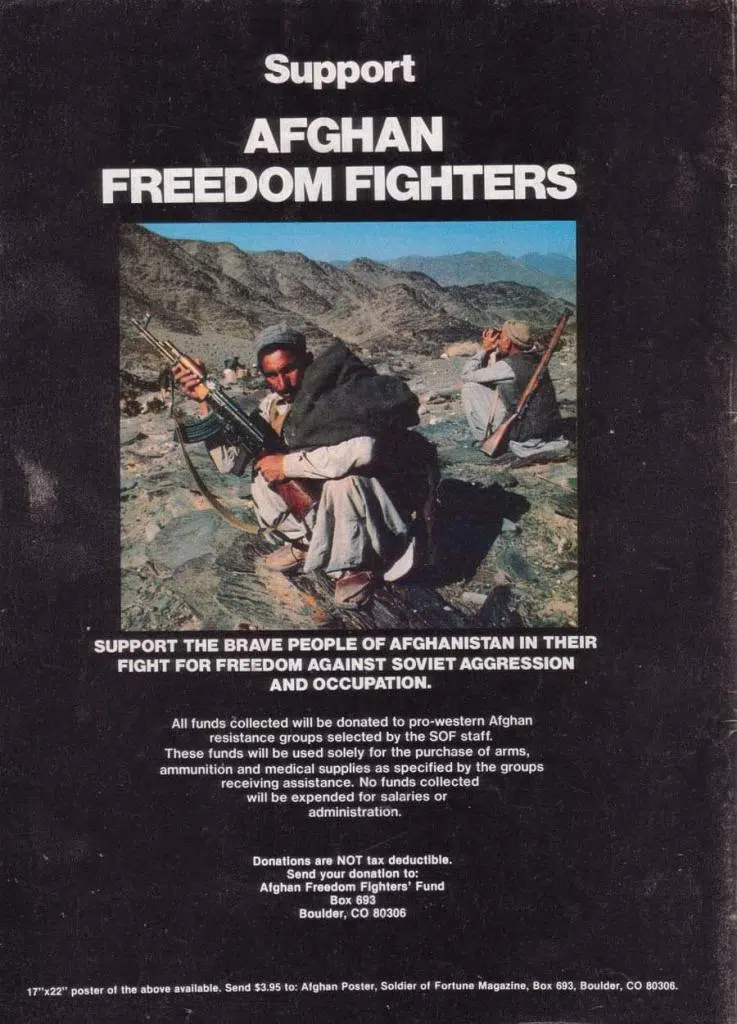 "Support Afghan freedom fighters - USA/Afghanistan, 1980s. Soldier of Fortune. Send your tax-deductible donation for arms and ammunition to: Boulder, Colorado."[/caption]
Consider the disparity: when a white perpetrator attacks, it is characterized as a product of "personal grievance or frustration." When a Middle Eastern individual commits an act of violence, it is categorized as a "religious or political agenda."
What is America’s Blackwater? How does it terrorize the World?
Are we to believe that white perpetrators hold no political or social grievances? Has the media forgotten—or willfully chosen to ignore—that white extremism represents one of the most significant threats within the United States today?