
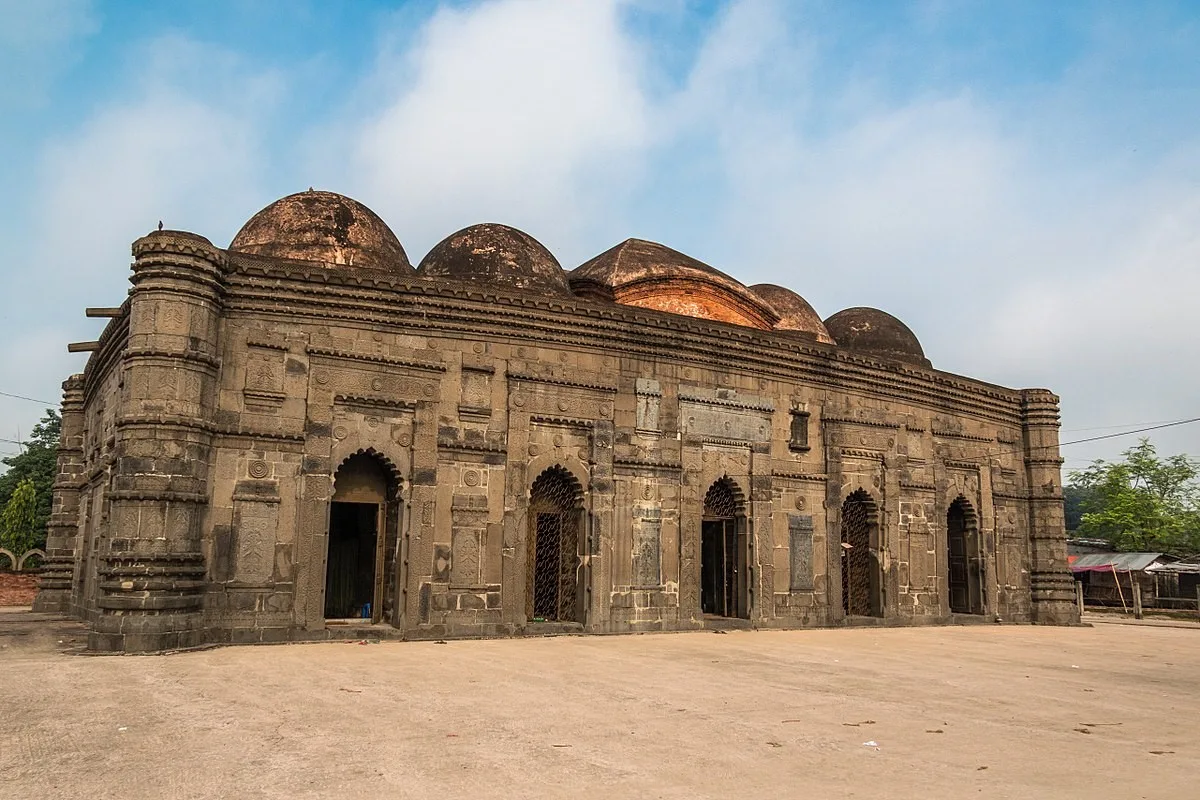
The Sultanate Era
The Sultanate’s governance in Bengal spanned the 14th, 15th, and 16th centuries, a period of prolific construction. Among the enduring monuments of this era are the Choto Sona Mosque, the Khaniya Dighi Mosque, and the Darasbari Madrasa and Mosque.The Mughal Era
The Mughal administration held sway from 1526 to 1858, leaving behind a wealth of architectural heritage. Key structures from the Mughal period in Gaur include the Tahkhana Complex and the mosque and tomb of Shah Niamat Ullah Wali.
Architectural Techniques
The Islamic architecture of Gaur reflects a dialogue between the imperial traditions of Delhi and the vernacular motifs of Bengal. The dualities of this construction methodology are examined below.Read more: Sultanate Architectural Techniques in Ancient Gaur
Indigenous Elements
As custodians of Central Asian Islamic architectural heritage, Muslim rulers adapted essential elements—domes, *mihrabs*, minarets, and arches—by incorporating local craftsmanship and materials to create a distinct Bengali-Islamic idiom. This style, in both structural form and ornamentation, diverges significantly from its contemporaries in the broader Islamic world. The defining indigenous elements include:Curved Cornices Inspired by Vernacular Huts
Since antiquity, the thatched huts of rural Bengal have featured curved bamboo cornices. Under the patronage of Muslim rulers, this modest vernacular form was transposed into brick and mortar using lime-surkhi plaster. Nearly every Sultanate-era building exhibits this subtle, elegant curvature.Chauchala Roofs
The *Chauchala* (four-sided) roof, mirroring the structure of traditional Bengali dwellings, is prominently featured in mosques such as the Choto Sona and Lattan Mosques.Dochala Roofs
The *Dochala* (two-sided) roof reached its architectural maturity in the Mughal-era Fateh Khan Tomb (1660), mirroring the iconic design of rural Bengali shelters.Corner Turrets
The four corner turrets of these mosques echo the four bamboo posts that anchor the corners of traditional Bengali huts.Mughal Architectural Techniques in Ancient Gaur
Barrel Vaulting
The "boat-roof" or barrel vault—reminiscent of the arched covers on riverine boats or North Bengali bullock carts—is a hallmark of local influence. Notable examples include the Adina Mosque in Pandua and the Bara Katra and Choto Katra in Dhaka.Bi-centric and Pointed Arches
The use of bi-centric and foliated arches represents a unique stylistic innovation within the architectural history of the Indian subcontinent, first appearing in Bengali-Islamic structures.Terracotta Ornamentation
Terracotta relief work is an authentically Bengali artistic contribution. Eschewing representational figures, these works utilize abstract Islamic motifs, arabesques, calligraphy, and geometric designs, as seen at the Darasbari and Bagha mosques.Finials and Symbolic Chains/Bells
Rectangular Panel Ornamentation
To mimic the paneling of wattle-and-daub walls, architects utilized rectangular rows of panels on mosque facades, a technique visible in the Atiya Mosque (Tangail) and the Lalbagh Fort Mosque (Dhaka).Lotus Motifs and Botanical Designs
The Imperial Architectural Style of Delhi
The synthesis of indigenous traditions and the imperial style of Delhi birthed a new architectural trajectory that profoundly influenced the cultural evolution of medieval Bengal. Imperial characteristics include:- The arcuate tradition of arch and dome construction.
- The placement of domes upon drums.
- The use of squinches and pendentives during structural transitions.
- Bi-centric and quadri-centric arches, utilizing the *boussoir* method.
- Plaster ornamentation, inspired by the Begumpuri Mosque.
- The *iwan* entrance or spacious hallways, reminiscent of the Tughlaq-era Begumpuri Mosque.
- Muqarnas vaulting, adapted from the aesthetic of Akbar’s tomb.
- Inlay techniques, historically observed in the Qutb Minar complex.
- Elevated turrets, as seen in the Badshahi Mosque in Lahore.
- Finials, inspired by the tomb of Ghiyath al-Din Tughluq.