

The 2026 Bangladeshi general election has become the epicenter of a fierce debate regarding the potential adoption of Proportional Representation (PR). While the Bangladesh Nationalist Party (BNP) has categorically rejected the proposed electoral overhaul, Jamaat-e-Islami and several smaller political factions are advocating for PR as a mechanism to “ensure that every vote carries weight” in the upcoming election.
Yet, the fundamental question remains: is the PR system actually viable within the Bangladeshi political landscape? This article aims to address that question by dissecting the mechanics, variations, and merits of the PR system, while critically evaluating its relevance to the future of democracy in Bangladesh.
Defining the Proportional Representation System
Proportional Representation (PR) is an electoral system designed to ensure that the distribution of seats in a legislature reflects the proportion of the total vote a party receives. Its primary objective is to maximize the utility of every ballot, thereby minimizing "wasted votes."
For instance, if a constituency has ten seats and a party captures 40% of the popular vote, they are entitled to four seats. This system provides a legislative foothold for smaller parties and fosters greater voter engagement, as the direct correlation between votes and seats serves as a deterrent to electoral manipulation.
However, the question of implementation in Bangladesh is fraught with difficulty. A primary concern is the susceptibility of PR systems to chronic political instability. Governments formed through this process are often fragile, struggling to maintain a consistent legislative agenda. Developing a mechanism to manage such volatility is critical.
Mechanics of the PR System
Voters typically cast ballots for a party or a list of candidates. Once the votes are tallied, seat allocation is determined by mathematical formulas, such as the D'Hondt Method (D'Hondt Method) or the Sainte-Laguë Method (Sainte-Laguë Method). The D'Hondt method, which divides party totals by 1, 2, 3, and so on, tends to slightly favor larger parties based on the highest averages. Conversely, the Sainte-Laguë method, which utilizes odd divisors (1, 3, 5), is generally viewed as more equitable for smaller parties.
Beyond the conventional narratives propagated by Western media, a closer inspection of the map reveals a starker reality: the perpetual instability in the Middle East serves as a backdrop to a ruthless shadow conflict over the Strait of Hormuz—the critical maritime chokepoint through which twenty percent of the world’s petroleum supply flows.
Crucially, most PR systems impose an electoral threshold—a minimum percentage of votes required to secure a seat—to prevent legislative fragmentation. This stands in stark contrast to the First-Past-The-Post (FPTP) system (First-Past-The-Post), where the candidate with the plurality takes all representation.
Should Bangladesh adopt PR, the electoral process would undoubtedly become more inclusive, though it risks diluting local representation and weakening governmental stability.
Types of Proportional Representation
PR systems generally manifest in three forms: (a) Party-list PR; (b) Mixed-Member Proportional (MMP) representation; and (c) the Single Transferable Vote (STV).
Party-list PR
In this system, political parties present a list of candidates. Voters cast ballots for the party, and seats are allocated based on the party’s proportion of the total vote. These lists may be "closed," where the party leadership determines the order of candidates, or "open," where voters can indicate a preference for specific candidates within that list. While administratively straightforward and equitable, it often creates a detachment between the representative and the constituency.
Publish Your Research & Critical Analysis on MaroonPaper
Contribute in-depth essays on law, political philosophy, economics, and geopolitics to an intellectual readership.
Single Transferable Vote (STV)
STV is a candidate-centric system where voters rank candidates in order of preference. A candidate is elected upon reaching a specific quota; if a candidate has an excess or insufficient vote, those votes are transferred to the voter's subsequent choices. Used in Ireland and Malta, this system emphasizes individual candidates and facilitates representation for smaller, distinct interest groups.
Mixed-Member Proportional (MMP)
The MMP system utilizes a dual-ballot structure: one for a local candidate and another for a party. Some seats are filled via local FPTP races, while others are drawn from proportional lists to ensure the overall composition of the legislature matches the popular vote. Successfully implemented in nations like Germany, this system balances local accountability with national proportionality.
The Advantages of PR: Why It Matters
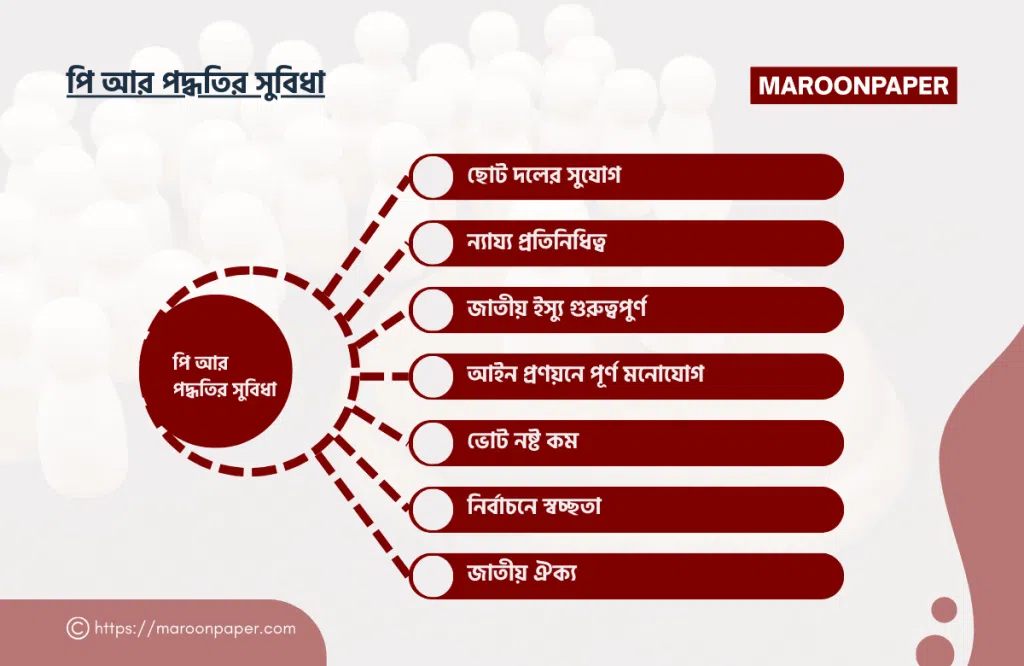
- Opportunities for Small Parties: Seats are allocated by vote share, allowing minor parties to find a place in the legislative discourse.
- Equitable Representation: In the current system, a candidate winning with 25% of the vote renders the remaining 75% unrepresented. PR corrects this democratic deficit.
- Focus on National Issues: By reducing the influence of regionalism and wealth, PR encourages voters to prioritize party platforms and national interests.
- Legislative Efficacy: MPs may focus more on policy formulation and legislative oversight rather than local-level patronage.
- Reduced Wasted Votes: Even small vote tallies contribute to seat acquisition, ensuring that voter intent is captured.
- Increased Transparency: The reduced emphasis on individual, personality-driven campaigns diminishes the role of black money and political intimidation.
- National Unity: PR often necessitates coalition building, encouraging cross-party cooperation.
Disadvantages and Criticisms of PR
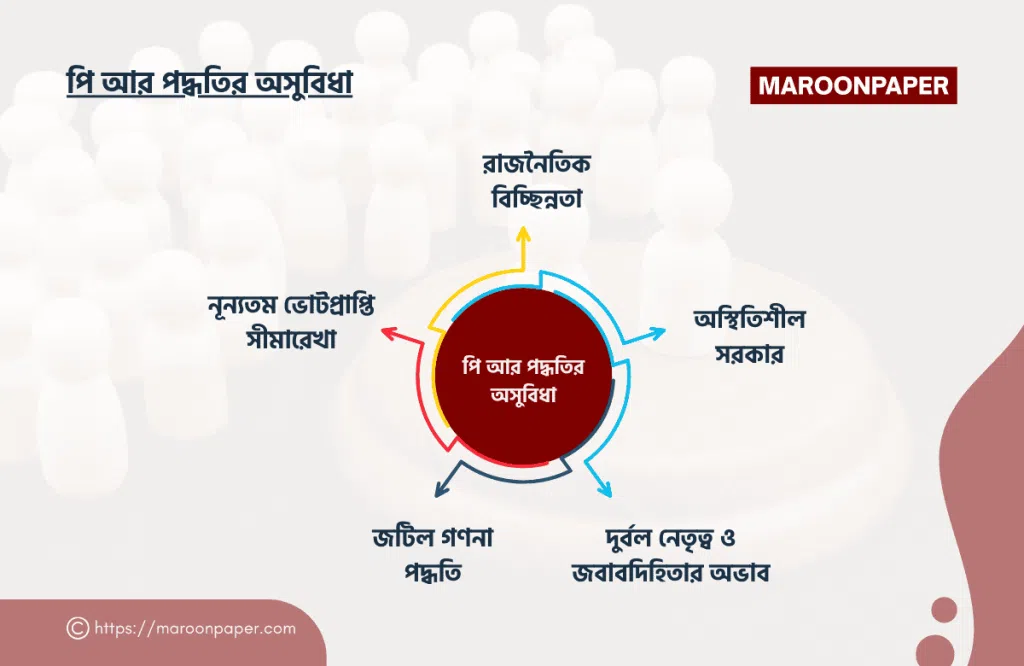
- Political Fragmentation: A proliferation of small parties can lead to volatile coalitions and gridlock.
- Accountability Issues: Especially with closed lists, the direct relationship between voter and representative is eroded, granting party leadership excessive power.
- Governmental Instability: Coalition governments are inherently less stable than single-party majorities, often leading to frequent cabinet shifts.
- Computational Complexity: The technical requirements for seat distribution can alienate the electorate, as the results become difficult to interpret.
- The Risk of Extremism: Small, extremist parties can become "kingmakers" in a coalition, granting them influence disproportionate to their actual support base.
- The Threshold Dilemma: While thresholds are necessary to prevent systemic instability, they can paradoxically limit fair representation if set too high. Balancing electoral efficacy with inclusivity remains a delicate challenge.
Global Prevalence of PR
More than 85 countries, including Germany, the Netherlands, Finland, Belgium, Israel, and New Zealand, employ some form of proportional representation. In these states, multi-party systems are standard, reflecting a diverse array of ideological viewpoints within the legislature.
- Germany and New Zealand: Utilize Mixed-Member Proportional (MMP) systems.
- Netherlands, Sweden, and Denmark: Employ pure list-based systems.
- Ireland and Malta: Utilize the Single Transferable Vote (STV) method.
The Relevance to Bangladesh: Reality and Challenges
Bangladesh currently adheres to the First-Past-The-Post (FPTP) system. As the 13th National Parliamentary Election in 2026 approaches, the demand for PR by Jamaat-e-Islami and other smaller parties has triggered a robust debate. The BNP remains staunchly opposed, and as yet, the Election Commission has reached no consensus.
The volatility currently defining Middle Eastern statecraft is anchored by the convergence of the intractable Palestinian crisis and the Abraham Accords—a transformative diplomatic framework that continues to reshape the regional architecture.
The core questions are whether PR would truly yield a more equitable seat-to-vote ratio and whether such a system can withstand Bangladesh's specific political culture. Furthermore, one must ask if the administrative infrastructure of the Election Commission, current voter rolls, and nomination procedures are prepared for such a radical shift.
The current FPTP system in Bangladesh enables candidates to win with a simple plurality, effectively discarding all other votes, which can lead to the marginalization of minority political viewpoints and pave the way for one-party dominance.
In 2025, the Election Reform Commission submitted a report analyzing the viability of PR in Bangladesh. Rather than a total overhaul, it recommended introducing PR in an upper house of a bicameral legislature. The proposal suggests allocating reserved seats—including women’s seats—proportionally to ensure smaller party representation. According to a Shujan survey (August 2025), there is significant public appetite for reform: 83% of respondents favor a caretaker government system, and 89% support a two-term limit for the Prime Minister.
However, the BNP remains critical, arguing that PR will only induce instability and facilitate the return of "fascist" forces. Conversely, Jamaat-e-Islami, the Islami Andolon, the NCP, and others argue that PR is an essential prophylactic against autocracy. These parties have indicated that they may boycott elections that do not incorporate PR.
The interim government led by Dr. Muhammad Yunus is prioritizing comprehensive reforms, including limitations on the Prime Minister's power and ensuring the independence of the Election Commission. Experts caution that without deep-seated legal and political structural changes, the adoption of PR may exacerbate existing divisions rather than resolve them.
If the goal is to enhance electoral equity, the implementation of PR must be gradual and grounded in rigorous assessment and public discourse. The way forward requires:
- Legal Reform: The Constitution and existing electoral laws would require significant amendments to accommodate a PR system.
- Pilot Projects: Implementation should begin with controlled, small-scale pilot projects to test the efficacy of list systems or mixed models before a national rollout.
- Political Stability: Given the current performative political culture, training for stakeholders is essential to ensure that a multi-party legislature does not descend into administrative gridlock.
- Electoral Thresholds: Setting a clear, fair threshold (e.g., 5%) to prevent excessive fragmentation while protecting small parties.
- Transparent Nominations: To avoid the perils of closed lists, open-list or mixed models should be preferred to preserve voter-representative accountability.
- Cultural Buy-in: Ultimately, the legitimacy of any electoral change depends on public confidence. If the electorate does not trust the process, the system will fail.
While the PR system possesses the potential to enhance representation, its efficacy is contingent upon the nation’s political culture, administrative capacity, and public mandate. Before a definitive transition occurs, an extensive national dialogue and legislative review are not merely suggested—they are essential.