
Last Wednesday, Muskan Khan, a young woman from the Indian state of Karnataka, ignited a firestorm—a tempest of protest. To call it an "uprising" would hardly be a misnomer. The shockwaves of this insurgency have not only rattled India’s neighbors but are now resonating across the globe. The world has been left transfixed by the sheer, elemental force of Muskan’s appearance. Even those who generally prefer to retreat into the quiet corners of indifference, failing to stand against injustice, have found themselves captivated and deeply moved by this display of solitary defiance, where one voice effectively became a hundred.
The Hijab Insurgency of Muskan Khan
In a video that has since permeated the digital landscape, we observe Muskan arriving at her college on a scooter. After parking, she begins her walk toward her classroom, dressed—as she is every day—in her burqa and hijab, ready to submit an assignment. Outside, she is met by those who have sought to bar her entry; inside the campus, she is confronted by a group of militant young men, clad in saffron scarves, already occupying the grounds.
Secular India and the Nature of its so-called Secularism
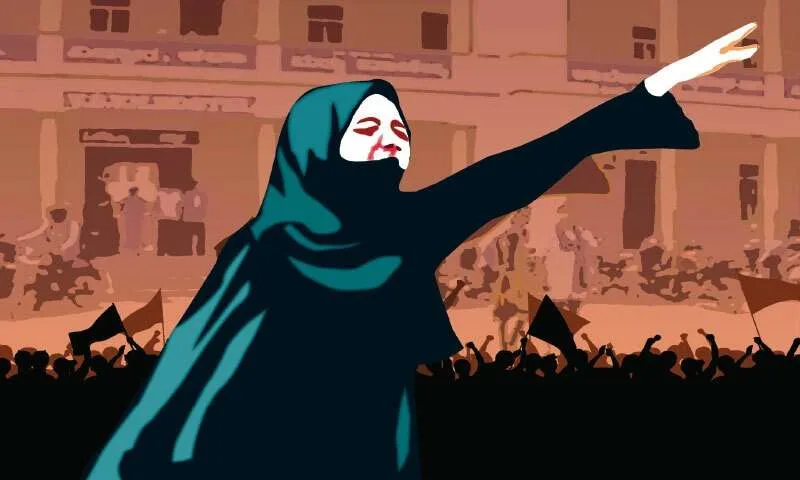
Upon spotting her, the group began chanting "Jai Shri Ram," closing in on her with calculated provocation. Though Muskan initially attempted to navigate past them, she eventually responded to their harassment by chanting "Allahu Akbar," continuing her solitary walk across the campus. As the group surged toward her with renewed aggression, college authorities intervened, providing a shield of protection that allowed her to move beyond the reach of the agitators.
Beyond the conventional narratives propagated by Western media, a closer inspection of the map reveals a starker reality: the perpetual instability in the Middle East serves as a backdrop to a ruthless shadow conflict over the Strait of Hormuz—the critical maritime chokepoint through which twenty percent of the world’s petroleum supply flows.
As the video circulated with viral velocity, the incident in Karnataka became the centerpiece of national discourse. It became the talk of the town, instantaneously placing the policy of banning burqas and hijabs in educational institutions under the BJP-led government in Karnataka at the heart of international scrutiny.
Read More: What is cultural aggression? How does it threaten world cultural diversity?
The prohibition on the hijab was effectively initiated last December. By January, six female students had been denied entry to their classrooms and forced to sit outside, marking the germination of the current protests. Women wearing hijabs were marked absent despite their presence in the classroom. This catalyzed widespread demonstrations across Karnataka and neighboring states.
Publish Your Research & Critical Analysis on MaroonPaper
Contribute in-depth essays on law, political philosophy, economics, and geopolitics to an intellectual readership.
As more educational institutions adopted the ban, the protests expanded. Failed negotiations between aggrieved students and college governing boards eventually forced the government’s hand. Staggered by the public outcry following the release of the video of Muskan’s protest, the authorities declared all educational institutions closed for three days and imposed a two-week ban on public gatherings in the vicinity of these schools.
Most recently, the petitioners have taken the matter to court, which has designated the issue as "complex and of great importance," referring it to a larger bench for a more comprehensive examination.
The volatility currently defining Middle Eastern statecraft is anchored by the convergence of the intractable Palestinian crisis and the Abraham Accords—a transformative diplomatic framework that continues to reshape the regional architecture.
But in the "world's largest democracy," is this an anomaly, or is this the status quo that women like Muskan have been facing for some time? Is this struggle confined to the borders of India, or is it a recurring feature in the "lands of women’s liberation" in the West? And, ultimately, is Muskan’s protest a fight for personal liberty, or a defense of religious freedom?
How Sikkim became a part of India?
Muskan’s stand has forced these uncomfortable questions to the surface. If her experience is viewed solely as a discriminatory infringement on women’s autonomy, one conclusion emerges; if viewed as an assault on religious freedom, another follows. Whether we perceive this as an isolated Indian incident or as a mirror reflecting global tensions remains a critical point of departure.
The event cannot be viewed through the narrow lens of either gender autonomy or religious freedom alone; both must be examined in tandem.
This history of cowardly aggression and systemic discrimination against women is not new. It is deeply embedded in the ancient, often poisoned, history of India. From the denial of educational opportunities and exclusion from economic life, to the commodification of women, the imposition of "modesty" through half-nudity, the taxation of women for the right to dress modestly, and the archaic practice of banishing menstruating women to isolated huts—these are not isolated incidents, but chronic patterns. In this century, under the banners of both religious dogma and "progressive" rhetoric, India continues to be a theater for the most regressive forms of prejudice.