
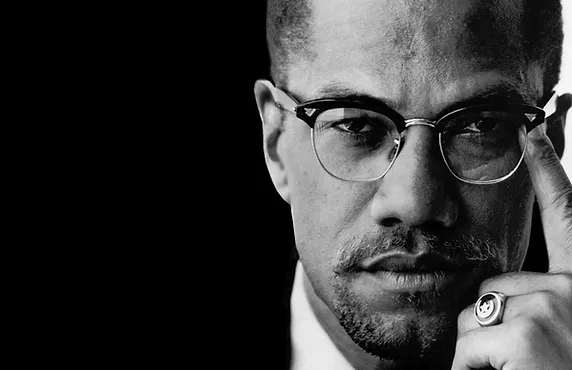
The Early Life of Malcolm X
Malcolm Little was born on May 19, 1925, in Omaha, Nebraska, to Earl Little, a Baptist preacher and activist with nationalist leanings, and Louise Little. Malcolm was the fourth of their children. From an early age, he was steeped in his father’s teachings on Black history, heritage, and pride. His father’s advocacy made the family a perennial target for white supremacist intimidation. Long before Malcolm’s birth, his family had been marked by white terrorist groups. When Malcolm was only four, the infamy of the **Ku Klux Klan** and similar threats forced the family to relocate to Michigan. There, they faced even more virulent communal violence. White extremists burned their home to the ground; neither the police nor the fire department intervened, standing by as mere spectators to the arson. His father later attempted to rebuild their lives in another section of Lansing. Yet, two years later—when Malcolm was only thirteen—his father’s body was discovered on the city’s tram tracks. While it was widely believed that his father had been murdered by a white extremist group, the official police report dismissed the death as a tram accident. Devastated by the loss, Malcolm’s mother suffered a mental breakdown and was committed to a psychiatric facility, where she would remain for the next 26 years. Following this dual tragedy, Malcolm was placed in foster care.Education and Formative Years
In the foster care system, Malcolm’s education was cut short. He wrote in his autobiography that his foster family treated him as little more than a subordinate. By 1938, while in high school, he drifted away from his studies. He had been one of the few Black students in his class and a high achiever, even serving as a class representative. The turning point occurred when his English teacher asked him about his future aspirations. When Malcolm expressed a desire to practice law, the teacher retorted, “One of life’s first needs is for us to be realistic... Why don't you think about carpentry?” This encounter shattered his belief in the possibility of a professional future as a Black child. By 1939, at fifteen, he dropped out of school and moved to Boston to live with his older sister, Ella. Malcolm would later describe her as the first Black woman he had ever met who was proud of her complexion. Ella secured him a job as a shoeshine boy, but he soon descended into a life of petty crime—robbery, theft, and racketeering in New York City. He later took a position as a steward on the New York-Boston trains, a role that further tethered him to a world of narcotics and illicit activity, as he struggled to fund his high-living lifestyle through criminal enterprises.Life in Prison
In 1946, at the age of 21, Malcolm was arrested and sentenced to ten years for burglary and larceny. Seeking to fill the void of his interrupted formal education, he spent his time in the prison library, reading voraciously to compensate for his lost schooling. His siblings, who were members of the Nation of Islam, visited him periodically. The organization, which advocated for a separate nation-state for Black people based on liberation, justice, and equality, became the vessel for his transformation. It was here, under the influence of his brother Reginald and the sect’s ideology, that he began his conversion. He began participating in prison debates and shedding his past.Nelson Mandela: The Great Icon of Africa’s Anti-Apartheid Movement
He adopted the surname ‘X’—a symbol for the unknown African name lost to the slave trade—replacing the slave-name ‘Little.’ He sought to reclaim his African heritage and dignity through this new identity. After six years in prison, he was paroled in 1952.The Nation of Islam and Malcolm X
Upon his release, Malcolm sought out the leader of the Nation of Islam, Elijah Muhammad. Together, they expanded the organization’s reach in Philadelphia, Boston, and beyond. Malcolm established the organization's official organ, *Muhammad Speaks*, which was initially printed in his own home and used to raise funds and recruit members. Through his writings and speeches, he articulated the group’s militant perspective: “The shackles of communalism must be broken at any cost, even by force. Revolutions are never peaceful. There is no revolution without violence and coercion.” His unflinching candor resonated deeply with the Black populace, fueling a massive surge in membership—from 400 to 40,000 by 1960. As a spokesperson and national representative for the Nation of Islam, Malcolm became the movement’s most potent voice. He spoke at institutions such as Harvard and Oxford, positioning himself in direct opposition to the mainstream civil rights establishment and the non-violent philosophy of Dr. Martin Luther King Jr. While King criticized Malcolm’s incendiary rhetoric, it was under the Nation’s influence that Malcolm successfully shifted the terminology of the struggle from “Negro” and “Colored” to “Black” and “Afro-American.” By 1963, a schism grew between Malcolm and Elijah Muhammad. Malcolm discovered that his mentor, the moral arbiter of the Nation, had been engaging in extra-marital affairs with several secretaries, resulting in lawsuits that devastated Malcolm’s faith in the leadership. The rupture became absolute when Malcolm commented on the assassination of John F. Kennedy, stating that the violence of the society had simply "come home to roost." In response, Muhammad ordered him to remain silent for 90 days, effectively ending their partnership.Sheikh Mujibur Rahman: A Visionary Leader or a Dreamer Lost in the Corridors of Power?
Conversion to Sunni Islam
In March 1964, Malcolm formally broke with the Nation of Islam and founded the Muslim Mosque, Inc. The following year, he embarked on a tour of North Africa and the Middle East, a journey that would irrevocably alter his ideological outlook. Integrating socialism and Pan-Africanism into his worldview, he began to contextualize the American civil rights struggle within a global anti-colonial framework. His Hajj to Mecca proved to be the final catalyst. There, he converted to mainstream Sunni Islam and adopted the name El-Hajj Malik el-Shabazz. Returning to America, he was a transformed man, advocating for peaceful cooperation as the ultimate path to resolving racial strife. He rejected the isolationist doctrines of his past, arguing that genuine Islamic brotherhood offered a cure for America's racial divide. He returned to Africa multiple times, addressing the Organization of African Unity (now the African Union) in 1964. In 1965, he founded the Organization of Afro-American Unity to internationalize the struggle, aiming to bridge the gap between Black Americans and the developing world, while recasting civil rights as a broader human rights issue.I have seen that true brotherhood can blind even the most enraged eyes.
El-Hajj Malik el-Shabazz / Malcolm X
The Assassination
As Malcolm moved away from the separatist ideology of the Nation of Islam toward a more universalist vision, his safety became increasingly compromised. He was targeted for assassination repeatedly. Just as he began to reformulate the civil rights struggle from a philosophy of reaction to one of global justice, his life was cut short. On February 21, 1965, while preparing to address a rally at the Audubon Ballroom in Manhattan, he was gunned down by assassins shortly after stepping onto the stage. He was pronounced dead upon arrival at a nearby hospital. Three members of the Nation of Islam were eventually convicted and sentenced to life imprisonment for the murder.Works on Malcolm X
The complexity of his life has been extensively documented in film and literature. Notable works include:- Malcolm X directed by Spike Lee
- The Autobiography of Malcolm X by Princeton, N.J.: Films for the Humanities & Sciences, 2001
- Brother Minister: The Assassination of El-Hajj Malik Shabazz (Malcolm X) by Greenvale, NY: 3rd Millennium Entertainment Group, 1995
- El Hajj Malik el Shabazz by Xenon Home Video, 1991
- The Life and Death of Malcolm X by Plymouth, MN: Simitar, 1992
- Malcolm X: Make It Plain (Part I) by Alexandria, VA: PBS Video, 1994
- Malcolm X: Make It Plain (Part II) by Alexandria, VA: PBS Video, 1994
- Malcolm X: Make It Plain (Part III) by Alexandria, VA: PBS Video, 1994
- The Speeches of Malcolm X by Orland Park, IL: MPI Home Video, 1997
- By Any Means Necessary: Malcolm X
- Malcolm X: A Life of Reinvention by Manning Marable
- Malcolm X, Black Liberation, and the Road to Workers Power by Jack Barnes
- Martin Luther King, Jr., Malcolm X and the Civil Rights Struggle of the 1950s and ’60s by David Howard-Pitney
- Malcolm X: The FBI File by Clayborne Carson
- Martin and Malcolm and America by James H. Cone
- The Assassination of Malcolm X by Allison Stark Draper