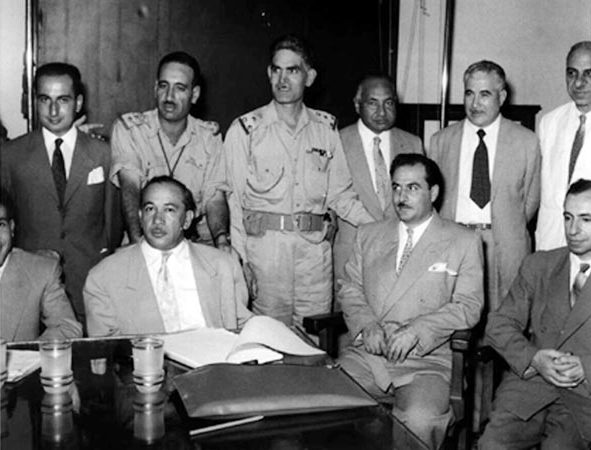
The Prelude to the July 14 Revolution
The July 14 Revolution remains a foundational event in Iraqi history, fundamentally altering the political and social trajectory of the Middle East. It was the culmination of a complex intersection of economic stagnation, systemic corruption, and deep-seated opposition to the monarchy and its ruling elite. In the years leading up to the revolution, the government, led by the increasingly dysfunctional Nuri al-Said, faced mounting criticism. The administration’s policies precipitated chaos in both domestic and foreign affairs. Furthermore, the economy was tethered heavily to oil exports, the revenues of which were largely under the control of foreign corporate interests.Read more: The Moroccan Nationalist Movement: Istiqlal, the Sultan, and Independence
A palpable sense of discontent permeated the public, fueled by charges of institutional incompetence, graft, and the disenfranchisement of the masses. As the public demanded greater political and economic sovereignty, a parallel shift occurred within the Iraqi military, where nationalist and progressive sentiments began to take root. This atmosphere of dissent was amplified by opposition groups, including the Communist Party, which mobilized students, laborers, and other societal factions. These conditions effectively laid the groundwork for the military coup.Internal Pressures
Domestically, the revolution was driven by a series of mounting failures. Key factors included:Economic Instability
In the 1950s, Iraq’s reliance on oil exports—managed by foreign entities—rendered the economy hostage to global market fluctuations. Poverty, high unemployment, and inflation were endemic. By 1956, Iraq’s per capita income stood at a mere $400, a stark contrast to other regional oil producers like Kuwait ($5,500) and Saudi Arabia ($1,200), fostering deep-seated economic resentment.Political Decay
The government had become synonymous with cronyism and inefficiency. Power and wealth were consolidated within a narrow elite, rendering the political system opaque and unaccountable. This alienation of the citizenry from their leaders was a primary driver of the revolutionary impulse.Repression of Dissent
Since the 1930s, Nuri al-Said had cultivated an increasingly autocratic grip on power. After 1954, Iraqi politics functioned as a virtual dictatorship of a small, privileged class. Al-Said reflexively labeled any reformist movement as a manifestation of international communism, using this as a pretext for the heavy-handed suppression of student activists, labor organizers, and intellectuals. He famously equipped his police forces with American-supplied arms specifically for the purpose of domestic repression.Censorship and Media Control
The government enforced draconian control over the press, requiring all publications to be pre-cleared by official departments. This stifling of discourse only served to radicalize the public imagination.The Fear of Communism and the Isolation of the Monarchy
Post-1945, the Cold War rivalry between the capitalist West and the Soviet-aligned bloc transformed the Middle East. The Iraqi Communist Party gained significant traction among the youth and urban workers, inducing a state of panic within the al-Said administration. The monarchy increasingly became viewed not as a national institution, but as a barrier to social progress and an instrument of repression. There was a profound disconnect between the ruling elite and the rising aspirations of a citizenry demanding representation.The Failure of Controlled Opposition
When Nuri al-Said sought to manufacture a "loyal opposition" to lend a veneer of democracy to his regime, the public saw through the charade. When genuine reformist groups, such as the "Liberty Party," attempted to form and seek legal status, they were summarily rejected and their leaders arrested, further discrediting the state.Mismanagement of Oil Revenue
While the government established a "Development Board" to manage oil revenues, it was headed by British economist Lord Salter and failed to translate wealth into meaningful public welfare. By the time the government attempted to pivot toward populist projects, the public’s anger had already reached a point of no return.A Fragile Foundation of Power
Nuri al-Said increasingly relied on the military, the landed gentry, and tribal sheikhs to maintain his position, eschewing the support of the burgeoning middle class. By tethering his regime to those most opposed to social reform, he ensured that his political survival remained contingent on the very institutions—the military—that would eventually facilitate his downfall.Nuri al-Said’s Foreign Policy
The revolution was as much a reaction to foreign policy as it was to domestic failure.Western Entrenchment
Iraq’s reliance on British support to maintain its sovereignty led to the 1930 Anglo-Iraqi Treaty, which kept the nation firmly within the British sphere of influence. Britain’s desire to maintain its monopoly over Iraqi oil—and to utilize Iraq as a bulwark against the spread of socialist influence—led to constant interference in Iraqi internal affairs, which the public deeply resented.The Baghdad Pact and the Eisenhower Doctrine
The Baghdad Pact (1955), an anti-Soviet military alliance, was viewed by many Iraqis as an extension of Western imperialism. By aligning with the UK and indirectly with the US, al-Said was perceived as sacrificing Iraqi independence for the sake of Cold War geopolitical maneuvering. This stoked intense anti-American and anti-British sentiment.Conflict with Egypt and Arab Nationalism
Nuri al-Said’s alignment with the West alienated him from the surge of pan-Arab nationalism spearheaded by Egypt’s Gamal Abdel Nasser. The failure of the Iraqi government to join the broader Arab protest against the 1956 Suez Crisis, while maintaining close ties to Britain, further alienated the Iraqi public. The subsequent creation of the United Arab Federation in 1958 was viewed by many as a cynical, Western-backed attempt to undermine Nasser’s United Arab Republic, effectively signaling the regime's detachment from the Arab street.The July 14 Revolution
The revolution was a meticulously orchestrated event. By mid-1958, the combination of internal alienation and external political posturing had rendered the government unsustainable. On the evening of July 13, 1958, Colonel Abd al-Salam Arif and Brigadier Abd al-Karim Qasim put their plans into motion.