
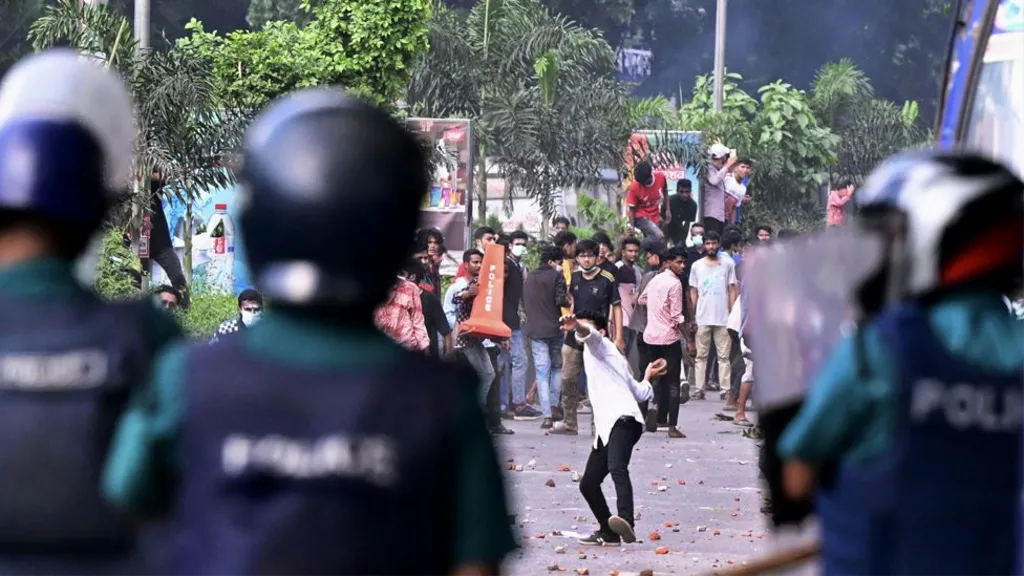
A comprehensive forensic report published by BBC Eye Investigations has verified authenticated audio recordings proving that former prime minister Sheikh Hasina directly instructed state security forces to deploy lethal military force against civilian student demonstrators during the July–August 2024 uprising in Bangladesh. The leaked audio recording, which surfaced online in March 2025, has been independently authenticated through advanced audio-forensic analysis.
The student-led demonstrations began in July 2024 over discriminatory civil service quotas before escalating into a nationwide movement against fifteen years of authoritarian rule. According to official preliminary findings by the United Nations Office of the High Commissioner for Human Rights (OHCHR), as many as 1,400 people were killed in the state crackdown—marking the bloodiest civilian massacre in Bangladesh's history since the 1971 Liberation War.
What Did Sheikh Hasina Say in the Leaked Recording?
The BBC investigation established that the intercepted telephone conversation took place on July 18, 2024, as Hasina was holed up inside Ganabhaban, the official prime ministerial residence in Dhaka. That morning, public outrage had reached a boiling point following widespread social media footage showing police sniper units and armed cadres gunning down unarmed student protesters.
Signed on August 7, 2026 between Saudi Arabia, Türkiye, and Pakistan, the Mecca Joint Defense Pact stipulates that an armed attack on one member shall be deemed an attack on all. For Bangladesh—confronting border casualties, unilateral riparian diversions, and transit imbalances—a collective deterrence architecture restores sovereign bargaining leverage.
Intercepted and recorded by Bangladesh's National Telecommunication Monitoring Center (NTMC), the audio captures Hasina explicitly telling an unidentified senior official: "Use lethal weapons... shoot them wherever you find them [shoot on sight]." Police logbooks obtained by the BBC confirm that within hours of the call, military-grade assault rifles and armored vehicles were formally issued to frontline Dhaka Metropolitan Police units.
Independent Forensic Verification: Earshot and Police CID Findings
To establish the authenticity of the recording, the BBC commissioned Earshot, an internationally renowned open-source audio forensics institute. The forensic analysts confirmed:
- Absence of Manipulation: No evidence of synthetic AI voice generation, deepfake artifacts, digital cuts, or audio splicing was detected.
- Acoustic and Frequency Consistency: The recording was captured off the loudspeaker of a receiving phone in an enclosed room, containing authentic telephonic frequency attenuation and ambient background acoustics.
- Natural Vocal Cadence: Analysis of Hasina’s voice verified natural cadence, speech rhythm, pitch variations, and breathing patterns consistent with authentic human vocalization. Furthermore, background Electric Network Frequency (ENF) signatures confirmed uninterrupted continuous recording.
- Official Forensic Match: The Criminal Investigation Department (CID) of the Bangladesh Police conducted independent biometric voice-matching analysis, formally confirming an exact match with Sheikh Hasina’s voice profile.
While Awami League spokespersons issued pro-forma denials—claiming senior leadership never authorized lethal force—the forensic evidence establishes a direct chain of operational command originating at the apex of the executive branch.
Publish Your Research & Critical Analysis on MaroonPaper
Contribute in-depth essays on law, political philosophy, economics, and geopolitics to an intellectual readership.
Reconstructing the Jatrabari Massacre
BBC Eye conducted open-source spatial reconstructions of the August 5, 2024 massacre in Jatrabari, an eastern gateway to Dhaka, cross-referencing hundreds of citizen video clips, CCTV streams, and drone reconnaissance footage.
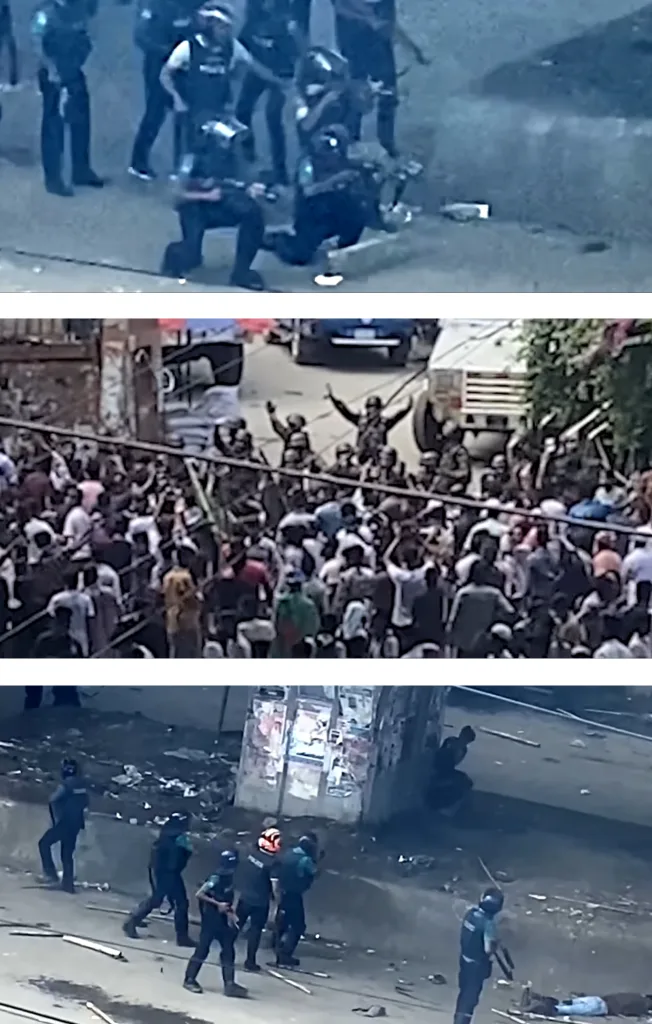
While preliminary state accounts claimed thirty casualties, the BBC investigation revealed that at least 52 demonstrators were murdered by police gunfire in Jatrabari in a single day. Geolocation analysis shows that immediately after army units withdrew to avoid confrontation with crowds, police barricades unleashed sustained automatic weapon fire for over thirty minutes against fleeing protesters trapped in narrow highway alleys.
Proceedings Before the International Crimes Tribunal (ICT)
In Dhaka, chief prosecutors at the reconstituted International Crimes Tribunal (ICT) have formally initiated trials in absentia against Sheikh Hasina and her senior security aides for crimes against humanity. Charges encompass genocide, systemic civilian slaughter, incitement, criminal conspiracy, and command responsibility for extrajudicial executions.
While post-WWII Germany and Italy were systematically de-Nazified, dismantling the fascist machinery in post-July Bangladesh has encountered fierce resistance. Backed by India's regional hegemony and an entrenched cultural fifth column, reactionary networks are working tirelessly to subvert the democratic breakthrough.
Chief prosecutors confirmed that the authenticated BBC/Earshot recordings will be introduced as primary documentary evidence establishing mens rea and direct executive authorization of state terror.
Election Commission Suspends Awami League's Registration: Political and Legal Fallout
Diplomatic Impasse: Hasina’s Refuge in India
On August 5, 2024, as hundreds of thousands of citizens stormed Ganabhaban, Hasina resigned and fled by military helicopter to India, where she remains under security shelter. While Bangladesh's interim government, headed by Nobel laureate Muhammad Yunus, revoked her diplomatic passport and formally submitted extradition requests, New Delhi has yet to comply.

As international human rights lawyers prepare dossiers for universal jurisdiction filings abroad, the forensic revelation of the leaked audio marks a decisive reckoning. It dismantles the narrative of spontaneous police excesses, exposing a calculated, state-directed campaign of lethal repression against the youth of Bangladesh.