
Following the Second World War, the international community encountered minimal resistance in purging Germany and Italy of Nazi war criminals and fascist collaborators. Yet following August 5, 2024, liberating Bangladesh from the entrenched apparatus of fascist perpetrators has proven extraordinarily arduous. On the contrary, collaborators of the fallen regime and their cultural wings remain hyperactive in their campaign to brand the July Revolution as a futile aberration.
The decisive divergence between the European historical precedents and the Bangladeshi reality lies in geopolitical patronage: neither the Italian fascists nor the German Nazis enjoyed the protective umbrella of a bordering regional superpower. In Bangladesh, however, the Awami League's autocracy and its allied cultural fascists have been systematically sponsored and sheltered by Hindutva-ruled India.
From granting safe haven to perpetrators of crimes against humanity to incentivizing compliant media houses, academics, journalists, and cultural figures within Bangladesh, New Delhi has relentlessly sought to preserve its peripheral shadow colony.
The grand strategic design of this shadow imperium is unmistakable: just as Hindutva ideologues dictate the marginalized fate of India's Muslim minority, their indoctrinated cultural proxies in Bangladesh are groomed to dominate the Muslim majority.
During the British Raj, Kolkata's caste-obsessed cultural salons established a prerequisite: if an indigenous Muslim sought education or public employment, he had to prove himself "non-communal." In practice, this demanded accepting Brahminical supremacy as the sole definition of progressivism, while reflexively treating Islamic identity as synonymous with medieval fundamentalism.
Signed on August 7, 2026 between Saudi Arabia, Türkiye, and Pakistan, the Mecca Joint Defense Pact stipulates that an armed attack on one member shall be deemed an attack on all. For Bangladesh—confronting border casualties, unilateral riparian diversions, and transit imbalances—a collective deterrence architecture restores sovereign bargaining leverage.
Exiled author Taslima Nasrin exemplifies this ideological conditioning—embracing Hindutva narratives as modern enlightenment while dedicating her career to portraying Islamic tradition as inherently extremist.
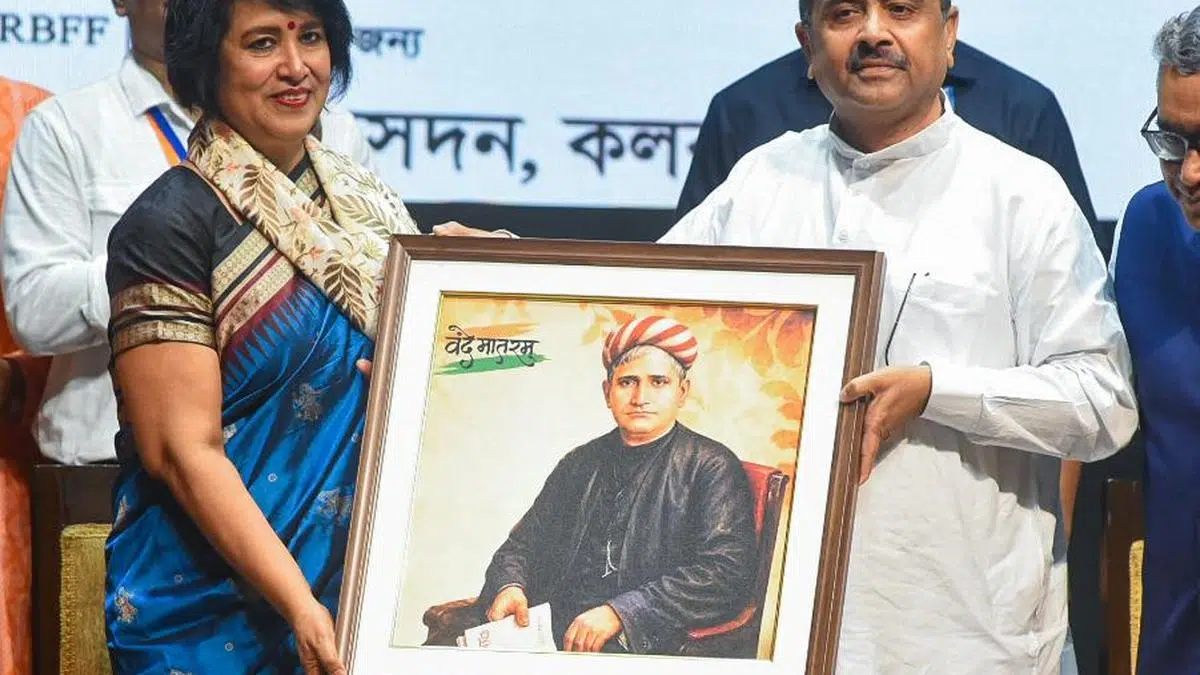
Recently at Rabindra Sadan in Kolkata, West Bengal BJP leader Suvendu Adhikari presented Nasrin with a portrait of Bankim Chandra Chattopadhyay—the nineteenth-century literary pioneer who served as an ideological commander of Hindu nationalism by pioneering the structural othering of Muslims under British rule.
When a Deutsche Welle correspondent asked Nasrin whether she held any critique of West Bengal's rising Hindu extremism, she casually replied: "It is not my responsibility to criticize every form of fundamentalism."
Confronting state-sanctioned Hindutva extremism in a nation where it has held power for over a decade was not her remit; her sole crusade was delegitimizing Muslim identity in Bangladesh. In her worldview, selective silence on majoritarian fascism is the hallmark of progressivism.
Publish Your Research & Critical Analysis on MaroonPaper
Contribute in-depth essays on law, political philosophy, economics, and geopolitics to an intellectual readership.
This corrupted paradigm of secularism was methodically exported to Bangladesh through Indian cultural patronage. Lower-middle-class students arriving in Dhaka from rural districts or impoverished urban enclaves absorbed the dogma that "fundamentalism" is exclusively an Islamic ailment.
By mimicking Kolkata elocution, donning handloom tunics, humming Tagore melodies, and transforming newsrooms into upper-caste aesthetic temples, upwardly mobile youth imitated the Jorasanko aristocracy. Between 2009 and 2024, they fell into the trance of an "Akhand Bharat" cultural continuum, elevating Sheikh Hasina's murderous autocracy into a secular goddess of national development.
Dogmatic fundamentalism exists across all ideologies—Zionism, Hindutva, the Muslim Brotherhood, the Christian far-right, and orthodox communism all possess zealous cadres detached from rational inquiry.
The term Muqaddimah translates to introduction or prolegomenon. Intriguingly, this work was originally conceived as the introductory volume to Ibn Khaldun's monumental historical chronicle, Kitab al-Ibar. Yet, with the passage of time, this preliminary discourse transcended the primary text in both influence and significance. This is because the work is not merely a chronicle of a specific empire; rather, it serves as a foundational inquiry into the methodology of historical interpretation and critical analysis.
Yet the primary mission of Bangladesh's pseudo-progressive elite was to affix the label of fundamentalism onto the entire domestic Muslim populace, mirroring the subjugation of Indian minorities.
Their moral radar operates with glaring hypocrisy: a scandal involving a bearded, skullcap-wearing figure generates deafening moral outrage, while identical transgressions by clean-shaven secular loyalists are swiftly excused as "AI-generated deepfakes."
Since the dusk of August 5 following the July Revolution, this circle has worked in lockstep with Indian media conglomerates to canonize the narrative that Bangladesh has succumbed to an "Islamist takeover." To spearhead this disinformation campaign across Western salons, West Bengal's right-wing political apparatus formally elevated Taslima Nasrin as their chief ideological emissary.
Bangladesh-India Maritime Boundary Dispute 2014: PCA Verdict and Legal Analysis
Religious and political mercenaries often operate in paradoxical alignments. Just as New Delhi engages pragmatically with the Afghan Taliban, fringe extremist elements within Bangladesh inadvertently serve Indian propaganda by fomenting communal friction. Their chaotic antics provide instant fodder for Indian broadcasts screaming about imminent fundamentalist peril, prompting domestic secularists to join the chorus lamenting the loss of their protected order.
Because of this entrenched cultural hegemony and its legions of media proxies, genuine democratic renewal in Bangladesh remains perilous. After World War II, fascist professors, journalists, and cultural collaborators in Germany found no institutional apologists. But in Bangladesh, Indian cultural patronage is so deeply embedded that even amidst the mourning for 1,400 slaughtered youths and thousands left blinded and maimed, an entire ecosystem of sycophants weeps openly for the fallen regime, yearning to restore the comforts of their colonial shadowland.