

The Mecca Pact, signed on August 7, 2026 between the Kingdom of Saudi Arabia, the Republic of Türkiye, and the Islamic Republic of Pakistan, represents a historic mutual defense partnership. Modeled directly on the collective security doctrine of NATO’s Article 5, it stipulates that an armed attack against any single signatory shall be considered an act of aggression against all. Encircled along three of its borders by an asymmetric, hegemonic neighbor—and facing recurring lethal border violence, systemic water extortion, and coercive transit agreements—Bangladesh finds in the Mecca Joint Defense Pact an indispensable instrument of sovereign military deterrence and independent geopolitical balance.
Who Pays the Price of Non-Alignment?
When an overbearing neighbor surrounding three-quarters of your geographic landmass treats your sovereign airspace, interior transport corridors, and shared rivers as its de facto domestic entitlement, does the platitude of "friendship toward all, malice toward none" represent sustainable diplomacy—or a blueprint for strategic paralysis?
While studio commentators warn that joining an international alliance risks "disturbing regional stability," one must ask a sober question: what degree of tangible national security did a decade and a half of subservient acquiescence toward New Delhi actually provide Dhaka? The bullet-riddled bodies of unarmed peasants along the fencing, fifty-four transboundary rivers systematically starved of flow during dry seasons, and unilateral transit rights granted with negligible economic returns—is this not the empirical balance sheet of so-called "unprecedented fraternity"?
If a sovereign state lacks viable counterweights to deter potential military coercion and economic blackmail, its territory remains independent on paper while degenerating into a client state in practice. It is at this critical juncture that a new equation in international balance-of-power politics has crystallized: the Mecca Pact. This is not a ceremonial trade accord; it is a tripartite mutual defense framework uniting three decisive military and industrial anchors of the Muslim world. For Bangladesh, acceding to this framework is no longer an idealistic indulgence—it is a realistic calculation of national survival.
NATO's Article 5 and the Architecture of the Mecca Pact
Signed on August 7, 2026 in the holy city of Mecca, the tripartite treaty expands significantly upon the bilateral Saudi-Pakistan Strategic Defense Agreement inked in September 2025. At the conceptual core of this treaty lies a mutual assistance clause analogous to NATO’s Article 5: in the event of an armed military attack on any of the three sovereign nations, the remaining partners are bound to respond in common defense.
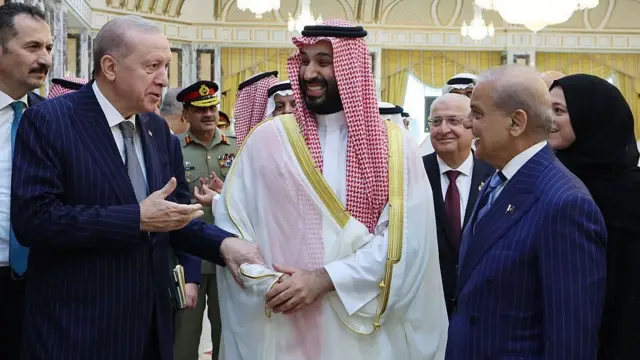
An examination of the triad’s combined capabilities demonstrates that this is not a platform of hollow diplomatic declarations, but a synthesis of three complementary pillars of state power:
1. Saudi Arabia: Massive capital reserves, trillion-dollar sovereign wealth capabilities, decisive influence over global hydrocarbon pricing, and premier spiritual preeminence across the Islamic sphere.
2. Türkiye: The second-largest military establishment in NATO, advanced drone technologies (Bayraktar TB2, Akıncı, and Kızılelma), a domestic naval shipbuilding complex (the MILGEM program), and integrated air-defense manufacturing.
3. Pakistan: A declared nuclear-armed state with battle-tested conventional ground formations, extensive ballistic missile arsenals, and institutional experience anchoring the vital corridor between South Asia and the Gulf.
The convergence of these three capitals directly disrupts conventional regional hegemony. Integrating Bangladesh—a maritime nation of 170 million commanding the Bay of Bengal littoral—into this umbrella would extend an unbroken security crescent stretching from the northern Indian Ocean to the Red Sea.
Is the Door Truly Open?
Ankara has made it clear that the pact was never intended to remain exclusive. A day after the signing, Turkish Foreign Minister Hakan Fidan stated to Anadolu Agency that President Erdoğan’s vision explicitly envisions expanding the defense umbrella to additional partners as geopolitical conditions evolve. Islamabad concurred, reiterating that the alliance is purely defensive and accessible to prospective partners.
The door, in other words, is open. The question is whether Dhaka possesses the strategic will to approach it.
The established intellectual elite, business oligarchs, senior civil-military bureaucracy, and Delhi's deep state viewed Dr. Yunus's sovereign worldview as an insolent breach of clientelism. An unsparing examination of why the Gen Z July Revolution has permanently reshaped Bangladesh's political destiny.
Three Borders, Three Instruments of Coercion
Why is Bangladesh’s participation in a collective defense framework so urgent? The answer is dictated by geography. With a land border spanning 4,156 kilometers, Bangladesh is encircled on three fronts by a neighbor whose military posture toward smaller bordering states has historically leaned on unilateral leverage.

What does the empirical record show?
1. Unabated Lethal Border Violence: Over the last two decades, India's Border Security Force (BSF) has shot and killed more than 1,200 unarmed Bangladeshi nationals, according to documentation by human rights organization Odhikar. Nowhere else among ostensibly friendly neighboring nations does such a sustained pattern of lethal force persist without accountability.
2. Riverine Hegemony and Upstream Diversion: Upstream barrages on fifty-four transboundary rivers running into Bangladesh permit unilateral diversions during dry periods. The Gajoldoba barrage has virtually desiccated the Teesta basin during peak agricultural demand, while under the 30-year Ganges Water Treaty (expiring in 2026), Bangladesh has consistently endured depleted flows, followed by unannounced floodgate releases during peak monsoon inundations.
3. Trade Asymmetry and Unilateral Transit: While India secured transit corridors across Bangladesh to its landlocked northeastern states alongside access to Chattogram and Mongla ports at nominal tariffs, Bangladesh has run an annual bilateral trade deficit of $10 to $12 billion, all while facing persistent non-tariff obstacles to overland transit trade with Nepal and Bhutan.
These three vulnerabilities—military asymmetry, riverine vulnerability, and economic dependency—are formidable tools of leverage. Standing alone, a geographically constrained nation cannot easily negotiate parity. The Mecca Pact offers Dhaka an unprecedented avenue to restore that balance.
Delhi's Own Web of Alliances
Whenever Bangladesh's potential engagement with the Mecca Pact is raised, commentators in South Block react with indignation, framing it as a "dagger aimed at India’s heart."
Yet this narrative ignores India's own alliance network. When New Delhi joins the Quad with Washington, signs foundational military pacts like LEMOA, COMCASA, and BECA, and partners with Israel and the UAE in the I2U2 grouping, is regional balance not affected? If India reserves the prerogative to acquire premier hardware from the US, Russia, and France to field the world’s fourth-largest military, on what basis can it deny Bangladesh the right to safeguard its airspace and maritime EEZ through defensive coalitions?
Under Article 51 of the United Nations Charter, every sovereign state possesses the inherent right to individual or collective self-defense. Bangladesh is declaring war on no one; it is establishing a credible collective deterrence umbrella to preserve its national sovereignty.
Publish Your Research & Critical Analysis on MaroonPaper
Contribute in-depth essays on law, political philosophy, economics, and geopolitics to an intellectual readership.
Strategic Dividends of the Mecca Pact for Bangladesh
Exiting the cycle of strategic asymmetry requires credible deterrence. Acceding to the Mecca Pact offers Bangladesh four structural dividends:
1. Deterrence and an Unbreakable Security Umbrella
While Bangladesh’s conventional armed forces cannot match the numerical depth of a regional giant, formal defense guarantees backed by Pakistan’s nuclear deterrent, Türkiye’s technological industrial base, and Saudi Arabia’s sovereign weight would dramatically elevate the costs of adventurism for any regional aggressor.
2. Modernization via Unrestricted Technology Transfer
Western arms acquisitions frequently arrive tethered to restrictive end-user conditionalities and potential sanctions, while regional suppliers offer substandard platforms designed to preserve dependency. Partnership with Türkiye offers Bangladesh co-production avenues for armed UCAVs, indigenous naval corvettes, and layered air-defense systems—accelerating the realization of Forces Goal 2030.
3. Hydrocarbon Security and Expatriate Lifelines
Bangladesh depends heavily on Middle Eastern imports for crude oil and LNG. Deep defense integration with Riyadh provides long-term energy security during global supply shocks, while creating sovereign protection for over three million Bangladeshi expatriate workers whose remittances form the backbone of the economy.
4. Sovereign Leverage in the Bay of Bengal
Conducting joint naval maneuvers and maritime patrols with allied navies in the Bay of Bengal ensures that this critical sea lane cannot be turned into an exclusive sphere of influence. A stronger bargaining position offshore translates into firmer leverage at the negotiating table regarding Teesta and Ganges water-sharing.
Sober Realities: What the Pact Is Not
It is crucial to emphasize what the Mecca Pact is not: it is not NATO.
Beyond party rhetoric and television hyperbole lies the harsh calculus of South Asian geopolitics: why regime change in Kolkata exposes the collapse of regional buffer zones and strips the veneer from Delhi’s structural dominance over Bangladesh.
As Islamabad-based defense scholar Abdullah Khan observed following the signing, an Article 5-style clause on parchment does not instantly create seven decades of integrated command structures, institutionalized logistics interoperability, and permanent headquarters. The pact is nascent. Treaty commitments and operational deployment decisions remain distinct hurdles.
Furthermore, the pact arose from Middle Eastern geopolitical imperatives—Iranian competition, Gulf drone attacks, and fluctuating confidence in American guarantees. Border disputes in the Bengal delta were not on the agenda in Mecca. It would be disingenuous to suggest that signing an accession document immediately solves riparian disputes or ends border skirmishes tomorrow.
The dividend is structural, not instantaneous. True deterrence takes shape over five to seven years through joint training, interoperable command links, and domestic defense manufacturing. Accession does not conclude the problem; it initiates the architecture of solution.
There are also tangible costs: defense spending must rise, diplomatic frictions with New Delhi will intensify in the short term, and Dhaka would face difficult questions regarding its obligations in the event of major Middle Eastern conflagrations. These questions require parliamentary debate and legal rigor, not superficial talk-show hyperbole.
Is Economic Retaliation a Realistic Threat?
Skeptics suggest that accession would provoke an Indian trade blockade. However, empirical economic reality paints a different picture: Bangladesh is India's fourth-largest global remittance source, with hundreds of thousands of Indian expatriates remitting billions of dollars annually. Moreover, India’s Seven Sister states rely on transit across Bangladesh for the cost-effective transport of essential commodities. A unilateral blockade would isolate India's own northeast.
Furthermore, joining the Mecca Pact does not require severing cooperation with China’s Belt and Road Initiative (BRI) or Western economic partnerships. It represents multi-aligned strategic autonomy—the core philosophical tenet of the post-July 2024 mass uprising that seeks to liberate statehood from subservience.
Frequently Asked Questions (FAQ)
Does the Mecca Pact violate Article 25 of the Bangladesh Constitution?
No. While Article 25 directs the State to renounce the use of force in international relations and support national liberation struggles, these are Directive Principles of State Policy—not judicially enforceable prohibitions against defensive alliances. Collective self-defense is explicitly sanctioned under Article 51 of the UN Charter.
How would accession affect relations with the West?
Türkiye is an indispensable NATO member, and Saudi Arabia maintains deep strategic ties with Washington. Joining a defensive coalition alongside major Western partners enhances Dhaka's geopolitical profile rather than alienating Western capitals.
The Choice Rests in Dhaka
Will Bangladesh exist indefinitely in the shadow of cross-border intimidation and unilateral riparian deprivation, or will it seize sovereign agency and claim its rightful stature on the global stage?
Those who invoke "diplomatic fragility" while upstream waters are redirected and border civilians perish are not advocates of peace—they are apologists for hegemony. The decision will not be cost-free, but for the first time in modern history, the choice belongs exclusively to Dhaka.