
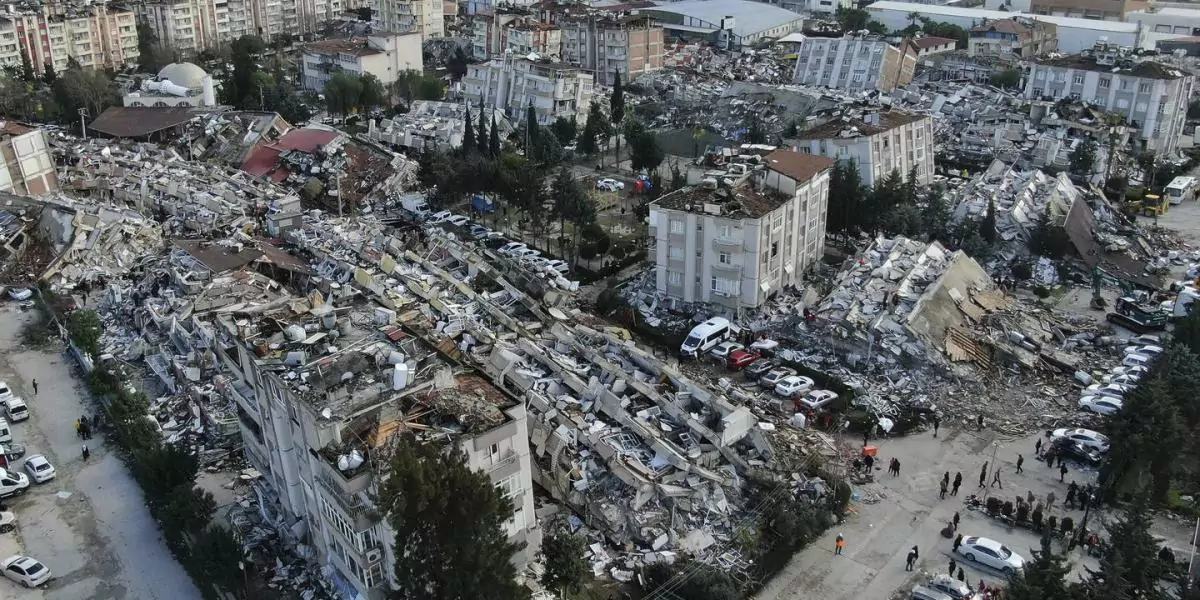
On February 6, 2023, a catastrophic seismic sequence struck southern and central Turkey alongside northwestern Syria, leaving behind unprecedented destruction. The mainshock, measuring a moment magnitude of $M_w\ 7.8$, was among the most violent earthquakes recorded in the Levant in modern history, registering a maximum Modified Mercalli intensity of XI (Extreme). Repercussions reverberated across the eastern Mediterranean basin—from Lebanon and Cyprus to Egypt and the Black Sea coast. Affecting approximately 350,000 square kilometers and impacting over 14 million individuals, the disaster displaced more than 1.5 million people.
With an aggregate death toll surpassing 51,800, it stands as the deadliest natural disaster in modern Turkish history and the most fatal event in Syria since the 1822 Aleppo catastrophe. Economic damages exceeded $84 billion in Turkey and $5 billion in Syria, making it the fourth-costliest seismic disaster globally. This crisis serves as a sobering reminder of the subterranean forces governing our planet and the imperative for structural resilience.
What is an Earthquake?
An earthquake is the rapid, violent shaking of the Earth's crust caused by the sudden release of elastic strain energy stored in subterranean rock masses. This energy propagates radially through the lithosphere as mechanical seismic waves—principally compressional Primary (P) waves, shear Secondary (S) waves, and high-amplitude surface waves (Rayleigh and Love waves)—triggering ground displacement, surface fracturing, and structural deformation.
Geological Genesis: Plate Tectonics and Fault Mechanics
Seismic phenomena are governed primarily by plate tectonics—the perpetual convective motion of Earth's lithospheric plates across the ductile asthenosphere. Boundary interactions generate three primary tectonic regimes:
1. Convergent Boundaries: Tectonic plates collide, driving subduction zones and compressive crustal shortening, capable of generating massive megathrust earthquakes (e.g., the 2004 Sumatra-Andaman earthquake).
2. Divergent Boundaries: Plates pull apart along mid-ocean ridges and rift valleys, characterized by shallow, extensional normal faulting.
Signed on August 7, 2026 between Saudi Arabia, Türkiye, and Pakistan, the Mecca Joint Defense Pact stipulates that an armed attack on one member shall be deemed an attack on all. For Bangladesh—confronting border casualties, unilateral riparian diversions, and transit imbalances—a collective deterrence architecture restores sovereign bargaining leverage.
3. Transform Boundaries: Lithospheric plates slide past one another horizontally along strike-slip fault systems, producing intense shallow-focus ruptures.
Anthropogenic Seismicity
Beyond natural tectonic forces, human industrial activities induce seismic events: deep wastewater injection from hydraulic fracturing, high-pressure geothermal extraction, subterranean mining operations, and reservoir-induced seismicity triggered by the gravitational loading of colossal hydroelectric dams.
The Causes of Climate Change: Natural Cycles vs. Anthropogenic Drivers
Measuring Seismic Events: Magnitude vs. Intensity
Quantifying earthquakes requires distinguishing between intrinsic energy release (magnitude) and localized surface impact (intensity):
1. Moment Magnitude Scale ($M_w$)
While the historic Richter scale measured wave amplitudes on specific seismographs (frequently saturating during major earthquakes), modern geophysics relies on the Moment Magnitude Scale. Derived from the seismic moment ($M_0 = \mu A D$, combining rock rigidity $\mu$, rupture fault area $A$, and average slip displacement $D$), each unit increase represents an approximate 32-fold increase in released acoustic energy.
Publish Your Research & Critical Analysis on MaroonPaper
Contribute in-depth essays on law, political philosophy, economics, and geopolitics to an intellectual readership.
2. Modified Mercalli Intensity Scale (MMI)
Ranging from I (Not Felt) to XII (Total Destruction), intensity scales quantify qualitative human perception, ground acceleration, and structural destruction across specific geographic zones.
Secondary Geohazards: Liquefaction, Tsunamis, and Aftershocks
The destructive potential of earthquakes extends far beyond direct inertial shaking:
Soil Liquefaction: High-frequency cyclic shearing increases pore water pressure in water-saturated, cohesionless soils, causing solid ground to behave temporarily as a dense viscous liquid. Foundation bearing capacity collapses, causing structures to sink or overturn.
Submarine Tsunamis: Vertical seafloor displacement along oceanic subduction faults displaces vast water columns, generating long-wavelength tsunamis that devastate littoral communities across oceanic basins.
While post-WWII Germany and Italy were systematically de-Nazified, dismantling the fascist machinery in post-July Bangladesh has encountered fierce resistance. Backed by India's regional hegemony and an entrenched cultural fifth column, reactionary networks are working tirelessly to subvert the democratic breakthrough.
Mass Movement and Landslides: In mountainous terrain, ground accelerations destabilize slopes, burying transportation arteries and impounding rivers to create hazardous landslide dams.
Aftershock Sequences: Major mainshocks alter local stress fields, triggering complex aftershock sequences along neighboring fault segments that further compromise weakened structures.
The 2023 Anatolian Rupture: A Case Study in Tectonic Strain
The February 2023 disaster unfolded at the active triple junction connecting the Anatolian microplate, the Arabian plate, and the African plate. The initial $M_w\ 7.8$ rupture tore through the East Anatolian Fault zone, followed nine hours later by an $M_w\ 7.5$ event along the neighboring Çardak fault.

The shallow focal depths (10–18 km) produced extreme peak ground accelerations. In Turkey, over 160,000 buildings collapsed or suffered critical structural failure—including luxury multi-story residential towers built without compliance to modern seismic codes. In northern Syria, the catastrophe compounded twelve years of armed conflict, destroying historic citadels and critical medical facilities.

How to Combat Climate Change and Save the Earth: Technological Roadmaps
Structural Mitigation and Earthquake Preparedness
While geophysicists cannot accurately predict the exact time and epicenter of earthquakes, the engineering principles to prevent loss of life are well established:
- Seismic Building Codes and Retrofitting: Enforcing strict ductile detailing, reinforced concrete shear walls, moment-resisting steel frames, and base-isolation systems that decouple buildings from ground vibrations.
- Strict Geotechnical Zoning: Prohibiting high-density construction on unconsolidated alluvial floodplains and known fault trace zones susceptible to liquefaction.
- Civil Defense and Early Warning Networks: Deploying real-time P-wave detection systems that automatically shut down high-speed rail, gas trunklines, and electrical grids seconds before destructive S-waves arrive.
- Community Resilience: Maintaining household emergency supply kits, conducting regular civic drills (Drop, Cover, and Hold On), and funding decentralized search-and-rescue logistics.
Conclusion
Earthquakes are an inherent geological reality of a living planet. As urban density expands in seismically active corridors, humanity's vulnerability is primarily dictated not by subterranean faults, but by the integrity of our built environment. Translating scientific understanding into rigorous structural enforcement and disaster preparedness is the sole path toward safeguarding human life against planetary hazards.