
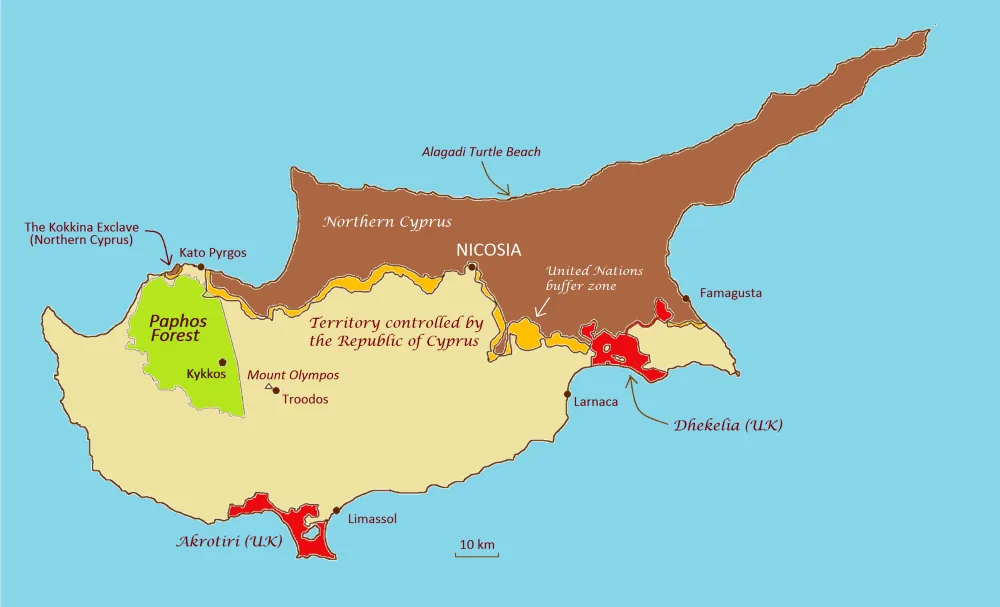
Cyprus—an island strategically anchored in the eastern Mediterranean merely forty miles off the southern coast of Turkey—remains one of the most intractable diplomatic stalemates of modern history. Demographically divided between a Greek Cypriot Christian majority in the south and a Turkish Cypriot Muslim minority in the north, competing nationalisms and deep historical animosities have transformed this picturesque island into a perennial fault line between Greece, Turkey, and NATO allies for over half a century.
Etymologically, the name Cyprus is widely traced to the island's abundant ancient copper deposits—rendered as Kypros in classical Greek—which fueled Mediterranean trade for millennia.
The 1958 Military Revolution in Iraq: Geopolitical Precedents
Colonial Legacy and the 1960 Independence Accords
Administered by Great Britain since 1878 following the Congress of Berlin, Cyprus witnessed escalating Greek Cypriot demands for self-determination and political union with Greece (Enosis). In the aftermath of World War II, this campaign assumed an armed dimension under the leadership of Colonel Georgios Grivas and the nationalist militant organization EOKA.
Terrified by the prospect of Greek hegemony, Turkish Cypriots rallied around the counter-demand of partition (Taksim). Attacks on Turkish Cypriot enclaves triggered severe retaliatory anti-Greek riots in Istanbul in September 1955, threatening a military conflagration between two key NATO partners. Seeking to defuse the Mediterranean powder keg, representatives from Britain, Greece, Turkey, and both Cypriot communities convened in London.
On February 19, 1959, the parties ratified the London-Zurich Agreements, establishing the constitutional architecture of the new Republic of Cyprus:
Beyond party rhetoric and television hyperbole lies the harsh calculus of South Asian geopolitics: why regime change in Kolkata exposes the collapse of regional buffer zones and strips the veneer from Delhi’s structural dominance over Bangladesh.
- Cyprus was granted full sovereign independence effective August 16, 1960.
- Executive governance was structured around an intricate power-sharing quota: a Greek Cypriot President and a Turkish Cypriot Vice President, with a 70:30 ratio across the legislature, civil service, and security forces.
- Great Britain retained two Sovereign Base Areas at Akrotiri and Dhekelia.
- Under the Treaty of Guarantee, Greece, Turkey, and the United Kingdom were designated guarantor powers, retaining the right to intervene to preserve the constitutional order, maintaining treaty garrisons of 950 Greek and 650 Turkish troops respectively.
Greek Cypriot nationalist leader Archbishop Makarios III was elected President, while Turkish Cypriot statesman Dr. Fazıl Küçük assumed the vice presidency.
Constitutional Breakdown and Intercommunal Strife
The consociational settlement quickly fractured under mutual suspicion. Greek Cypriots viewed the Turkish minority's veto powers as a recipe for institutional paralysis, while Turkish Cypriots feared that concessions would lead inexorably to Hellenic assimilation. In late 1963, President Makarios proposed the "Thirteen Amendments," seeking to strip the vice-presidential veto and alter municipal quotas.
Turkish Cypriots rejected the revisions as an unconstitutional usurpation. Armed clashes erupted during the "Bloody Christmas" of December 1963, forcing thousands of Turkish Cypriots into besieged rural enclaves. In March 1964, the United Nations Security Council dispatched a peacekeeping force (UNFICYP) under Resolution 186 to prevent full-scale war.
Moroccan Nationalist Mobilization and the Exile of Sultan Muhammad V
When Greek Cypriot paramilitary forces launched coordinated offensives against Turkish enclaves in late 1964, the Turkish Air Force intervened with warning airstrikes. Escalations were narrowly halted through intense American and UN mediation. In 1965, UN mediator Galo Plaza recommended an integrated unitary state with minority protections, but Ankara swiftly rejected the proposal, insisting that a bizonal federation was the only viable security guarantee.
Publish Your Research & Critical Analysis on MaroonPaper
Contribute in-depth essays on law, political philosophy, economics, and geopolitics to an intellectual readership.
Tensions spiked again in 1967 when Grivas's national guard units assaulted Turkish settlements, prompting Ankara to issue an invasion ultimatum. War was averted only when Washington pressured Athens to withdraw thousands of clandestine mainland Greek military personnel from the island.
The 1974 Coup and Turkish Military Intervention
By the early 1970s, Archbishop Makarios had abandoned immediate union with Greece in favor of non-aligned Cypriot sovereignty. This shift infuriated the right-wing military junta in Athens and EOKA-B militants, who branded Makarios a traitor. On July 15, 1974, the Greek junta orchestrated a violent military coup in Nicosia, toppling Makarios and installing hardline ultra-nationalist Nikos Sampson as president.
Recognizing the immediate peril to the Turkish Cypriot population and citing its legal obligations under the 1960 Treaty of Guarantee, Turkey launched Operation Atilla on July 20, 1974. Amphibious Turkish forces landed at Kyrenia, swiftly occupying approximately 37 percent of the island's northern territory.
The military catastrophe prompted the immediate collapse of both the Sampson puppet regime in Nicosia and the military junta in Athens. However, the island was permanently fractured along the "Green Line," resulting in massive demographic displacement: over 150,000 Greek Cypriots fled south, while approximately 45,000 Turkish Cypriots moved north.
Just two years after its triumph against Myanmar, Bangladesh secured another landmark verdict in the Bay of Bengal. An analytical deconstruction of the 2014 PCA arbitration in The Hague, equidistance vs. equity, South Talpatti Island, and the Blue Economy.
The 1983 Declaration of Northern Cyprus and Diplomatic Stagnation
Following a decade of sterile UN-sponsored negotiations, Turkish Cypriot leader Rauf Denktaş unilaterally proclaimed the Turkish Republic of Northern Cyprus (TRNC) on November 15, 1983. Ankara extended immediate diplomatic recognition; however, the UN Security Council passed Resolution 541, declaring the secession legally invalid and calling upon all member states to respect the sovereignty of the Republic of Cyprus.
How Sikkim Was Integrated into the Indian Union: Annexation and Geopolitics
Throughout the 1990s, high-level diplomatic initiatives pursued a bi-communal, bi-zonal federation. In 1991, US President George H.W. Bush advanced a comprehensive four-party framework between Athens, Ankara, and the two Cypriot communities, but conflicting security doctrines regarding Turkish troop presence stalled progress.
In 2004, the United Nations presented the Annan Plan—a comprehensive proposal to reunite the island prior to European Union accession. In twin simultaneous referendums, 65 percent of Turkish Cypriots voted in favor, while 76 percent of Greek Cypriots overwhelmingly rejected the plan, citing concerns over property restitution and transitional security. Days later, a divided Republic of Cyprus entered the European Union as a full member, leaving northern Cyprus in international isolation.
The Strait of Hormuz and Global Energy Geopolitics
Conclusion
Half a century after the 1974 partition, Cyprus remains a militarized, frozen conflict zone. The discovery of major offshore hydrocarbon reserves in the Levantine Basin has added a combustible economic dimension to existing geopolitical rivalries between Greece and Turkey. Achieving a lasting, equitable resolution requires dismantling zero-sum nationalist paradigms, demilitarizing the buffer zone, and forging a genuine power-sharing federal compromise that safeguards the fundamental rights and collective security of all Cypriots.
Dictatorship and Human Rights: The Ongoing Struggle for Freedom