
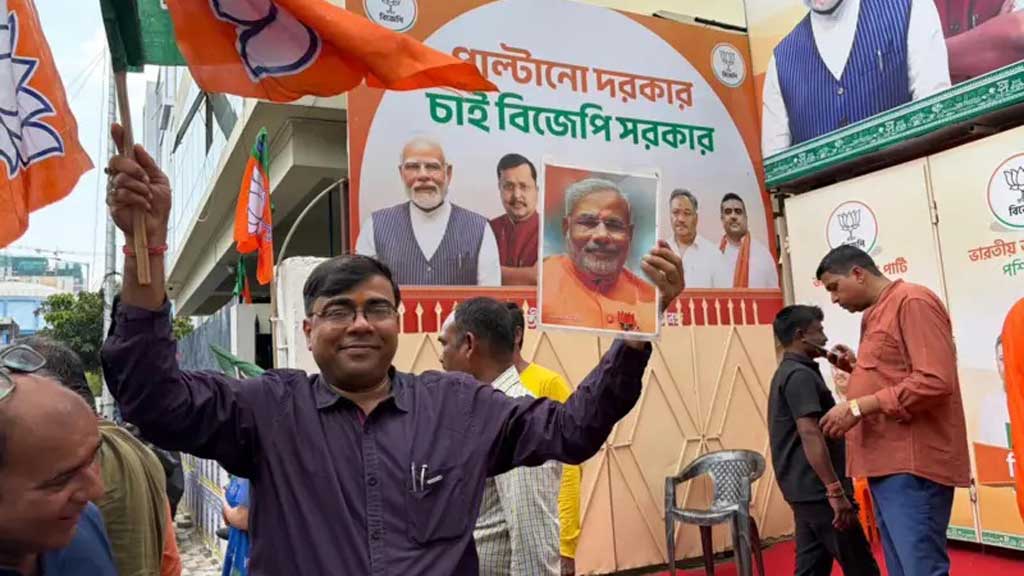
To those observers in Dhaka’s drawing rooms who lament electoral shifts in West Bengal as a catastrophic rupture for Bangladesh, a fundamental question must be posed: what tangible diplomatic benevolence did Bangladesh actually enjoy during Mamata Banerjee’s prolonged tenure? Did Kolkata deliver the long-delayed Teesta river water-sharing accord? Or did it offer the slightest guarantee against the lethal impunity of Indian Border Security Forces (BSF) gunning down unarmed Bangladeshi citizens along the frontier?
Strip away the performative talking points curated by corporate news networks. The alarmism coursing through sections of Bangladesh's political commentary regarding electoral realignments in Bengal is fundamentally misplaced. Whether governance is wielded from Delhi’s South Block or Kolkata’s Nabanna, India's grand strategy toward Bangladesh has remained remarkably consistent across party lines: economic extraction, political surveillance, and unyielding asymmetric hegemony.
Beneath the electoral theater lies a raw geopolitical reality that transcends the simplistic dichotomy of Hindutva versus secularism. It is time to look behind diplomatic euphemisms and assess what these realignments truly mean for Bangladeshi sovereignty.
Hollow Rhetoric of Friendship versus Structural Extraction
On international multilateral stages, New Delhi routinely characterizes its relationship with Dhaka as a "golden chapter" (Sonali Adhyay). Yet what is the empirical reality of this partnership? Is it genuinely golden, or has it been sustained at the expense of Bangladeshi rights and lives?
Examine the structural balance of payments: beneath rhetorical declarations of friendship lies an immense, perpetual bilateral trade deficit running into tens of billions of dollars. Bangladesh has been systematically cultivated into a captive market for Indian industrial goods. Conversely, whenever Bangladeshi competitive manufacturers attempt to export to India, they are met with non-tariff barriers, arbitrary bureaucratic hold-ups, and punitive anti-dumping duties.
Signed on August 7, 2026 between Saudi Arabia, Türkiye, and Pakistan, the Mecca Joint Defense Pact stipulates that an armed attack on one member shall be deemed an attack on all. For Bangladesh—confronting border casualties, unilateral riparian diversions, and transit imbalances—a collective deterrence architecture restores sovereign bargaining leverage.
Nowhere is this coercive asymmetry more visceral than at the border. The Bangladesh-India border remains one of the most lethal peacetime frontiers on earth. The routine shooting of impoverished villagers—symbolized indelibly by the tragic hanging of young Felani Khatun’s body on barbed wire in 2011—reveals the brutal reality behind diplomatic handshakes. Routine formal diplomatic protests and "flag meetings" function merely as performative rituals while lethal shootings persist unabated.

In hydropolitics, flouting basic international riparian norms, upstream dams unilaterally divert river waters during arid dry seasons while opening floodgates during peak monsoons, inundating downstream delta communities. The Teesta treaty remains indefinitely shelved—an eternal diplomatic carrot dangled to extract strategic concessions.
Whether the BJP or Trinamool governs Bengal, Bangladesh remains the designated subaltern in India’s strategic transit aspirations to connect its isolated Northeastern states.
Publish Your Research & Critical Analysis on MaroonPaper
Contribute in-depth essays on law, political philosophy, economics, and geopolitics to an intellectual readership.
The Hegemonic Facade: Shielding Autocracy
Consider the glaring moral contradictions of Indian policy. While presenting itself to Western capitals as the "world's largest democracy," New Delhi spent fifteen years providing unconditional diplomatic, intelligence, and logistical support to Sheikh Hasina's brutal authoritarian regime in Dhaka. Why? Because a genuinely democratic, constitutional, and sovereign government in Dhaka represents an insurmountable obstacle to regional hegemony.
Delhi sought a dependent client state incapable of articulating an independent foreign policy—a subordinate territory facilitating transit corridors to India’s "Seven Sisters" while receiving zero reciprocity on core national interests. When the historic July-August student-mass uprising toppled that autocratic edifice in 2024, the Indian establishment's immediate reaction was to grant political asylum to the fallen dictator whose hands were stained with the blood of over a thousand youth. This reflex made it transparent that New Delhi was never interested in Bangladeshi democratic stability, but solely in protecting its compliant proxies.
Domestic Rhetoric and Bilateral Hypocrisy
The cynical nature of Indian statecraft is on full display during domestic electoral campaigns. While ruling party politicians regularly mobilize communal voters by branding Bangladeshi migrants as "infiltrators" (ghuspaithiye) and "termites," the foreign ministry concurrently demands unhindered transit privileges through Bangladeshi territory. The National Register of Citizens (NRC) and Citizenship Amendment Act (CAA) were weaponized to foster communal polarization at home, even as Delhi sought naval access across the Bay of Bengal.
The established intellectual elite, business oligarchs, senior civil-military bureaucracy, and Delhi's deep state viewed Dr. Yunus's sovereign worldview as an insolent breach of clientelism. An unsparing examination of why the Gen Z July Revolution has permanently reshaped Bangladesh's political destiny.
The Dissolution of the Regional "Buffer Zone"
Historically, Delhi operated a cynical "good cop, bad cop" strategy regarding bilateral deadlocks. Whenever Dhaka pressed for the signing of the Teesta agreement, the central government conveniently deflected culpability onto Kolkata: "The Centre is willing, but Mamata Banerjee opposes."
A unified political landscape in Bengal removes that convenient procedural shield. The comfortable buffer zone between Delhi's strategic calculations and Kolkata's provincial politics evaporates. A monolithic power structure in eastern India will either be forced to deliver on long-stalled riparian pacts or demonstrate unequivocally that resistance was never merely provincial, but anchored in central strategic indifference.
An Isolated Hegemon in South Asia
Crucially, India’s strategic posture must be understood in the context of its profound regional isolation. Its vaunted "Neighborhood First" policy has collapsed across the subcontinent:
- The Maldives and Sri Lanka: In Malé, the triumphant "India Out" platform forced the evacuation of Indian military personnel, while Colombo has increasingly diversified its security and economic partnerships.
- Bangladesh: With the collapse of Hasina’s regime, New Delhi lost its most compliant client state in South Asia.
- Nepal: Kathmandu has decisively rejected Indian micro-management, issuing revised maps asserting sovereignty over Kalapani and Lipulekh while cementing multi-billion-dollar transit and energy agreements with Beijing.
Having alienated virtually all its neighbors, New Delhi faces strategic claustrophobia. This humiliation creates the temptation to resort to economic coercion and cross-border disinformation campaigns against Bangladesh in a desperate bid to demonstrate that the region cannot function without Indian arbitership.
Conclusion: The Imperative of Strategic Autonomy
In the brutal arena of international relations, a weak neighbor possesses no genuine allies. India is neither an altruistic friend nor an eternal benefactor; it is a calculating regional power pursuing self-interest. To Delhi, Bangladesh has too often been viewed merely as a security perimeter, a transit route, and an economic captive market.
Rather than obsessing over electoral outcomes across the border, Dhaka's strategic imperative is clear: constructing a resilient, sovereign national consensus, diversifying diplomatic and defense partnerships across East Asia and the Islamic world, and instituting an unyielding defense posture. History offers no concessions to compliant satellite states; sovereign dignity is earned only by those prepared to defend it.