
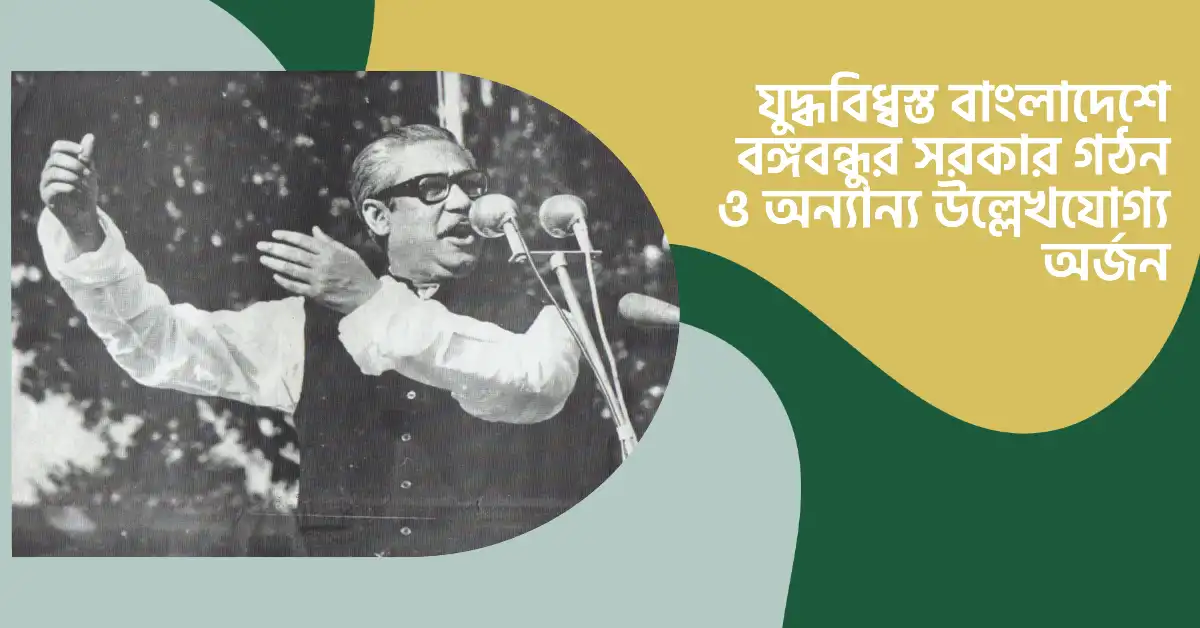
The Formation of Bangabandhu’s Government and Key Milestones in War-Torn Bangladesh
During the Liberation War, the Pakistani military razed millions of homes, thousands of administrative buildings, primary schools, secondary schools, madrasas, and hundreds of colleges and rural markets. They systematically dismantled the nation’s communication infrastructure, destroying hundreds of bridges, both road and rail. In such a climate, the colossal challenges facing the newly liberated nation included the rehabilitation of nearly ten million refugees, the reconstruction of countless ruined village dwellings, and the provision of food, clothing, education, medical care, and housing for seventy-five million people—all while simultaneously restoring law and order. To confront these crises, Bangabandhu, upon his release from Pakistani incarceration on January 10, 1972, traveled via a special Pakistani aircraft to London, before eventually returning to Dhaka following a brief stopover in New Delhi, India. Bangabandhu.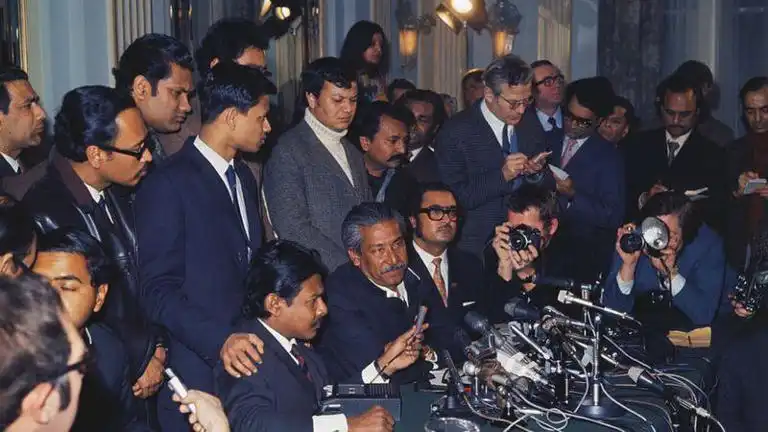
The Framing of the Constitution under a Parliamentary System
On January 11, 1972, President Sheikh Mujibur Rahman promulgated a "Provisional Constitution Order," establishing a parliamentary system. On January 12, he took the oath as Prime Minister. On April 11, 1972, a 34-member committee, chaired by then-Law Minister Dr. Kamal Hossain, was formed to draft a constitution. The draft, presented by Dr. Hossain, was adopted by the Constituent Assembly on November 4, 1972, and came into force on December 16. The core pillars of the document were democracy, socialism, secularism, and nationalism. The Constitution codified universal suffrage, fundamental rights, and the recognition of the political, economic, and social rights of all citizens.Sheikh Mujibur Rahman: The Architect of Bangladesh
The Constituent Assembly
On March 23, 1972, Bangabandhu issued an order establishing the "Constituent Assembly of Bangladesh." By this mandate, members elected to the national and provincial assemblies in the 1970 elections were recognized as members of the Constituent Assembly. On April 19, 1972, the assembly held its first session, facilitating the passage and implementation of necessary legislation for the nation.Nationalization of Industry
The Pakistani government had prioritized capitalist development, leaving financial and industrial institutions to the private sector, which fostered severe economic disparity. Following independence, as Pakistani and Indian industrialists fled the country, the Bangabandhu government, acting to secure the rights of the common people, nationalized approximately 85 percent of the country’s industrial base under the Bangladesh Nationalization Order, 1972.Developments in Education
During the Pakistani era, primary school teachers received negligible compensation. Bangabandhu nationalized approximately 38,000 primary schools, thereby assuming state responsibility for primary education. On July 26, 1972, he formed an Education Commission led by the scientist Dr. Qudrat-e-Khuda, which in 1974 presented a roadmap for a people-oriented, science-based education policy. Furthermore, in 1973, his government passed the University Act to grant autonomy to public universities.Reconstruction and Rehabilitation
The emergency reconstruction of bridges destroyed during the war restored the nation's communication network to a satisfactory state by 1974. Key infrastructure, including the Hardinge Bridge, was restored to service. The government also prioritized aviation, initiating international routes and refurbishing the Tejgaon Airport. As the administrative structure had collapsed, the government undertook the difficult task of rehabilitation, distributing relief supplies from the village level to the district level via the Red Cross Society, and managing the distribution of foreign aid, blankets, and food to affected families.The 1973 General Election
The first general election in independent Bangladesh was held on March 7, 1973. The Bangladesh Awami League won 306 out of 315 seats, including the seats reserved for women. This paved the way for the second term of the Bangabandhu government.Uncovering the Agartala Conspiracy Case: A Political Conspiracy against Bangladesh!
The Transition to a Presidential System
On January 25, 1975, through the Fourth Amendment to the Constitution, a presidential system was introduced. In this model, the national parliament lost its effective power, as the President was granted the authority to appoint and dismiss the Vice President, Prime Minister, and other officials. Additionally, the President was empowered to dissolve all other political parties and form a single national political platform. On February 24, 1975, Bangabandhu dissolved all existing parties to establish the Bangladesh Krishak Sramik Awami League (BAKSAL). However, BAKSAL cannot strictly be labeled a "political party" in the conventional sense, as it was established through a constitutional mandate.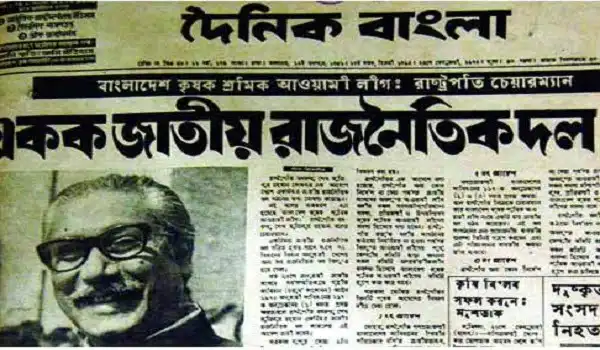
A Powerless Parliament
The Fourth Amendment to the Constitution introduced several controversial provisions unprecedented in other presidential systems.2 Unlike the American model, which limits a president to two terms, the Bangladeshi amendment allowed the President to serve for an unlimited duration. Furthermore, removing the President now required a 2/3 majority to introduce a motion and a 3/4 majority to pass it—effectively rendering removal impossible. The original Constitution, in Article 80,3 dictated that the President must assent to a bill within 15 days or return it to Parliament for reconsideration. If the bill was passed again, it became law. The Fourth Amendment, however, granted the President the power to withhold assent indefinitely, preventing any bill from becoming law—a provision fundamentally at odds with the spirit of a presidential system.4 Moreover, the Fourth Amendment stripped the High Court Division of its power to enforce fundamental rights, prevented members of parliament from switching parties or voting against their own, and curtailed the independence of the judiciary, actions that were explicitly contrary to the tenets of a democratic presidential framework.The 6-Point Charter: The Foundation of Bengali Emancipation and its Significance for Independence