
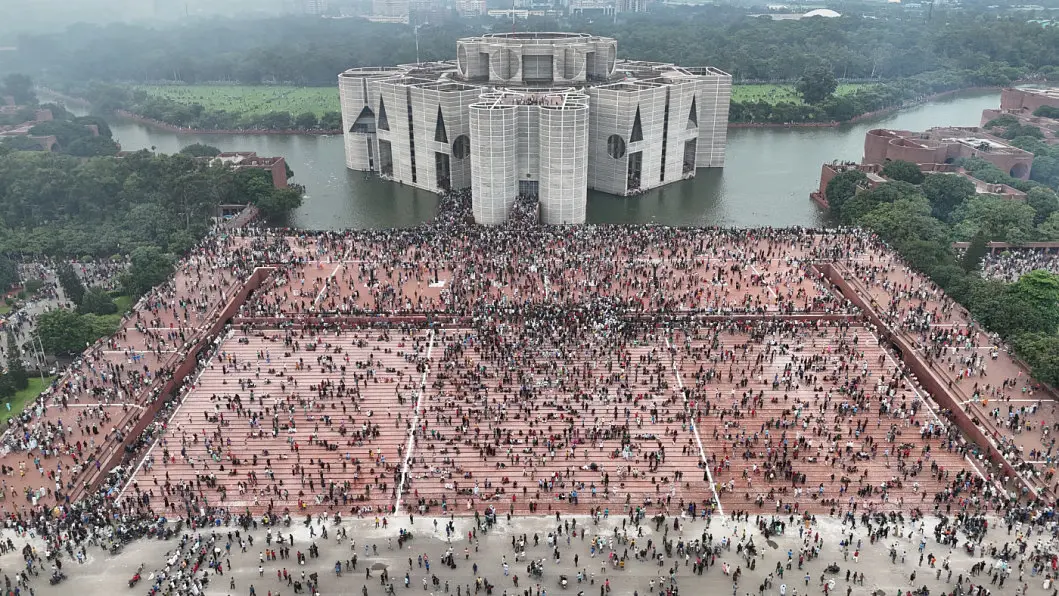
The Backdrop to the July Uprising
Although Bangladesh ostensibly embraced democratic ideals following its independence, the return of the Awami League to power in 2009 heralded an era where, under the stewardship of Sheikh Hasina, the democratic rights of the populace were progressively curtailed, transforming the nation into an autocracy. Freedom of speech was dismantled, political dissenters faced relentless persecution, and democratic values were systematically discarded, from the judiciary down to the administrative machinery. The electoral process became the primary target for the dismantling of democracy. Beginning with the non-participatory election of 2014 and culminating in the "midnight vote robbery" of 2018, every maneuver acted as a nail in the coffin of democracy. Transparency International Bangladesh (TIB) famously characterized these as "voterless elections." Fabricated cases against political opponents, extrajudicial killings, and enforced disappearances became the standard arsenal of a regime operating as an occupying force. Reports from Human Rights Watch and international media underscored that Bangladesh’s human rights landscape was in terminal decline, marked by "extrajudicial killings" and disappearances. The imposition of draconian censorship, the weaponization of the Digital Security Act, and Bangladesh’s descent to 163rd position out of 180 countries in the Reporters Without Borders World Press Freedom Index serve as stark testaments to this suppression. Rampant corruption, capital flight, casino scandals involving the political elite, and stock market manipulation—the state was engulfed in total criminalization. According to Transparency International, Bangladesh’s standing in the corruption perception index plummeted continuously. Hasina transformed power into a fortress for the corrupt, shielded by a Praetorian guard of loyalists. She fostered a cabal of kleptocrats whose only mandate was the protection of her regime, punishing any who dared to question the rot. The Halishahar casino scandal, the corruption surrounding the Padma Bridge project, systematic bank looting, and the volatility of the stock markets were merely symbolic symptoms of this malignancy. The education system, too, was decimated by the specter of partisan politics. The reign of terror perpetuated by the Chhatra League and the policy of "auto-pass" obliterated the future of students. The 2023 HSC results, in which over 90% of students achieved a GPA-5, were regarded by academics as a statistical fiction. Consequently, unemployment reached catastrophic proportions. According to the Bangladesh Bureau of Statistics, the youth unemployment rate surged from 5.5% in 2023 to nearly 10%—a figure far more conservative than reality. Most chilling, however, was the auctioning of national interests. Hasina reduced Bangladesh to a client state of India. From the failure to secure a Teesta water-sharing treaty and silence on the NRC-CAA issue, to the border agreements and the granting of transit rights for Indian goods, every action stood in stark opposition to the national interest. Voting in favor of India at the United Nations served as the final igniter for a populace already simmering with resentment.The History of the July Uprising: From Quota Reform to National Insurgence
The 2018 quota movement served as the prologue to the history of the July Uprising. Sparked at Dhaka University, the protests against discriminatory quotas in government jobs saw students and the public flood the streets. Faced with this irrepressible fervor, the government was forced to abolish a 46-year-old system. However, when a High Court ruling on June 5, 2024, declared that decision illegal, the fire was rekindled. In July, the movement intensified through the "Bangla Blockade." The death of student Abu Sayed by police gunfire in Rangpur imbued the struggle with a new, somber resolve. A comment made by Hasina on July 14 further inflamed the situation: > "If the grandchildren of freedom fighters do not get quotas, should they then be given to the grandchildren of Razakars?" The protest against this slur resonated across the country from the dawn of July 15: > "Who are you? Who am I? Razakar, Razakar! Who said that? Who said that? Autocrat, Autocrat!" On government orders, all educational institutions were closed on July 16. Yet, as private university students in Dhaka took to the streets, violent clashes erupted in areas such as Rampura, Kuril, and Mohakhali. Although the Appellate Division ordered a 93% merit-based recruitment policy on July 21, the movement had long since transcended the issue of quotas, evolving into a clarion call for the restoration of democracy. On that day, students from Primeasia University, BRAC University, and East West University engaged in intense confrontations with law enforcement in the Rampura area. Simultaneously, students from AIUB, North South University, Independent University Bangladesh, Dhaka International University, and UIU protested on the Kuril Bishwa Road and Pragati Sarani. Concurrent demonstrations were mounted by students from Ahsanullah University of Science and Technology, Bangladesh University of Textiles, Southeast University in Mohakhali, and Northern University in Uttara.