
The Genesis of the United Front
Following the birth of Pakistan, the West Pakistani elite embarked on a campaign of institutionalized injustice against the residents of East Bengal. The authoritarian policies of the Muslim League, most notably the imposition of Section 144 during the 1952 Language Movement and the subsequent police firing that claimed the lives of Salam, Barkat, Rafiq, Jabbar, and others, fueled the flames of dissent. In retrospect, the 1954 election was the inevitable culmination of these years of unrest. After independence, the Provincial Legislative Assembly Act of 1947 allowed representatives from the former undivided Bengal to continue as members of the East Bengal Legislative Assembly. While general elections were promised for 1953, the Muslim League government resorted to procrastination and pretexts, eventually passing the East Bengal Legislative Assembly Act, 1953. Under pressure, the government announced that elections would be held in March 1954 based on universal adult suffrage.What is America’s Blackwater? How does it terrorize the World?
In an attempt to end this exploitation, the Youth League first proposed an opposition coalition in September 1952. By November 14, 1953, formal talks at the Awami League offices gained momentum, drawing interest from the Krishak Praja Party, Nizam-e-Islam, Khilafat-e-Rabbani, the Youth League, the Ganatantri Dal, and the Communist Party.Formation of the United Front
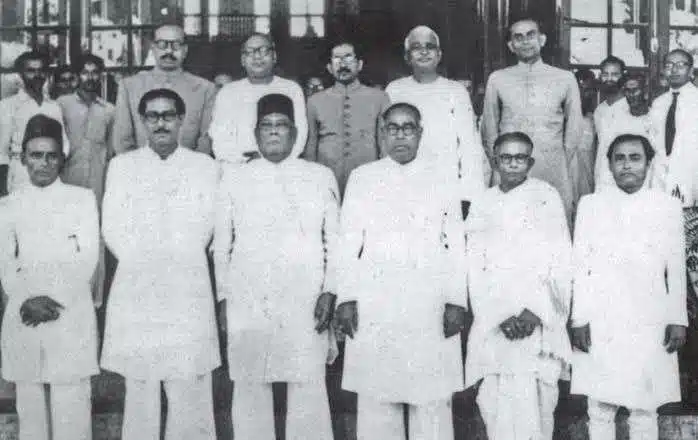
Recognizing the existential urgency of the moment, opposition leaders solidified their alliance on November 14, 1953. Prominent figures—including Maulana Bhashani, Sher-e-Bangla A.K. Fazlul Huq, and Huseyn Shaheed Suhrawardy—orchestrated a coalition to challenge the Muslim League. This alliance, known as the United Front, comprised:- The Awami Muslim League, led by Maulana Bhashani;
- The Krishak Sramik Party, led by Sher-e-Bangla A.K. Fazlul Huq;
- Nizam-e-Islam, led by Maulana Athar Ali;
- The leftist Ganatantri Dal, led by Haji Mohammad Danesh and Mahmud Ali; and
- The Pakistan Ganatantri Dal.
The Backdrop of the 1958 Iraqi Military Revolution
A retrospective of European historiography reveals that, while the continent languished in the medieval depths of superstition, squalor, and intellectual stagnation, the Iberian Peninsula served as a luminous beacon of civilization. It was within this crucible that the Muslim architects of the region forged the enduring, multifaceted heritage of Al-Andalus.
The Twenty-One Point Program
The United Front announced a twenty-one-point manifesto, championed by Huq, Suhrawardy, Bhashani, Danesh, and Sheikh Mujibur Rahman. This program resonated deeply with the Bengali electorate. Its core demands included:- Recognizing Bengali as one of the state languages of Pakistan.
- Abolition of the Zamindari system without compensation, with surplus land redistributed to landless peasants.
- Nationalization of the jute industry and ensuring fair prices for jute farmers.
- Promotion of cottage and labor-intensive industries through cooperatives.
- Establishment of salt factories on the coast to achieve self-sufficiency, and rehabilitation for salt workers.
- Implementation of irrigation and canal-digging projects to mitigate floods and famine.
- Industrialization of East Bengal through scientific methods, ensuring financial and job security for laborers.
- Introduction of free and compulsory primary education and equitable pay for teachers.
- Reorganization of the secondary education system and instruction through the mother tongue.
- Granting autonomy to Dhaka University and repealing restrictive laws.
- Drastic reduction in administrative costs and the implementation of a salary cap for ministers at 1,000 rupees.
- Eradication of corruption and nepotism through the mandatory declaration of assets by government officials since 1940.
- Release of all political prisoners detained under the Public Safety Act and ensuring freedom of the press and assembly.
- Separation of the judiciary from the executive.
- Conversion of the Chief Minister’s residence, "Bardhaman House," into a student dormitory and later a research center for the Bengali language.
- Construction of a monument to the language martyrs and compensation for victimized families.
- Declaring February 21 as "Shaheed Day" (Martyrs' Day) and a public holiday.
- Full regional autonomy for East Bengal based on the Lahore Resolution; the center to retain only defense, foreign affairs, and currency. Relocation of the Naval Headquarters to East Bengal.
- No extension of the legislative term; the cabinet must resign six months before the expiration of their term to facilitate free and fair elections.
- Mandatory by-elections for vacant seats within three months; if a United Front candidate loses three consecutive by-elections, the cabinet must resign.
Is Modi scared of India’s textbook history?
Publish Your Research & Critical Analysis on MaroonPaper
Contribute in-depth essays on law, political philosophy, economics, and geopolitics to an intellectual readership.
The 1954 Election
The East Bengal Legislative Assembly elections took place between March 8 and 12, 1954, under the Government of India Act, 1935. The United Front’s symbol was the "boat," while the Muslim League’s was the "hurricane lamp." United Front leaders campaigned across the province, exposing the failures of the Muslim League. They highlighted the sacrifices of the 1952 Language Movement and the soaring prices of essential goods like salt and rice. Within a short span, the coalition gained the unwavering support of laborers, farmers, professionals, intellectuals, and the middle class, all united in their resolve to topple the regime.Major Oil Fields of the Middle East and Dr. Mosaddeq’s Role in Nationalizing Iran’s Oil Industry
Widely recognized as one of the world's inaugural written constitutions, the Charter of Medina serves as a seminal historical document, establishing foundational precedents for the Islamic state, religious pluralism, and the architecture of social cohesion.
Election Results
Out of an electorate of over 19 million, 37.19% cast their votes. The United Front achieved a resounding victory in the Muslim-majority seats.| East Bengal Provincial Election | Muslim Seats | Non-Muslim Seats | Total Seats |
| Seats | 237 | 72 | 309 |
| United Front Wins | 223 | 13 | 236 |

How Sikkim became a part of India?
Significance of the 1954 Victory
The 1954 election was a watershed moment in Pakistani history:- Unified Public Mandate: The election provided the first opportunity for the populace to collectively register their rejection of central discrimination.
- Dawn of Bengali Nationalism: The momentum from the 1952 Language Movement solidified here, setting the course for the eventual establishment of a sovereign Bangladesh.
- Political Consciousness: It broke the Muslim League’s monopoly on power, catalyzing active political engagement among the masses.
- End of Autocratic Rule: The defeat forced the termination of the Muslim League's unilateral grip on provincial affairs.
- The Collapse of the League: It demonstrated that Muslim League legislators no longer represented the interests of their constituents.
- A Catalyst for Constitutional Reform: The United Front pushed for a newly elected Constituent Assembly to draft a democratic constitution.
- The Emergence of a True Opposition: The victory marked the rise of the Awami League as a credible, organized opposition force.

Is the USA a Leading Terrorist State?
Beyond these points, the victory fostered the growth of secularism, empowered East Bengal's political identity, and elevated the status of the Bengali language. While the government was short-lived due to central hostility and internal fractures, the election was an irreversible step toward the independence of Bangladesh.Causes of the Muslim League’s Defeat
The collapse of the Muslim League in 1954 can be attributed to several factors:- Language Policy: Persistent refusal to recognize Bengali as a state language alienated the entire population.
- Systemic Exploitation: The regime's record of economic and social discrimination was a primary driver of public fury.
- Neglect of the Lahore Resolution: The failure to grant the promised provincial autonomy.
- Constitutional Stagnation: Chronic delays in the drafting of a national constitution.
- Institutional Alienation: Widespread resentment among students, youths, and all strata of society.
- Leadership Deficit: The absence of visionary leadership within the League.
- Internal Factionalism: Organizational weakness caused by incessant power struggles.
- Bureaucratic Intransigence: The dominance of West Pakistani bureaucrats who viewed East Bengal as a colony.
- Economic Failure: The uncontrolled inflation and the spiraling costs of essential goods.
- Electoral Deferral: Repeatedly delaying the promised 1951 elections created a perception of illegitimate governance.
Freedom of Expression and its Boundaries
The victory of the United Front in 1954 was not merely an electoral upset; it was a profound act of resistance. It laid the ideological foundations for the struggles that would follow, culminating in the nine-month War of Liberation and the glorious birth of Bangladesh on December 16, 1971.