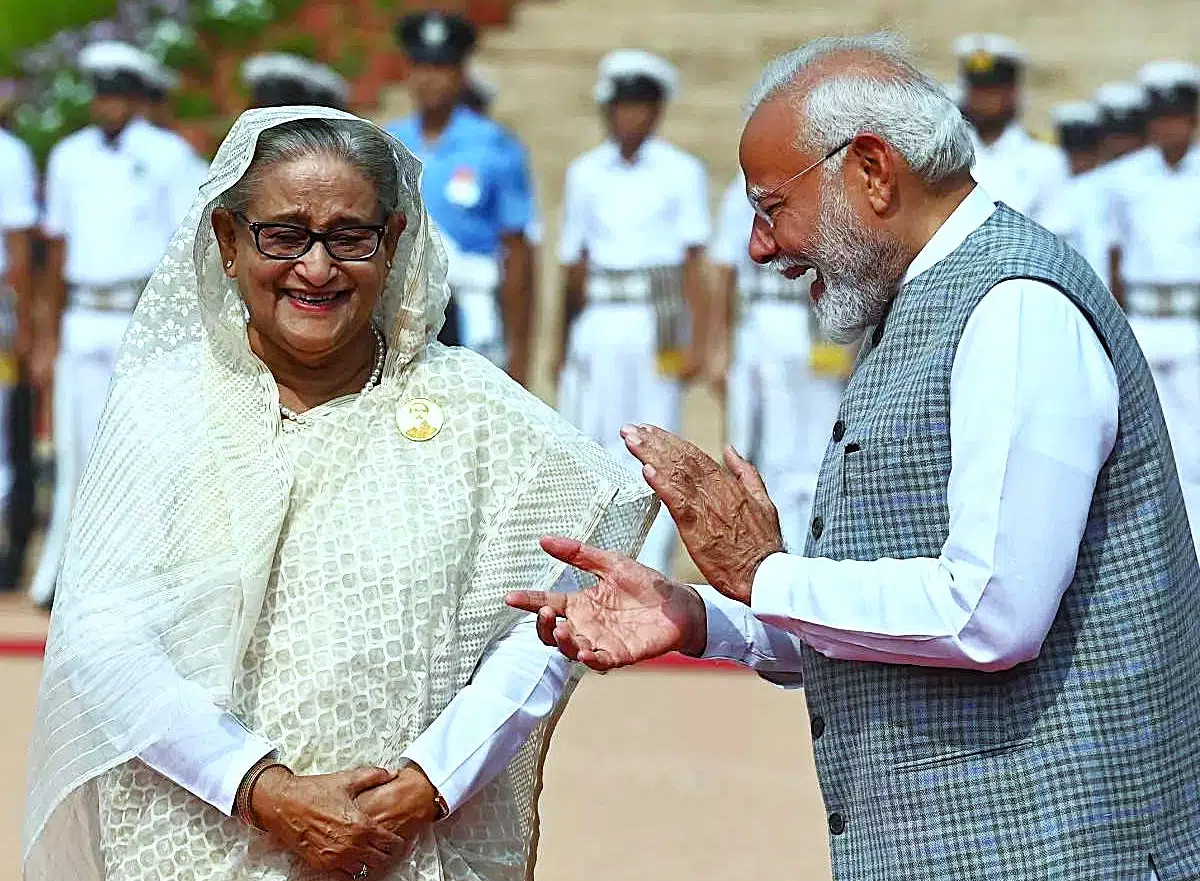
In the wake of Sheikh Hasina’s ouster in Bangladesh, the Indian state apparatus and its associated media organs have been fervently engaged in fabricating a narrative of 'Hindu persecution,' leveraging disinformation and propaganda to color the transition.
Since the collapse of Sheikh Hasina’s administration in Bangladesh, the Indian state apparatus and its media proxies have been scrambling to manage the fallout. Having long viewed Hasina as their primary strategic linchpin, New Delhi has responded to her ouster by manufacturing a narrative of "Hindu persecution" through a calculated campaign of disinformation. In the wake of the regime's collapse, a broad-based popular uprising targeted the architects and enforcers of fifteen years of authoritarian rule; among those held accountable were individuals from the Hindu community who were complicit in the regime’s abuses. Yet, Indian media outlets have systematically stripped these individuals of their political identities, reframing them exclusively as victims of communal violence. These biased reports are clearly intended to court Western sympathy by weaponizing the issue of minority rights.
Far-right Hindu organizations across the United States, Canada, and the United Kingdom have amplified this propaganda, fomenting confusion and spreading misinformation within Western civil society. In stark contrast, international outlets such as *Voice of America* have reported that under the interim government led by Dr. Muhammad Yunus, Bangladesh’s Hindu population is more secure and confident than ever. From its inception, this administration has prioritized the establishment of a secure environment for all communities. It is the mendacity of the Indian media that serves as the primary source of instability, artificially stoking fear and tension among Bangladeshi Hindus.
The situation was further inflamed by the arrest of Chinmoy Das, a Hindu hardline leader, on charges of sedition. In response, Awami League loyalists and extremists attempted to incite a communal backlash by murdering a Muslim lawyer in Chittagong. However, the tragedy did not yield the desired sectarian chaos; the victim’s grieving father called for restraint, and both Hindu and Muslim communities acted with commendable maturity, upholding communal harmony.
Facing months of relentless hostility from Indian media, university students in Dhaka engaged in symbolic protests by painting the Indian flag on the floors of their campus gates. The backlash was instantaneous: Indian media launched a coordinated anti-Bangladesh campaign, while violent mobs in Kolkata burned Bangladeshi flags and an attack was carried out on the Bangladesh Consulate in Agartala.
Indian social media platforms continue to disseminate forged news and distorted imagery to validate the false narrative of Hindu persecution in Bangladesh. The goal is clear: to weaponize Islamophobia and provoke violence against Muslims. Pro-Hasina figures within the Hindu community are frequently used as pawns in these staged provocations, providing fodder for sensationalist headlines in Indian media.
This desperation reflects the sheer scale of India’s political investment in the Hasina regime. Driven by a deluded sense of regional hegemony, New Delhi has found itself increasingly isolated from neighbors like Nepal, Bhutan, the Maldives, Sri Lanka, and Pakistan. Bangladesh was the final holdout in this sphere of influence, a status that shattered on August 5. The erratic reporting of the Indian press now exemplifies a "two-faced journalism"—sensationalist, performative, and entirely unmoored from reality.
Muskan Khan’s Hijab and the Secularism of India
Within its own borders, the BJP-led government is actively promoting a militant Hindu agenda. The judiciary has lent its weight to irrational claims, such as the demand that ancient Mughal-era mosques be surrendered on the premise that they sit atop pre-Islamic temples. Similar revisionist campaigns have targeted the historic Ajmer Sharif Dargah. This obsession with "restoring" temples has only served to intensify violence and state-sponsored Islamophobia. While the Indian media busies itself with meddling in Bangladeshi internal affairs, four Muslim youths were recently lynched by Hindu extremists in India. Furthermore, the performative hypocrisy of banning the consumption of beef for religious reasons, while simultaneously remaining one of the world's largest beef exporters, exposes the deep contradictions at the heart of the modern Indian state.
In this context, India’s posturing as a defender against radicalism in Bangladesh is nothing short of hypocritical. Under the Hasina regime, social fragmentation was deliberately cultivated to maintain power, with both Muslim and Hindu extremist elements being utilized as tools of the state’s propaganda apparatus. Her departure has revealed a more unified Bangladesh, one where diverse communities have rejected the politics of extremism.
Secular India and the Nature of its so-called Secularism
The myth of Hasina as the sole bulwark against radicalism has evaporated. Today, both Hindu and Muslim communities in Bangladesh are united in their demand for justice and accountability. Consequently, the dream of maintaining Bangladesh as an informal colony has crumbled, and India’s current frustration is merely the death rattle of that failed ambition.
The future of relations between India and Bangladesh must not be defined by colonial-era posturing, but by mutual respect and cooperation. Only by abandoning the quest for dominance in favor of true equality can these two neighbors move toward a constructive and stable future.
Original text: Maskwaith Ahsan
Rakibul Islam
Author & Contributor, MaroonPaper
Contributing insightful research and analytical essays on law, politics, history, and international affairs for MaroonPaper.