
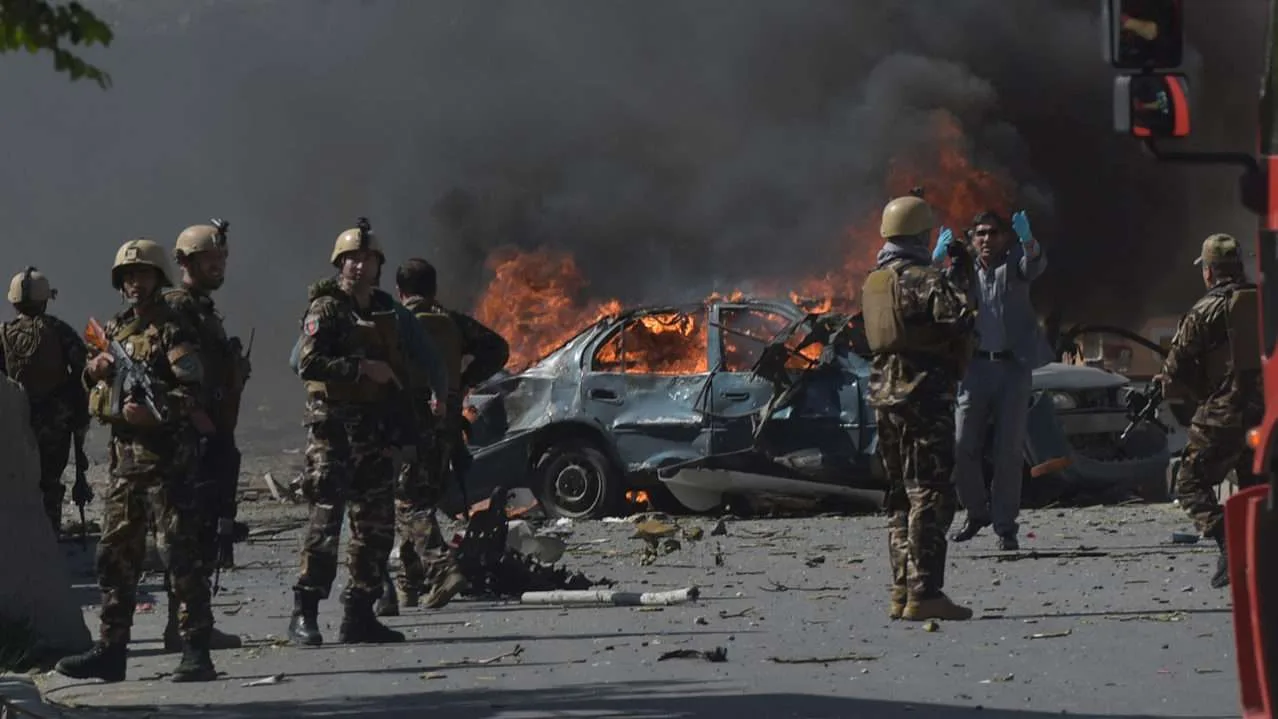
The 9/11 attacks could have been treated as a crime—a response both rational and consistent with legal precedent. When a law is broken, we seek to bring the perpetrators to justice rather than declaring war on the parties involved. When the IRA detonated bombs in London, no one called for airstrikes on West Belfast or Boston, the latter being a significant source of funding for the organization. When it was proven that white supremacists affiliated with ultra-right-wing militias were responsible for the Oklahoma City bombing, there were no calls to level Idaho or Montana. Instead, the perpetrators were pursued, located, arrested, brought to trial, convicted, and punished.
The Bush administration chose a different path. Rather than identifying, prosecuting, and punishing the culprits—and the culprits alone—it hastily launched a "Global War on Terror," a project that would ultimately claim millions of lives.
In the immediate aftermath of the attacks, the Bush administration demanded that the Taliban turn over Osama bin Laden. The Taliban offered to place bin Laden on trial provided the United States produced evidence of his culpability. Bush refused. He rejected any consideration of the Taliban's offer to hand bin Laden over to a neutral third-party country. He insisted there was no room for negotiation, offered no evidence (as he had none at the time), and refused all dialogue. As historian Carter Malkasian noted, Bush gave Secretary of State Colin Powell "no instructions to explore diplomatic avenues to avoid war."
Indeed, well before 9/11, the Taliban had offered to hand bin Laden over to a "neutral international body," yet the U.S. government showed no interest. Milt Bearden, the CIA station chief who oversaw covert operations in Afghanistan in the 1980s, told the Washington Post that the Taliban had long signaled a desire to be rid of bin Laden and were willing to assist in his capture, but the U.S. responded only with threats. The relationship between the Taliban and al-Qaeda was, in reality, quite fraught; the Taliban had, on various occasions, placed bin Laden under house arrest.
Read More: Noam Chomsky on the Refugee Crisis
Days after 9/11, rather than engaging in extradition talks, Washington demanded that Pakistan cut off food convoys and essential supplies to the Afghan people, effectively triggering a humanitarian catastrophe that placed millions at risk of starvation. Despite vociferous warnings from aid organizations regarding the impending humanitarian disaster, the Bush administration proceeded with its bombing campaign, showing a callous disregard for the Afghan civilian population.
In the first week of October 2001, Bush launched "Operation Enduring Freedom," unleashing a barrage of cruise missiles and long-range bombers to dismantle the Taliban government. Bush claimed the attacks were "carefully targeted" and declared that "the Taliban will pay a price." This approach flew in the face of counter-terrorism experts who advised against immediate, blunt-force military retaliation, favoring instead "police work and discretion." In Foreign Affairs, military historian Michael Howard proposed that the appropriate response would have been an international police operation under UN auspices to bring the criminal conspiracy to justice. However, according to neocon writer Robert Kagan, Bush was explicitly "looking to exact revenge." Colin Powell reportedly observed that the president "wanted to kill someone." Indeed, on September 20, Bush told religious leaders in the Oval Office: "I have trouble suppressing my bloodlust." Against one of the poorest nations on earth, the U.S. deployed F-15E Strike Fighters, carrier-based F-18s, B-2 stealth bombers, and 40-year-old Vietnam-era B-52s. The AC-130 Spectre gunship, equipped with a 150mm cannon, 25mm Gatling guns, and a 40mm cannon, functioned as a flying battery of artillery, complemented by the newly introduced Predator drones. Soon, the U.S. was running out of targets, as the Taliban possessed very little infrastructure to strike. (Middle East correspondent Patrick Cockburn noted in 2009: "Americans never explain why they are using weapons designed for World War III against villages that have barely reached the Middle Ages, making high civilian casualties inevitable.")
Once the bombing commenced, the Taliban proposed fresh negotiations regarding bin Laden’s handover, provided the U.S. ceased its aerial assault—dropping their initial demand for evidence. The Taliban condemned the strikes as terrorist acts; many, undoubtedly, were, and civilian death tolls soon rivaled those of 9/11. By late October, a Human Rights Watch report highlighted the harrowing aerial bombardment of remote villages, where residents insisted no Taliban or al-Qaeda presence existed. In one "carefully targeted" strike, a 40-year-old mother lost her husband and six children. U.S. strikes even hit UN and Red Cross facilities, killing workers and destroying the only facility providing food and blankets to 55,000 disabled Afghans—despite the U.S. being pre-informed of their exact coordinates.
Sarah Chayes, a former NPR reporter who covered the war from Afghanistan, observed that the "bombing was traumatizing the very civilians it was ostensibly meant to liberate."
“The Afghan refugees I interviewed every day could think of nothing else and speak of nothing else. Their hearts had been broken by decades of shelling and explosions, but they had never seen anything like the way this bombing campaign was tearing their country apart. Having no experience with 'precision weapons,' they were driven nearly mad by fear, their imaginations filled with memories of fragmented carnage.”
Chayes wrote, "I heard the same plea every day: for the love of God, tell President Bush to stop the bombing." However, the U.S. media proved unwilling to broadcast such accounts; one CNN correspondent told her they had received explicit instructions not to air footage of civilian casualties, while an NPR editor accused Chayes of "promoting Taliban propaganda," asserting her sources must be "pro-bin Laden."
The indiscriminate killing of innocent civilians is not a tactic against terrorism; it is terrorism itself. Yet, U.S. officials remained chillingly indifferent. After a village was razed by an AC-130 gunship, a Pentagon official remarked: "The people there are dead because we wanted them to be dead," and "We hit exactly what we aimed at." (Secretary of Defense Donald Rumsfeld commented: "I can't do anything about that particular village.") In another October incident, 2,000-pound bombs obliterated a village, killing 100 innocent people—none of whom were Taliban.
Even anti-Taliban Afghan leaders were appalled. Abdul Haq, a prominent commander, expressed intense opposition:
"The United States is trying to show its muscle, to scare the world with a victory. They don't care about the suffering of the Afghans or how many of us will be lost. And we don't like it. Because the Afghans are now suffering for these Arab fanatics, but we all know who brought these Arabs to Afghanistan in the 1980s, who armed them, and who gave them a base. It was America and the CIA. And the Americans who did this all received medals and comfortable lives, while for years the Afghans suffered for these Arabs and their allies. Now, when America has been attacked, instead of punishing those who did this, they are punishing the Afghans."
Haq argued that the U.S. bombing was sabotaging the efforts of anti-Taliban forces. He was not alone. In late October 2001, a thousand Afghan leaders—including tribal elders, Islamic scholars, and former guerrilla commanders—gathered in Peshawar, united in their commitment to topple the Taliban, yet they issued a collective call for the U.S. to cease its airstrikes. The Revolutionary Association of the Women of Afghanistan (RAWA) issued a declaration on October 11, 2001, strongly opposing the "massive aggression" that would "spill the blood of innocent civilians," calling instead for the eradication of the Taliban and al-Qaeda through an Afghan national uprising rather than foreign military intervention.
Donald Rumsfeld denied any U.S. responsibility for civilian deaths, stating, "We did not start this war." He claimed the responsibility for every casualty, whether Afghan or American, lay with al-Qaeda and the Taliban. This statement was absurd; the Taliban had not attacked the U.S., and the U.S. had initiated the war in clear violation of international law. As for whether an unauthorized invasion of a sovereign nation was a crime, Bush joked, "I don't care what the international lawyers say. We're going to kick some ass." (The governing principle of international law is that violence is justified only in self-defense against an armed attack, and even then, only with UN Security Council authorization—which the U.S. did not seek, likely because it would imply submission to a higher authority.) Given Rumsfeld's logic—that whoever starts a war is responsible for every death—the responsibility for all subsequent violence lies squarely with the United States.
Within six weeks, the Taliban were ousted and offered to surrender. Donald Rumsfeld declared, "We do not negotiate surrender," and at the Bonn Conference in November, the Taliban were excluded from the political process. Masoom Stanekzai, a senior advisor to the post-war Afghan government, later called this failure to include the Taliban a "historic error." Carter Malkasian noted that the prevailing mood of the time "overpowered sensible diplomacy." According to the U.S. delegation, the prevailing attitude was: "They are defeated. Why include them?" President Hamid Karzai was warned by Rumsfeld that "any kind of deal" with the Taliban would be "contrary to U.S. interests," with Rumsfeld threatening to withdraw U.S. support if any such agreement were made. Zalmay Khalilzad, the Afghan-American diplomat, believed that had the U.S. been willing to negotiate in December 2001, the "longest war" might have been recorded as the shortest. Foreign Service officer Todd Greentree remarked that the U.S. violated the "Afghan way of war," which dictates that when one side wins, the other lays down its arms and negotiates. The "American way of war," by contrast, entails total destruction and the treatment of the opposition as sub-human monsters to be bent before the global hegemon.
What factors precipitated Israel’s recent strike on Iran? An inquiry reveals a multifaceted convergence of objectives: a calculated maneuver to evade international judicial scrutiny, a tactical diversion from the humanitarian catastrophe in Gaza, and a desperate assertion of regional hegemony.
The Bush administration had given little thought to the consequences of toppling the Taliban. Malkasian noted that "reconstruction, economic development, and institutional investment were not envisioned," and Ambassador Ryan Crocker summarized Rumsfeld's mindset: "Our job is to kill the bad guys... we killed the bad guys, who cares what happens next?" The invasion was driven by Bush’s desire to "kill someone" and punish the Taliban for their defiance. It was never about bringing democracy or women’s rights to Afghanistan; these were merely cynical justifications for the suffering inflicted.
Bush quickly lost interest in Afghanistan. Plans for the invasion of Iraq began on September 11, 2001. That afternoon, Rumsfeld asked the CIA for "the best info fast" to determine if there was a link to Saddam Hussein—not just bin Laden. When asked about bin Laden’s whereabouts in March 2002, Bush replied, "I truly am not that concerned about him." He signaled that since bin Laden was no longer "running Afghanistan," he was no longer a priority. (In truth, the Taliban had viewed bin Laden as a nuisance and had offered to surrender him.)
Once Bush’s attention shifted to Iraq, the war in Afghanistan became a strategic afterthought. According to a note from Rumsfeld, when he asked Bush if he wanted to meet with Generals Franks and McNeill that week, Bush replied, "Who's General McNeill?" Rumsfeld had to explain, "He's the general in charge of Afghanistan." Bush replied, "Okay, I don't need to meet with him."
Vast sums of money were poured into Afghanistan—adjusted for inflation, exceeding the cost of the Marshall Plan for Western Europe after World War II. Yet, much of this money was squandered on projects Afghans neither needed nor wanted, or siphoned into the pockets of expensive contractors and corrupt Afghan officials. U.S.-funded schools, clinics, and roads frequently suffered from poor construction or fell into neglect. Much of the American funding never even entered the Afghan economy, but went directly to lining the pockets of U.S. contractors.
As Craig Whitlock of the Washington Post observed, what the U.S. created was a "corrupt, dysfunctional Afghan government that was entirely dependent on U.S. military power for its survival." Corruption reached such depths that, by 2012, Afghans were paying $3.9 billion annually in bribes—half of all Afghans had to pay bribes just to secure government employment. According to the Institute of World Politics, militias exploited their closeness to the U.S. and the Afghan government to control territory, secure lucrative contracts, and establish themselves as local warlords—sometimes playing both sides for profit.
Unsurprisingly, many joined the insurgency because they viewed the Americans as "infidel occupiers" and the Afghan government as "foreign puppets." In 2008, Roderick Braithwaite reported in the Financial Times that even Afghans who worked for the "coalition"—and who should have been supporters of peace and reconstruction—held a deep sense of despair. They compared Hamid Karzai to Shah Shuja, the British puppet installed during the First Anglo-Afghan War, and expressed nostalgia for both the Soviet era and even the Taliban.
Whitlock's The Afghanistan Papers serves as a vital document of the war's trajectory and the "lessons" (or lack thereof) learned. Whitlock highlights the fundamental problem: by allowing corruption to fester, the U.S. destroyed the very legitimacy of the government it was fighting to support. Many Afghans, embittered by judges, police chiefs, and bureaucrats who demanded bribes, turned to the Taliban for order. The U.S.-trained Afghan local police were "unaccountable militias that preyed on the population," quickly gaining notoriety for brutality. One official estimated that 30 percent of these recruits absconded with their government-issued weapons to establish private checkpoints and prey on travelers.
Slightly better than these predatory police were the "ghost" police—individuals on the payroll who didn't exist. Whitlock notes that although the Afghan army and police looked powerful on paper, Afghan commanders inflated numbers to pocket millions of dollars in salaries paid by U.S. taxpayers. By the end of Obama's second term, U.S. officials calculated that at least 30,000 Afghan soldiers didn't exist, and subsequently removed them from the payroll. The following year, the Afghan government removed an additional 30,000 "ghost" police.
New Yorker reporter Dexter Filkins noted that none of this was a secret:
"Everyone in the U.S. government knew the Afghan government was predatory. They knew it was a criminal state. They had a name for it; they called it V.I.C.E., standing for 'Violent, Illicit, Criminal Enterprise.' That was the Pentagon’s own name for the Afghan government."
Patrick Cockburn reminds us that in some cases, corruption was a product of desperation, as police earned only about $120 a month—the only way to feed their families was through bribery. Meanwhile, Afghan soldiers and police were engaged in the most dangerous work. At one point, approximately 30 to 40 were being killed every day, a statistic the government hid to prevent total collapse in morale. In 2019, researchers concluded that over 64,000 uniformed Afghan personnel had been killed during the war—nearly eighteen times the number of U.S. and NATO troop deaths.
Sarah Chayes writes that the "security concerns of Afghans" were entirely distinct from the "security concerns of foreigners." Americans and NATO forces were obsessed with the "former Taliban," while Afghans were preoccupied with the looting perpetrated by the U.S.-installed government. She criticizes those who suggest Afghans were "not ready" for democracy, noting they knew perfectly well what they wanted: paved roads, schools, certified doctors, accountability, and the rule of law. But they received none of this because of warlords like Gul Agha Sherzai, whom the U.S. kept in power.
Publish Your Research & Critical Analysis on MaroonPaper
Contribute in-depth essays on law, political philosophy, economics, and geopolitics to an intellectual readership.
Chayes is a fierce critic of the U.S. support for the most brutal Afghan warlords, including Abdul Rashid Dostum—who allegedly suffocated hundreds of Taliban prisoners in shipping containers and kidnapped and raped political rivals. Dostum became "America’s man in Afghanistan," reportedly on the CIA payroll, receiving between $70,000 and $100,000 monthly. Dostum eventually became Vice President of Afghanistan, though his presence in office was such an embarrassment that the Obama administration was forced to bar him from traveling to the U.S.
As The Afghanistan Papers demonstrates, most of the truth was kept from the public. The Special Inspector General for Afghanistan Reconstruction stated that all government statements "reeked of falsehoods." While the pattern began under Bush, Whitlock notes that Obama's officials "took it to a new level, promoting misleading, false, or outright fabricated statistics." In 2011, Hillary Clinton told the Senate that the lives of "most Afghans were improving," citing increased school attendance and decreased child mortality. However, government auditors later concluded these claims were based on faulty or unverified data. The administration knew the data was "junk" but used it to present a false picture of progress. According to Whitlock, when death tolls or other statistics became inconvenient, the White House and the Pentagon would twist them to their advantage.
With the 2010 release of the Afghan War Logs by WikiLeaks, numerous hidden instances of U.S. and coalition violence were brought to light. As The Guardian put it, missions ostensibly targeting Taliban militants were often "bloody blunders at the expense of civilians," including incidents where U.S. patrols fired on buses, killing passengers, or Polish soldiers mortared a wedding party, killing a pregnant woman and many others. Other atrocities included:
- "An Apache helicopter strike outside Kandahar, claimed to have killed three Taliban militants, but later proven to have killed two women and two children."
- "A Hellfire missile strike from an unmanned drone in Helmand, claimed to have killed six Taliban militants, but later revealed to have wounded two children."
- "In July, British soldiers killed four and wounded three civilians at a checkpoint in Sangin. In August, the 2nd Para squad killed three civilians and wounded four during a rocket attack on rebels. In September, a British patrol shot and killed an unarmed motorcyclist."
There were even more extreme atrocities, such as when an army staff sergeant killed 16 villagers in Kandahar province. An Australian soldier was taken to court over the killing of an Afghan teenager: "I shot that idiot in the head. The 15th guy told me not to kill anyone on the last job. So I took out my 9mm, fired a shot next to that idiot's head, blew his brains out. It was the most beautiful thing I’ve ever seen." In 2015, in one of the war's most horrific incidents, a U.S. Air Force AC-130 gunship—nicknamed "Hammer"—attacked a Doctors Without Borders hospital in Kunduz, burning patients alive in their beds and killing 42 people. (Doctors Without Borders had provided the U.S. with the hospital's GPS coordinates beforehand.) The Pentagon concluded that no war crimes had been committed.
Even more insulting and alienating to the Afghans was the practice of torture, as described by The Intercept:
"After the Taliban were ousted in 2001, one of the first things the U.S. did upon gaining effective control was to establish secret torture chambers. From 2002 onwards, the CIA tortured foreign detainees in these chambers across Afghanistan, Central Asia, Africa, and the Middle East. The worst of these was nicknamed 'The Dark' by the prisoners, who were subjected to such profound sensory deprivation that they didn't even know they were in Afghanistan. They were kept chained in solitary confinement, in total darkness, with loud music playing constantly. For days, they were forced to hang from their hands, slammed against walls, left naked on tarps, and submerged in ice-cold water. At least one prisoner died in CIA custody while chained in freezing temperatures."
The Intercept noted that "no one has ever been held accountable for the American torture program in Afghanistan."
The use of armed drones led to extreme brutality. A New York Times report stated that "there is no certainty even within the government about who has been killed," and that "independent investigations found far higher civilian casualty rates than those admitted by administration officials." Drone operator Brandon Bryant, who became a critic of the program, said that the act of killing a small child with a drone "has shredded my brain." He believes total civilian deaths were far higher than the administration’s count, because officials "deluded themselves about the results." U.S. airstrikes have targeted dozens of pine nut farmers and multiple wedding parties. Hamid Karzai pleaded with Barack Obama to stop using airstrikes as a weapon of war—a request Obama ignored. Every time news of these horrors emerged, U.S. officials insisted every strike had hit its intended target, dismissing allegations of village elder assassinations as falsehoods.
Of course, U.S. crimes against Afghans bolstered Taliban support. Patrick Cockburn cited statistics showing that while a quarter of Afghans supported armed force against U.S./NATO troops, that number rose to 44 percent among those who had been victims of shelling or bombing. The Intercept noted that "night raids," where troops would kick down doors at midnight to kill or detain people, generated so much rage that they sometimes forced entire villages to support the Taliban. Journalist Anand Gopal identified 11 Taliban leaders who had left the movement but rejoined and ascended to influential positions due to U.S. or government harassment. Malkasian noted that "overly aggressive and poorly informed U.S. counter-terrorism operations embittered Afghans and drove former Taliban members back to violence."
Successive U.S. presidents continued the war while denying these realities. Whitlock observed that Barack Obama pretended to end the war without actually doing so. Under Donald Trump, while the conflict became less visible to the American public, violence on the ground reached new levels of destruction, with U.S., NATO, and Afghan airstrikes killing over 1,000 civilians annually. Trump ramped up indiscriminate violence, infamously dropping the "Mother of All Bombs"—killing ISIS fighters, a teacher, and his young son, prompting another failed protest from Hamid Karzai against the "inhumane and brutal misuse of our country as a testing ground for new and dangerous weapons."
However, Trump was desperate to end the expensive commitment and signed a deal with the Taliban for U.S. withdrawal, provided they ceased attacks on U.S. and coalition forces. The Taliban complied, but ramped up attacks against the Afghan government. The deal was struck without Afghan government participation—as one U.S. official put it, "Who cares if they agree or not?"—effectively handing the country to the Taliban. Like Trump, Biden wanted out, prioritizing political considerations. As Hamid Karzai remarked in 2012, "Everything will collapse, the army is trash, the government is a puppet." Biden’s disastrous and hasty withdrawal abandoned many Afghans who were key U.S. allies. Dexter Filkins of The New Yorker called this "inexcusable" and "criminal," noting that these Afghans had fought for us and risked their lives—many had died for us—and yet we left thousands behind. But Biden’s administration simply decided that further effort was not "justifiable," as Afghan lives have been considered effectively worthless by U.S. presidents since 2001.
As the world's sole permanent tribunal tasked with the adjudication of war crimes, crimes against humanity, and genocide, the International Criminal Court currently confronts an existential crisis of unprecedented magnitude.
In 2021, the U.S. launched its final strike of the 20-year war, killing an aid worker and seven children. The military initially labeled it a "justified strike" against ISIS terrorists carrying explosives. Only after a lengthy New York Times investigation proved the government was lying did the Pentagon retreat, labeling the killing a "tragic mistake." No one was punished.
The combination of horrific violence against innocent Afghans, the shameless propaganda of U.S. officials, and the total impunity of the perpetrators makes a reckoning with the war long overdue.
“I have cried so much. There was no other way. No father in the world wants to sell his son’s kidney.” — Gul Mohammad, a resident of Herat, explaining why he had to sell his son's organ to pay off creditors.
“Desperate to feed her family, Saleha, a cleaner in western Afghanistan, is so overwhelmed by debt that her only option is to hand over her three-year-old daughter, Najibah, to the person who lent her money.” — The Wall Street Journal reporting that "as Afghanistan drifts toward poverty, some are selling their children to survive."
The current state of Afghanistan is dire. The World Food Program warned at the end of 2021 that 98 percent of Afghans were not receiving enough food, with millions facing starvation. As of August 2, the Special Inspector General for Afghanistan Reconstruction reported the humanitarian crisis remains "dire," with 18.9 million people facing "potentially lethal" hunger and 6 million on the brink of famine. News from the country is heartbreaking; parents are being forced to sell one child to feed the others, while some are even resorting to selling their own limbs or their children's organs.
Responsibility for this catastrophe rests squarely with the United States. Following the Taliban takeover in August 2021, the U.S. froze $9 billion in Afghan central bank assets, effectively severing the country from international banks and preventing the central bank from accessing reserves to boost cash flow. The Biden administration announced it would give half of this money to American families associated with 9/11 victims—even though the people of Afghanistan had no role in 9/11. There is no other word for this but theft; as Ruth Pollard of Bloomberg noted, "The problem is, the U.S. does not own this money—Afghanistan does." (The New York Times observed that "it is highly unusual for the U.S. government to order the seizure of another state's assets on its own soil.") Obeidullah Baheer of the American University of Afghanistan said the decision caused extreme outrage, because for Afghanistan to survive in the long term, it needs a sustainable economy, and the Federal Reserve is essential to that. Nasser Shahalemi, founder of End Afghan Starvation, said: "We are shocked. The humanitarian situation is dire. The people are hungry, and their funds are being held hostage. They cannot use their bank cards, they cannot access their accounts... it is absurd because we need that money for the people of Afghanistan." (The U.S. continues to refuse to release these funds.)
Laurel Miller of the International Crisis Group noted that the impact of U.S. policy has been "catastrophic for civilians." The Western move to isolate the new government triggered a recession. David Miliband of the International Rescue Committee wrote that the "current humanitarian crisis could kill many more Afghans than the 20 years of war." Mark Weisbrot concluded that "the Biden administration did not end the war; it continued it through other means, resulting in even more violence and instability."
We are not even offering an escape from the hell we created. The Biden administration has rejected over 90 percent of Afghan applications for entry into the U.S. on humanitarian grounds, imposing a different, much more restrictive standard than that applied to Ukrainian refugees—who are not required to pay administrative fees, show proof of vaccination, or undergo in-person consular interviews. (Polling suggests Afghan refugees are viewed less favorably, partially due to media coverage framing Ukrainians as "civilized" because they "look like us.")
If we are to be even minimally morally sincere, the question Americans must ask is: What do we owe the Afghan people for what we have done to them? If we truly believe in the narrative that we are the "greatest power in the history of the world for freedom and human dignity," how should we act? George W. Bush claimed the U.S. was the "friend of the Afghan people" and promised to drop food (alongside bombs). In our effort to punish the Taliban, we are forcing Afghanistan into starvation. Consistent with our history, we are punishing defiance with extraordinary cruelty. (Since Joe Biden is happy to engage with murderous dictators who serve U.S. interests, the opposition to a constructive relationship with the Taliban stems clearly from a desire to punish those who defeated us, rather than any principled commitment to Afghan life. This proves the U.S. was never sincere to begin with.)
We can start with several obvious changes. Rejecting Afghan refugee applications is irrational. Laurel Miller of the International Crisis Group recommends lifting sanctions on the Taliban as a group (maintaining individual and arms sanctions), funding specific state functions in areas like rural development, agriculture, and electricity, and restoring central bank operations to reconnect Afghanistan to the global financial system. Sanctions meant to punish the government for its crimes end up punishing the populace, which has no logical justification. Jan Egeland of the Norwegian Refugee Council says: "In this tragic situation, those who have fingerprints on it must at least distribute the funds we need so we can avoid a massive death toll." Needless to say, the "fingerprints" are mostly ours.
Our first duty to Afghanistan is to stop kicking the people while they are down—to stop holding the population in starvation and forcing them to sell their children and limbs to survive. Then, we must attempt to compensate them for our crimes. We should start with a policy never considered since 2001: Let the Afghans tell us what we should do, and act accordingly. We must also accept that, like it or not, the Taliban currently rules Afghanistan, and working with them is the only remaining option.
The Afghanistan war is often viewed as a noble failure, another case of American good intentions gone tragically awry. This narrative suggests our pure idealism was defeated by the harsh realities of a country unready for democracy. According to Barack Obama, "Afghanistan was a good war," started by the collapse of two towers, not born of faulty intelligence or exaggerated claims of weapons of mass destruction. In reality, the invasion of Afghanistan was a major crime with no justification. Neither the Afghan people nor their authoritarian Taliban government planned or executed the 9/11 attacks (indeed, the Taliban publicly condemned the attacks and called for the perpetrators to be brought to justice). Had the U.S. followed international law and treated 9/11 as a criminal act rather than the start of a global clash of civilizations, it could have saved the Afghan people from 20 years of misery, spared millions of lives, and saved $2 trillion and thousands of American lives. The war was entirely avoidable, and today the Taliban insists they had offered signals of moderation for negotiations in 2001.
Why, then, did the U.S. attack Afghanistan? Why were they there for so long? The short answer to the first question was given by Abdul Haq: it was certainly not to help the anti-Taliban resistance in an effort to improve Afghan living conditions. Instead, Bush, intoxicated by a desire to kill someone, wanted to "show muscle" after the attacks. Michael Howard described it as an American desire for "vengeance" against the "insult" to American honor, which a "long and subtle police investigation" would not satisfy. The desire for counter-attack and the demonstration of power is not an unusual purpose in the history of U.S. foreign relations. American presidents often follow the logic of the Godfather, using extreme violence as a means to project power and deter opposition. Why did we stay in Afghanistan? Partly because no president wanted to "lose," even though it became increasingly clear that the U.S.-backed government could not command the popular support necessary to survive. As Patrick Cockburn said in 2012, "The problem in Washington and London is that they have killed so many people and spent so much money in Afghanistan that it is difficult for them to wrap it up without something that can be presented as a victory." Whatever the "real" reasons behind the war, we can be certain that from Bush to Biden, U.S. presidents have shown no evidence of a sincere commitment to improving the welfare of the Afghan people, even as they ignored Afghan protests against the horrific torture the U.S. initiated and maintained.
There are still many who support the noble intentions of U.S. policymakers. Carter Malkasian, while acknowledging the horrific consequences of the U.S. refusal to engage the Taliban diplomatically and the lack of concern for the consequences of their ouster, describes the war as a "trade-off" between American and Afghan welfare:
“The U.S. subjected Afghans to prolonged harm to protect Americans from another terrorist attack. We revived the state of civil war so we could sleep a little more peacefully at home. Villages were destroyed. Families vanished. It was unintentional. U.S. leaders never thought about the terrible trade-offs between the welfare of American citizens and the welfare of Afghans.”
Destroying one of the world's poorest countries to "sleep a little more peacefully" might seem a harsh accusation, but Malkasian is actually wrong. If the Bush administration had wanted to "protect Americans from another terrorist attack," they would have pursued the criminal network responsible for the actual attack. Instead, it sought revenge and launched an illegal war that killed thousands of innocents. There was no "trade-off" between Afghan lives and American security; it was as heinous as it could have been. Bush quickly lost interest in bin Laden; American muscle successfully flexed, but at no cost to the architects of the war. The carnage was not "unintentional"—armed drones do not deploy themselves. Simply put, the United States was indifferent to the humanity of its victims.
Most frustratingly, those seeking absolution for the crimes of the Afghanistan war might point to the progress in women’s rights and infrastructure in a Taliban-free Afghanistan, but it is highly probable that had the U.S. never invaded, the Taliban might not be in power today. They had already lost popularity by 2001; Patrick Cockburn reported that "the brutality of the Taliban and their obsession with controlling people’s private lives meant they were long past being welcomed," as even those who enjoyed innocent pleasures like kite-flying were beaten or jailed. Malkasian notes that a primary source of the Taliban's new strength is their ability to position themselves as freedom fighters against a government backed by American occupiers: "They fought for Islam and against the foreign occupation, resistance in the Afghan identity. The government, allied with foreign occupiers, could provide no such inspiration." Abdul Haq insisted that the U.S. actually undermined the anti-Taliban resistance with its bombing, and if the U.S. had left the country to its own devices, that resistance might have been able to form a government with popular support. We will never know, but the U.S. is likely the primary reason the Afghans will now suffer indefinitely under a reinforced Taliban rule.
We are now compounding our crimes, and our first task is to look in the mirror and see who we are. Many Americans have poured their hearts out for the people of Ukraine following Russia's criminal invasion (even if the American government refuses to seek an end to the war). We might consider extending the same level of empathy to the victims of a criminal war of our own. We must acknowledge that the responsibility to accept those who can escape is ours, and what we owe Afghanistan is not "aid," but reparations, restitution, or compensation for the damage we have caused.
This essay is adapted from Nathan J. Robinson and Noam Chomsky's forthcoming book on U.S. foreign policy.