
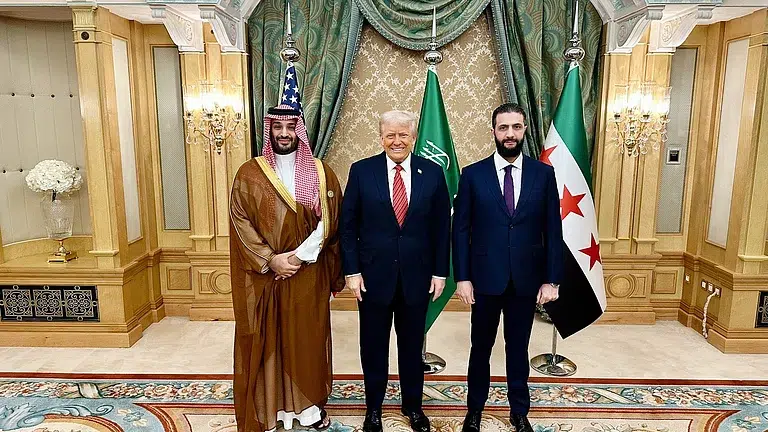
On May 13, at an investment summit in Riyadh, Saudi Arabia, U.S. President Donald Trump announced the lifting of sanctions imposed on Syria. This decision offers the nation a newfound opportunity for economic reconstruction and diplomatic reconciliation following 14 arduous years of civil war and international isolation.
Following the fall of long-standing ruler Bashar al-Assad in December 2024, Islamic leader Ahmed al-Shara assumed power and currently leads the administration. Trump remarked, “There is a new administration in Syria, and we hope they will be capable of stabilizing the country and maintaining peace.” He further added, “I will order the lifting of all sanctions against Syria so that they may have the opportunity to prosper.”
Signed on August 7, 2026 between Saudi Arabia, Türkiye, and Pakistan, the Mecca Joint Defense Pact stipulates that an armed attack on one member shall be deemed an attack on all. For Bangladesh—confronting border casualties, unilateral riparian diversions, and transit imbalances—a collective deterrence architecture restores sovereign bargaining leverage.
Since 1979, the United States has designated Syria as a “state sponsor of terrorism,” a classification that triggered stringent measures, including arms embargoes, restrictions on financial transactions, and the termination of foreign aid. These sanctions were further tightened in 2004, effectively pushing Syria out of the international financial system and creating significant impediments to the nation's economic recovery.
The removal of these sanctions presents the potential for a revitalized Syrian economy. The influx of international investment and humanitarian aid is expected to prove instrumental in rebuilding war-torn infrastructure. Syrian Finance Minister Mohammad Barnieh stated, “The lifting of sanctions creates a significant opportunity to build Syrian institutions, provide basic services to the population, and attract investment.”
Publish Your Research & Critical Analysis on MaroonPaper
Contribute in-depth essays on law, political philosophy, economics, and geopolitics to an intellectual readership.
The Syrian public has largely embraced the decision with enthusiasm. In Damascus’s Umayyad Square, thousands gathered to celebrate, playing music and waving the Syrian flag. Huda Kassar, an English teacher, noted, “This decision will positively impact the entire country. Reconstruction will begin, the displaced will return, and inflation will decrease.”
While post-WWII Germany and Italy were systematically de-Nazified, dismantling the fascist machinery in post-July Bangladesh has encountered fierce resistance. Backed by India's regional hegemony and an entrenched cultural fifth column, reactionary networks are working tirelessly to subvert the democratic breakthrough.
However, the move is not without apprehension. Lingering concerns remain regarding allegations of human rights abuses under the new administration, as well as Israel’s security interests. U.S. Secretary of State Marco Rubio is prepared to meet with the Syrian Foreign Minister in Turkey, a potential prelude to normalizing diplomatic relations between the two nations.43
Mediated by Saudi Arabia and Turkey, this initiative is also viewed as a strategic maneuver to diminish the influence of Iran and Russia in the region. Trump stated, “The people of Syria have endured years of war, bloodshed, and suffering. It is now time for them to flourish.”
Ultimately, the U.S. decision to lift sanctions unveils a new horizon for Syria. It paves the way not only for economic reconstruction but also for the political reconciliation essential for stability and peace in the Middle East.