Switch language / ভাষা পরিবর্তন করুন
HistoryEnglish Edition

The Thuggee: Moralist Assassins of British India

Rakibul IslamRakibul Islam
•September 1, 2022•8 min read
The Thuggee: Moralist Assassins of British India

Operating as a pervasive specter of terror, the Thuggee traversed the Indian subcontinent in highly organized clandestine networks. Primarily targeting lone travelers, merchants, and pilgrims along the arterial thoroughfares of the region, these syndicates orchestrated a campaign of systematic predation. By some historical estimates, the Thuggee were responsible for over a million fatalities between 1740 and 1840, a grim toll that underscores the profound, long-standing menace they posed throughout the eighteenth and nineteenth centuries.

Since antiquity, India has held a magnetic allure, drawing travelers from across the globe—from Vasco da Gama to Columbus—whose quests for the subcontinent’s riches led them either to its shores or to accidental discovery of new worlds. Long before the arrival of the Western powers, the region was governed for centuries by Muslim dynasties. The history of India is a tapestry woven with extraordinary diversity, yet within the folds of its storied past lie chapters of profound darkness. Among the most chilling of these is the legacy of the *Thug* or *Thuggee*. A terrifying scourge that haunted the Indian landscape, the Thuggees operated as highly organized criminal syndicates, predominantly along the major arterial roads. Their prey were lone travelers, merchants, and pilgrims. By some estimates, between 1740 and 1840, they claimed the lives of over a million people. If one considers the origins of this group to reach back as far as the thirteenth century, the total toll of their activities becomes impossible to quantify with any certainty.

Who Were the Thugs?

The word *Thug*—implying a swindler, cheat, or impostor—is derived from the Sanskrit *Sthaags*. It is this term that eventually entered the English lexicon. The Thuggees were a fanatical, cult-like group notorious for their ritualized murders, committed in the name of the Hindu goddess Kali. They utilized a secret cant language known as *Ramasi* to communicate among themselves. Viewing murder and plunder as divine duties, they established a reign of terror across Central and Northern India, including Bengal. Their primary centers of veneration were the Kalighat temple in modern-day West Bengal and the Bhavani temple in Vindhyachal.
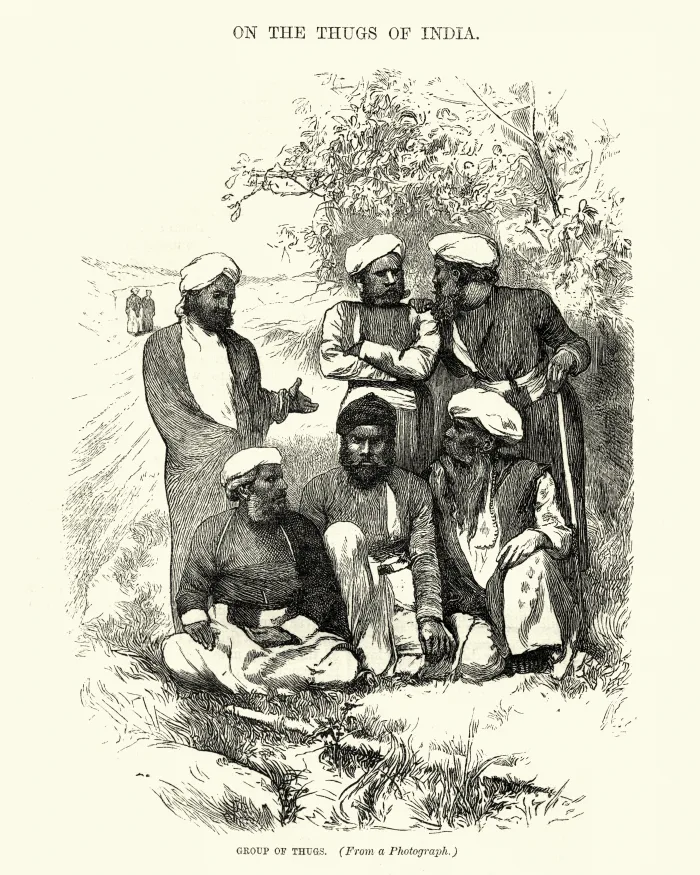
A Thug wearing a turban, dhoti, and carrying a yellow handkerchief; such was the attire of the terror of India.

A turban, a dhoti, and a yellow handkerchief: this was the signature attire of the men who terrorized India.

Historians remain divided over the origins of the Thugs. Many scholars argue that the "Thuggee menace" was an exaggerated narrative leveraged by the British to justify the expansion of their colonial control into remote areas far from the capital. These critics contend that the history of the Thuggees has been artificially confined to the period between 1740 and 1840 to suit imperial historiography.

The Jallianwala Bagh Massacre: A Brutal Gift of British Civilization

Related Analysis
The Islamic Legacy in Spain: An Eight-Century Chronicle of European Splendor

A retrospective of European historiography reveals that, while the continent languished in the medieval depths of superstition, squalor, and intellectual stagnation, the Iberian Peninsula served as a luminous beacon of civilization. It was within this crucible that the Muslim architects of the region forged the enduring, multifaceted heritage of Al-Andalus.
সানজিদা সীমা • History
Read Article →
However, the legend of the Thugs gained literary permanence through Philip Meadows Taylor’s 1839 novel, *Confessions of a Thug*, which drew upon the observations recorded in William Sleeman's three-volume study. Earlier mentions of the group appear in Ziauddin Barani’s *Tarikh-i-Firoz Shahi* (1356), which records that around 1290, during the Sultan’s reign, over a thousand Thugs were apprehended. Rather than executing them, the Sultan ordered them to be sent downriver on boats, effectively exiling them to ensure they would no longer disrupt Delhi. Barani described the Thugs as a highly disciplined and organized cohort. The sixteenth-century Bhakti poet Surdas also referenced them. The Moroccan traveler Ibn Battuta is said to have encountered them while journeying from Kolkata to Delhi, and Kim A. Wagner, in his book *Thuggee: Banditry and the British in Early Nineteenth-Century India*, suggests that the Chinese traveler Xuanzang had a narrow escape from being offered as a sacrifice to the goddess Kali. Similar accounts appear in the Sikh text *Janam-sakhi*, which describes a robber named Sajjan who housed travelers only to murder them, plunder their belongings, and bury their remains.
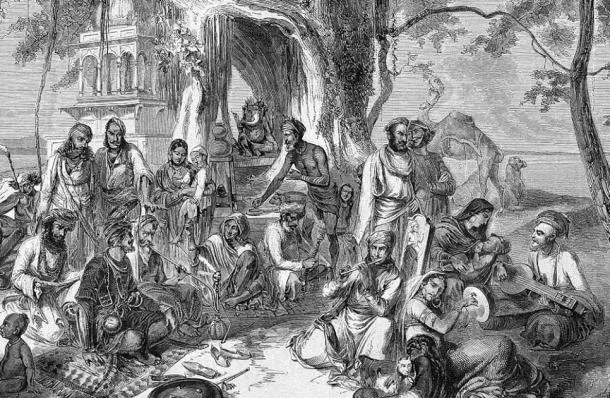
The Thugs had clandestine ties with local landlords, who provided them with resources in exchange for a share of the looted wealth.

The Thugs had clandestine ties with local landlords, who provided them with resources in exchange for a share of the looted wealth.

On October 3, 1830, a letter published in a Kolkata newspaper, written under a pseudonym (believed by many to be William Sleeman himself), sought to alert British authorities to the existence of a secret society murdering travelers in the name of Kali. D.F. McLeod traced the origins of the Thugs to seven tribes who had fled Delhi following the murder of a physician. William Sleeman, meanwhile, attributed the rise of Thuggee to the social and political vacuum between the rulers and the ruled in pre-colonial India. Conversely, historian Hiralal Gupta argued that the East India Company’s own policies—including economic exploitation and the chaos created by rigorous tax collection—fostered an environment in which such banditry flourished. Recent research suggests that Thuggees maintained covert relationships with local *zamindars* (landlords), who provided sanctuary and support in exchange for a percentage of the spoils.

Mughal-era Architectural Techniques in Ancient Gaur

Contributors Wanted • Write for MaroonPaper

Publish Your Research & Critical Analysis on MaroonPaper

Contribute in-depth essays on law, political philosophy, economics, and geopolitics to an intellectual readership.

Submit Writing →
According to Wagner, the phenomenon of Thuggee was inextricably linked to British colonial policy. As the East India Company consolidated power, local military contingents were disbanded, leaving many men unemployed and destitute. In their struggle for survival, these men turned to crime. Thus, while organized banditry existed previously, colonial displacement and suppression acted as a powerful catalyst for the Thuggee expansion.

The Theology of the Thugs

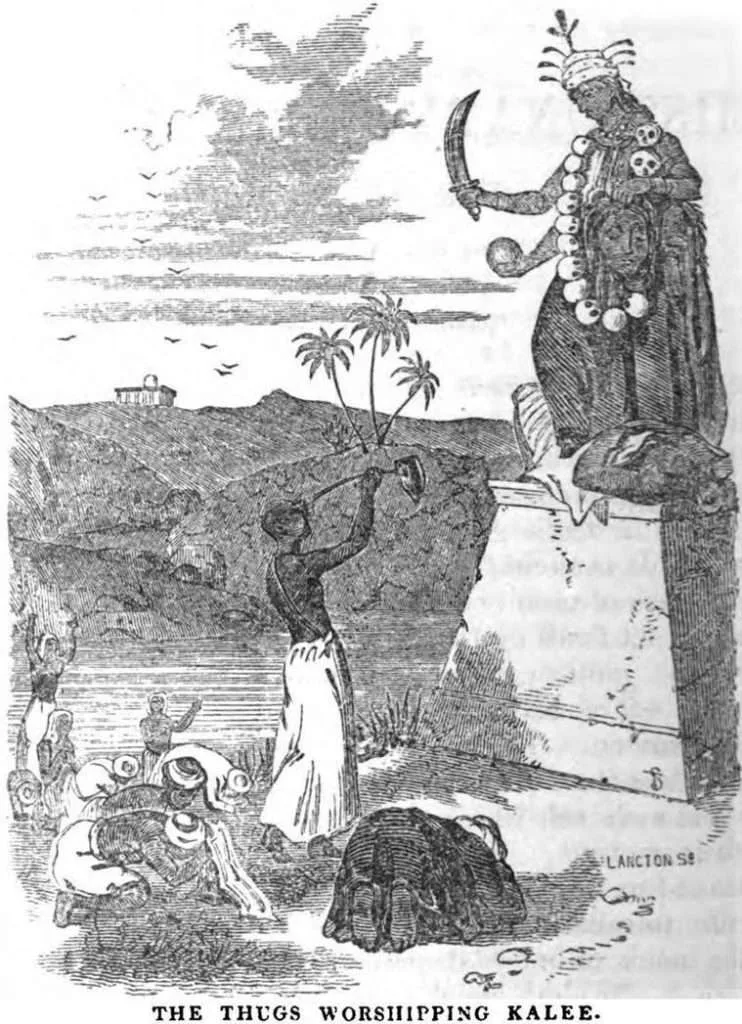
Historically, the Thuggees committed their crimes in the name of the goddess Kali, believing themselves to be born from the drops of sweat off her brow. They viewed these murders as both a worldly obligation and a spiritual necessity. They believed that if they did not conduct these sacrifices, Kali would consume humanity; human blood, they maintained, was her sustenance. While they identified as devotees of the goddess of death and rebirth, captured Thuggees included a significant number of Muslims—some estimates suggest as many as one-third. These Muslim Thugs often syncretized their faith, treating Kali as a subordinate power to Allah. As one prisoner confessed to Sleeman, "While strangling, I mentally say the name of Allah... I do not pray to Bhavani, I serve her." However, the question arises: can one categorize such an entity within any single faith? *Britannica* notes that while some links point to certain Muslim tribes, there is no discernible Islamic influence in their core rituals or the theology of their worship of Kali.

The Ethical Assassins

The Thuggees operated under a rigid code of conduct. According to their mythology, Kali tasked two men with strangling demons who consumed humans, providing them with a handkerchief and mandating that it be passed down through generations to eliminate those they deemed "intolerant."

According to Britannica, although some sources trace the origins of Thuggee to seven Muslim tribes, there is no evidence of Islamic influence in the religious practices or rituals of these devotees of the goddess Kali.

Latest Recommendation
The Constitution of Medina: An Analysis of Its Fundamental Tenets and Historical Significance in the Global Political Canon

Widely recognized as one of the world's inaugural written constitutions, the Charter of Medina serves as a seminal historical document, establishing foundational precedents for the Islamic state, religious pluralism, and the architecture of social cohesion.
সানজিদা সীমা • History
Read Article →
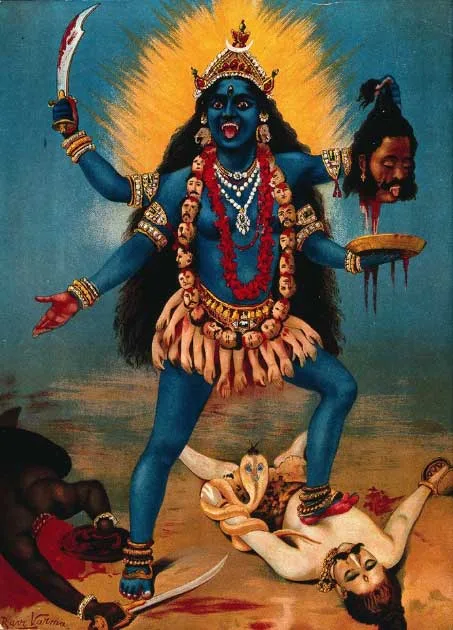
Thuggee, brandishing kali thagee
Thuggee, brandishing kali

According to the Thugs, the goddess Kali was bloodthirsty and demanded endless sacrifices to satisfy her hunger.

A cardinal rule of their operations was that the process had to be bloodless. They considered it a grave sin to harm women, fakirs, poets, dancers, or the infirm. Violating these taboos was believed to invite divine retribution.

Methods of Murder

Operating in groups of 10 to 200, they traveled under the guise of merchants or pilgrims. Each group was led by a *Jamadar*, with members performing specialized roles—some as guides, others as decoys, or scouts. They were master manipulators, engaging their targets in conversation to establish trust before choosing the optimal moment to strike.

How Sikkim became a part of India?

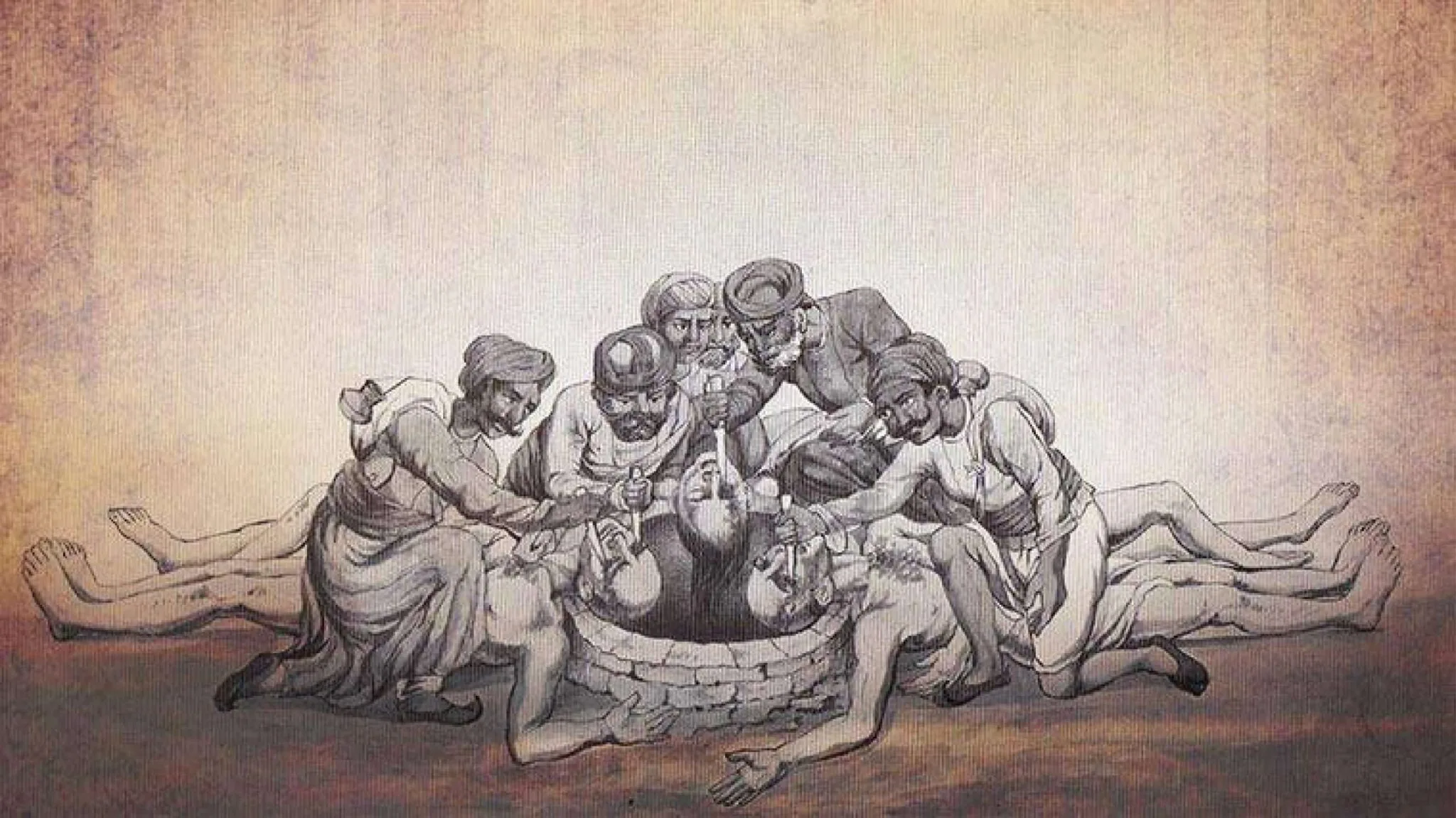
Once the target was isolated, the ritual began: a silk scarf (*rumal*) was tightened around the victim's neck. While one member strangled the victim, others would restrain the limbs to ensure the death was swift and silent. Only after death was confirmed would they proceed to loot the body and bury the remains, often dismembering parts to prevent identification. A portion of the remains was reportedly sacrificed at their Kali temples.

The Suppression of the Thugs

The Thuggees’ success relied on their ability to blend into society as law-abiding citizens during the day. It was only when British travelers began to vanish in alarming numbers that the colonial administration shifted its focus. Beginning in 1830, William Henry Sleeman spearheaded a campaign against them. In 1835, he successfully arrested a Thug named Syed Amir Ali, who turned state’s evidence. His testimony led to the capture of the infamous Behram, said to have personally strangled 931 victims. The Thuggee Act of 1836 formalized the legal crusade against them, mandating life imprisonment for involvement in Thuggee activities. Under Sleeman's department, over 3,200 individuals were arrested between 1831 and 1837, resulting in 412 executions and 483 convictions that relied on state informants. While historian Mike Dash has suggested that the death toll was likely inflated for political reasons, the impact of their suppression was absolute. By 1870, the organized cult of Thuggee was effectively dismantled, leaving behind a legacy that would eventually inform the draconian *Criminal Tribes Act* of 1871.

Secular India and the Nature of its so-called Secularism

Share this intellectual discourse

Help expand constructive dialogues on global affairs, law, and politics.

Rakibul Islam

Rakibul Islam

Author & Contributor, MaroonPaper

Contributing insightful research and analytical essays on law, politics, history, and international affairs for MaroonPaper.

Stay Connected with MaroonPaper

Subscribe to receive selected intellectual essays, critical commentaries, and translations directly in your inbox.

No spam, ever. Unsubscribe at any time.