
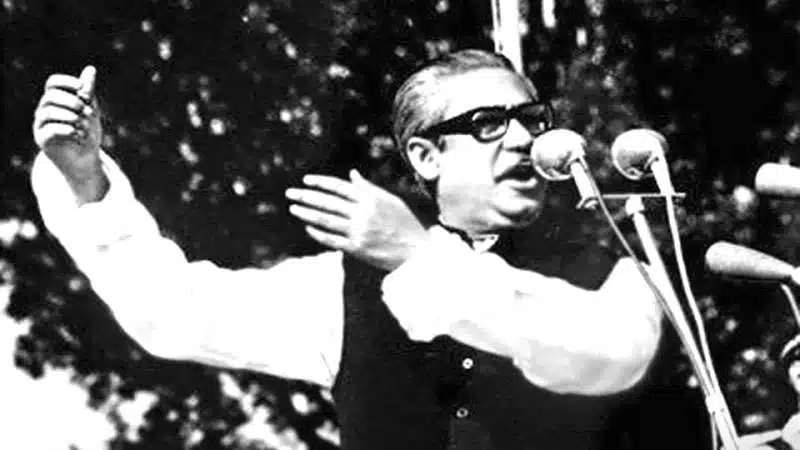
The founding architect of Bangladesh, Sheikh Mujibur Rahman, stands as one of the twentieth century's most charismatic mass leaders. Through his magnetic oratory, organizing prowess, and unyielding resistance against Pakistani military hegemony, an oppressed Bengali nation found its voice and won sovereign statehood. Yet his life embodies an inescapable historical paradox: an epochal champion of anti-colonial liberation who, upon ascending to state power, succumbed to executive centralism, institutional decay, and profound governance miscalculations. This critical biographical inquiry examines the life of Sheikh Mujibur Rahman—his formative years, his role in national emancipation, and the turbulent political and economic realities of his post-independence administration.
Formative Years and Education
Born on March 17, 1920, in the rural hamlet of Tungipara, Gopalganj, Mujib was affectionately nicknamed "Khoka" by his parents, Sheikh Lutfar Rahman and Sayera Khatun. Reared in the agrarian heartland of East Bengal, he displayed an instinctive empathy for the downtrodden and a spirited intolerance for perceived injustice from an early age.
His academic journey commenced at Tungipara Mission School, moving subsequently to Gopalganj Public School and Gopalganj Mission High School, from where he matriculated in 1942 despite recurrent bouts of illness. During these secondary school years, Mujib was drawn into the anti-colonial nationalist ferment, absorbing the political crosscurrents of the All-India Muslim League and the Pakistan movement.
Proceeding to Calcutta, Mujib enrolled in Islamia College, residing at the Baker Hostel. There, his latent organizational acumen flourished. He was elected General Secretary of the Islamia College Students' Union and completed his Bachelor of Arts in 1946. Crucially, Calcutta brought him into the intimate intellectual and political mentorship of stalwarts such as Huseyn Shaheed Suhrawardy and Abul Hashim, figures who fundamentally shaped his pragmatic populism and mass political instincts.
Following Partition in 1947, Mujib entered the Law Faculty at the University of Dhaka. However, his formal academic career was abruptly curtailed in 1948 when he was expelled for leading strikes in solidarity with university menial workers and championing the Bengali language cause. While this marked the end of his formal legal schooling, it catalyzed his lifelong commitment to grassroots mass politics.
The Rise of a Mass Politician
In June 1949, when progressive and dissident factions broke away from the Muslim League to establish the East Pakistan Awami Muslim League, the young Mujib was elected joint secretary in absentia while incarcerated. Over the following decade, he played a central role in transforming the party into a secular, pluralist vehicle, ultimately dropping "Muslim" from its nomenclature to form the Awami League.
From the crucible of the 1952 Language Movement to the historic triumph of the United Front in the 1954 provincial elections—wherein he briefly served as a minister—Mujib distinguished himself as an unflagging mobilizer. With the advent of General Ayub Khan's military dictatorship in 1958, Mujib suffered repeated, prolonged imprisonments. Far from neutralizing him, these incarcerations forged his reputation as the quintessential symbol of Bengali defiance against West Pakistani economic and military exploitation.
Tariq ibn Ziyad stands as the preeminent figure in the Islamic annexation of Andalusia. This examination chronicles his seminal 711 expedition into the Iberian Peninsula, evaluating the historicity of his legendary maritime immolation and the decisive tactical maneuvers that defined the Battle of Guadalete.
The Six-Point Movement: The Charter of Emancipation
In February 1966, Mujib unveiled the historic Six-Point Programme in Lahore, proposing a radical federal restructuring of Pakistan that bordered on a confederal pact. The demands demanded two separate, freely convertible currencies, provincial control over fiscal revenue, regional militia capabilities, and comprehensive internal autonomy.
The Six-Point charter resonated deeply across East Pakistan as the Magna Carta of Bengali self-determination. To the military oligarchy in Rawalpindi, however, it smelled of secession. In response, the Ayub regime arrested Mujib and in 1968 implicated him as the prime accused in the Agartala Conspiracy Case, charging him with high treason for allegedly colluding with India to dismember Pakistan.
The trial backfired catastrophically for the regime. A massive mass upsurge in 1969 forced the unconditional withdrawal of the case, toppled Ayub Khan, and saw a freed Mujib honored with the affectionate title Bangabandhu ("Friend of Bengal") by millions at the Racecourse Maidan.
The 1970 Elections and the Birth of Bangladesh
The subsequent 1970 General Election proved to be a political referendum on Bengali autonomy. Under Mujib's stewardship, the Awami League secured a sweeping majority, capturing 167 of the 169 National Assembly seats allotted to East Pakistan—securing an absolute majority in the all-Pakistan parliament.
When General Yahya Khan and Zulfikar Ali Bhutto conspired to block the peaceful transfer of power, Mujib orchestrated a historic non-violent non-cooperation movement. His electrifying address on March 7, 1971—declaring that "The struggle this time is for our freedom; the struggle this time is for our independence"—effectively established de facto civilian sovereignty across East Pakistan.
Publish Your Research & Critical Analysis on MaroonPaper
Contribute in-depth essays on law, political philosophy, economics, and geopolitics to an intellectual readership.
On the midnight of March 25, 1971, the Pakistan Army launched Operation Searchlight, unleashing genocidal violence across Dhaka and beyond. Moments before his arrest, Mujib formally proclaimed the independence of Bangladesh. Throughout the grueling nine-month Liberation War, while Mujib languished in a solitary prison cell in West Pakistan, the provisional government in exile led the armed resistance in his name, culminating in victory on December 16, 1971.
Post-Independence Realities: Governance in a Ruined Republic
Returning triumphant in January 1972 to a liberated homeland, Sheikh Mujibur Rahman assumed the mantle of Prime Minister. He inherited a shattered nation: infrastructure decimated, ports mined, millions of refugees returning from India, depleted foreign reserves, and thousands of roving armed guerrillas.

In his first two years, Mujib achieved significant milestones: orchestrating the swift withdrawal of Indian allied troops, formulating an admirable democratic constitution within ten months, and securing diplomatic recognition from the United Nations and the global community. Yet the transition from a heroic populist agitator to an institutional statesman overseeing a fractured state proved exceedingly complex.
The Authoritarian Turn: Jatiya Rakkhi Bahini and BAKSAL
Faced with growing leftist insurgencies, underground armed factions, and rampant smuggling, the regime increasingly relied on coercive force. In 1972, Mujib established the Jatiya Rakkhi Bahini (JRB), a paramilitary force drawn largely from loyalist wartime cadres. Operating with sweeping statutory immunity, the JRB was deployed to suppress internal political dissent.
Independent observers and chroniclers—including Anthony Mascarenhas and historian Ghulam Murshid—documented widespread abuses by the JRB, including arbitrary detentions, enforced disappearances, extrajudicial killings, and torture of political opponents. This militarization of domestic policing alienated the intelligentsia and generated deep resentment within the professional regular armed forces, who perceived the paramilitary force as a politicized, favored counterweight.
The intellectual architecture of Karl Marx’s project is anchored in the foundational tenets of dialectical materialism, historical materialism, the mechanics of class struggle, the systemic nature of capitalist exploitation, and the teleological trajectory of communism.
The definitive institutional rupture occurred in January 1975 with the passage of the Fourth Amendment. Dismantling the parliamentary democracy he had championed for decades, Mujib instituted a monolithic executive presidency and created the Bangladesh Krishak Sramik Awami League (BAKSAL)—outlawing all opposition political parties and shuttering all newspapers except four state-controlled dailies. Intended as a "Second Revolution" to eliminate factionalism and spur rapid economic mobilization, BAKSAL fundamentally extinguished constitutional pluralism, alienating even longtime comrades like Tajuddin Ahmad, the visionary wartime prime minister who was unceremoniously dropped from the cabinet.
The 1974 Famine and Economic Travails
The apex of the young republic's tragedy arrived with the catastrophic Famine of 1974, which claimed between hundreds of thousands and an estimated one million lives. While triggered by devastating floods that destroyed the summer rice crop, the catastrophe was exacerbated by systemic administrative incompetence, rampant hoarding, speculative rice hoarding by ruling party affiliates, and border smuggling into India.
Geopolitical maneuvering worsened the plight: US grain shipments under PL-480 were withheld due to Bangladesh's export of jute to Cuba. The visible inability of the administration to protect the poorest peasantry battered Mujib's public moral standing, tarnishing the myth of the benevolent leader.
The August 15 Tragedy and Historical Reckoning
By mid-1975, the convergence of economic distress, administrative authoritarianism, factional palace intrigues, and deep military alienation precipitated a deadly conspiracy. In the pre-dawn hours of August 15, 1975, a cabal of mid-ranking army officers—led by Majors Farooq Rahman, Khandaker Abdur Rashid, and Shariful Haque Dalim—staged a brutal coup d'état.
Assaulting the family residence at Dhanmondi 32, the putschists assassinated Sheikh Mujibur Rahman alongside his wife Fazilatunnesa Mujib, his three sons (Kamal, Jamal, and ten-year-old Russell), and several close relatives. Only his daughters, Sheikh Hasina and Sheikh Rehana, escaped the massacre by virtue of being in West Germany.
The tragedy of August 15 abruptly ended the founding era of Bangladesh, plunging the country into a fifteen-year cycle of coups, counter-coups, and military rule. It severed the young state's democratic journey and polarized national memory for generations.
Conclusion
Evaluating Sheikh Mujibur Rahman requires grappling with history in all its contradictions. To reduce him merely to the missteps of his final years is to erase the titanic courage that inspired a disenfranchised nation to shatter the shackles of military subjugation. Conversely, to mythologize his governance uncritically is to obscure the authoritarian impulses, institutional degradation, and economic mismanagement that hastened his tragic end.
Bangabandhu remains an indelible giant of Bengali history: an peerless mobilizer whose voice broke the silence of tyranny, yet whose ultimate tragedy serves as an enduring lesson on the perils of personalized power and the fragility of post-colonial state-building.