

The tenure of the Yunus interim administration resembled the defensive play of a Test cricketer fending off relentless deliveries of propaganda. It demonstrated a harsh reality: whenever an administration attempts to reform the state to bring a prime minister's monarchical powers down to human scale, rebuild a fractured economy to halt bank pillage, rein in institutional corruption, curb state-sanctioned human rights abuses, and dismantle the neo-feudal patronage networks of party sycophancy in favor of meritocracy—the entrenched nexus of oligarchs and political predators immediately labels these lifelong liberals with the taboo of religious extremism. The Yunus advisory council found itself besieged by this exact predatory campaign.
Dr. Yunus's finance adviser largely succeeded in stabilizing a crippled macroeconomy. The central bank governor exhibited exemplary resolve in managing commercial banking fragility. The shipping adviser restored operational order across waterways. Yet others proved more vocal than effective. Right at the genesis of the interim government, bowing to criticism from the cultural elite by replacing an exceptionally competent home affairs adviser with a visibly weaker figure was a calculated maneuver engineered to dilute the administration's authority.
Simultaneously, while certain reshuffles were made across a bureaucracy cultivated under Sheikh Hasina’s fifteen-year patronage, foot-dragging and reluctance were pervasive. Within the corridors of power, an "unwilling horse" syndrome took hold, rooted in the cynical presumption that the Bangladesh Nationalist Party (BNP) would inevitably assume power and that Yunus could be safely ignored. In the 2008 election, the vast majority of deputy commissioners and police superintendents actively campaigned as partisan instruments of the Awami League. At dawn the day after that election, our neighboring patron arrived with the first bouquet of flowers for Sheikh Hasina. Before the 2026 elections, the Indian foreign minister arrived bearing a missive from Modi expressing eagerness to engage with a future BNP-led Bangladesh. Consequently, in the eyes of the civil-military bureaucracy, the interim government was treated as a transient parenthesis, and the forthcoming election anointment became an inescapable formality.
Around Dr. Yunus emerged an insular circle of advisers whose diplomatic stewardship proved largely ineffective. Inevitably, they found themselves circumscribed by regional hegemony. In seeking to avoid placing all geopolitical eggs in the American and Indian baskets by reaching out to China, Pakistan, and Turkey, they incurred Delhi’s wrath. Rooted in its support during the 1971 Liberation War, India harbors a proprietary sense of ownership over Bangladesh, operating under the assumption that it holds an exclusive prerogative over Bangladesh's defense and foreign policy. For fifteen years under Sheikh Hasina, Delhi savored this suzerainty.
Delhi's South Block dictated Bangladesh’s external relations. India reacted with fierce indignation when the Yunus administration sought warmer ties with its geopolitical adversary China, or with Pakistan and Turkey—so much so that the Indian army chief publicly suggested freezing substantive engagement until a new elected government was installed. Yunus’s national security adviser had to travel to Delhi to pacify the Indian national security apparatus. Conscious of this asymmetry, the interim foreign affairs adviser spoke of India with perpetual caution. Bangladesh’s domestic establishment, legacy media, and cultural elite maintain a veneration of India as the eternal midwife of liberation.
In literary and intellectual spheres, this elite borrows Delhi’s vocabulary daily to offer reassurances. Even the BNP felt compelled to signal conformity to Indian red lines before assuming office. Under sustained pressure from ordinary citizens and July revolutionaries who rejected regional subservience, the Yunus administration walked a geopolitical tightrope. The country's intellectual establishment—deeply conditioned by an Indian-centric worldview—grew openly hostile toward Yunus. To them, India issuing warnings regarding the Chittagong Hill Tracts or harboring Sheikh Hasina while she faced prosecution for crimes against humanity was acceptable; what baffled them was why Yunus would dare comment on India's Northeast or demand Hasina’s extradition.
This sovereign posturing by Dr. Yunus and his key advisers was framed by the business elite, senior civil-military bureaucrats, and regional deep-state actors as an intolerable transgression against their patron. Recognizing this, opportunists within the interim structure who sought future political appointments treaded cautiously. The educated middle-class advisers found themselves ostracized by Dhaka's pro-India cultural salon.
Signed on August 7, 2026 between Saudi Arabia, Türkiye, and Pakistan, the Mecca Joint Defense Pact stipulates that an armed attack on one member shall be deemed an attack on all. For Bangladesh—confronting border casualties, unilateral riparian diversions, and transit imbalances—a collective deterrence architecture restores sovereign bargaining leverage.
Consequently, to survive within this ecosystem, many conceded to historic patronage structures, seeking favor with the BNP as the lesser evil in the Awami League’s absence. Offending the regional hegemon had proved perilous. You cannot easily battle the crocodile while residing in its river. The tragic demise of anti-hegemonic cultural figures like Hadi demonstrated the peril of challenging this hegemony. In this light, the final seven months of the Yunus council felt like a concession to political nemesis. The tragic reality that Bangladesh remains culturally subordinate to regional hegemony re-emerged vividly throughout Yunus's bittersweet tenure.
Throughout fifteen years of authoritarian consolidation, the traditional opposition proved incapable of dislodging the regime. It was the Gen Z revolutionaries of July—rising through the 2018 safe roads protests and the quota reform movements—who toppled the fascist structure in 2024 through the Anti-Discrimination Student Movement. While initially embracing these youth, legacy political machines gradually sought to sideline them. History has witnessed this before: in 1971 and 1990, the youth sacrificed blood to deliver liberation and democracy, only for veteran political oligarchs to climb those blood-stained stairs to build dynastic fiefdoms.
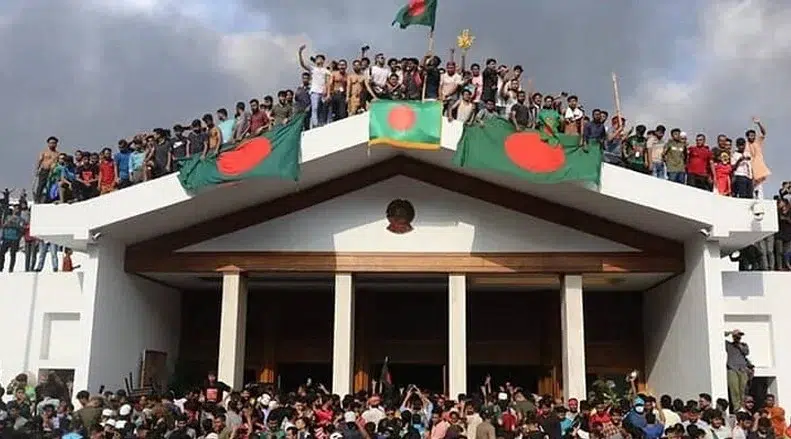
To institutionalize permanent dynastic entitlements, veteran elites retreated into familiar family fiefdoms. The 2024 revolution disrupted that convention. Three young revolutionaries joined Yunus’s advisory council. Almost immediately, legacy cultural figures deployed centuries-old petty politicking to discredit them. When Yunus lauded Mahfuz as the "brain behind the revolution" and praised the movement's meticulous nature, establishment pundits obsessively parsed his lexicon. Dynastic nepo-babies questioned why working-class student leaders were permitted into elite luxury venues, exposing an astonishing sense of class entitlement. Entrenched media figures mocked student leaders on social media, seeking petty gossip over substance.
In truth, these elite commentators were mourning the loss of their lavish gatherings at Gonobhaban. Having spent years showering uncritical praise upon Sheikh Hasina, these regime sycophants resented the disruption brought by July's revolutionary youth. Meanwhile, traditional opposition partisans, viewing themselves as the rightful inheritors of state power, viewed the young prodigies with undisguised suspicion. Across the border, sensationalist Indian media depicted the July revolutionaries with photoshopped Jinnah caps, wailing that Bangladesh had reverted to East Pakistan. For showing paternal affection to these youth, Dr. Yunus himself was caricatured with a beard and Jinnah cap. Yunus famously remarked to the press: "The Indian media brands me a Taliban; I suppose I must have removed my beard at home before arriving here."
Cultural adviser Mostofa Sarwar Farooki became an immediate target of the fallen autocracy's cultural apparatus after commissioning investigative documentaries on enforced disappearances, crossfire killings, and border shootings, and spearheading the rapid creation of the July Museum. Law adviser Asif Nazrul faced non-stop vitriol, while advisers Rizwana Hasan, Farida Akhter, and Sharmin Murshid endured brutal cyberbullying. Simply joining the interim government post-July was treated by the legacy establishment as an unpardonable offense.
Publish Your Research & Critical Analysis on MaroonPaper
Contribute in-depth essays on law, political philosophy, economics, and geopolitics to an intellectual readership.
Yet, through disciplined macroeconomic management, the administration stabilized commercial banking, replenished dwindling foreign reserves, stabilized commodity inflation, averted an energy breakdown, and ensured safe nationwide travel during religious festivals. These tangible achievements offered genuine relief to ordinary citizens. But ordinary citizens do not author op-eds or curate narratives on elite television talk shows. The narrative-makers are either grieving the autocracy’s fall or aggressively positioning themselves for the next partisan regime.
During the Awami League's reign, certain communal elements weaponized partisan alignment to carry out anti-public actions, while the autocrat deployed partisan security officers to suppress citizens. Following the regime's collapse, public indignation flared in isolated incidents. Sensationalist media in neighboring India magnified these events into lurid propaganda—falsely portraying the vandalism of cricketer Mashrafe Mortaza's house as an attack on minority cricketer Litton Das, or misrepresenting arson at a partisan restaurant as the burning of a temple.
The hypocrisy is glaring: while right-wing nationalist governance in India marginalizes minorities across Gujarat, Kashmir, and Bengal, stripped citizens of their rights, Indian media seized upon distorted anecdotes to corner Yunus. In reality, Islamic groups across Bangladesh guarded Hindu temples during Durga Puja; when lawyer Saiful Islam Alif was killed in Chittagong, his grieving father stood at the funeral calling for interfaith harmony, and Dr. Yunus visited temples to reassure the community. Yet these gestures of solidarity were conspicuously ignored by mainstream regional outlets.
Under the fallen regime, religious shrines had been thoroughly politicized, with ruling politicians presiding over their gatherings while concurrently appeasing conservative clerics. Both the shrine-based traditions and mainstream mosque establishments rely on public charity. Following the July Uprising, certain elements attempted to destroy local shrines to monopolize religious influence. Early attacks involved partisan operatives; as the trend spread, rogue mobs carried out vandalism under religious banners. Hamstrung by a demoralized police force, the interim government struggled to preempt every attack, though it instituted arrests against perpetrators.
While extortion networks shifted from the fallen regime to opportunists within the new political horizon, armchair commentators practiced selective silence. When a young woman in Shahbagh was arrested and lost his job for an altercation regarding modesty, and upon release was greeted by religious youth with garlands, the photo went viral as evidence of extremism. Yet when political thugs murdered an impoverished driver or committed assaults against revolutionary youth, an eerie silence settled over the same salons. The cultural establishment indulged in glaring selective outrage.
Beyond party rhetoric and television hyperbole lies the harsh calculus of South Asian geopolitics: why regime change in Kolkata exposes the collapse of regional buffer zones and strips the veneer from Delhi’s structural dominance over Bangladesh.
The Kolkata that witnessed the 19th-century Bengal Renaissance has largely embraced global cosmopolitanism, shedding the overt elitism of Bankim Chandra Chattopadhyay. Yet Dhaka's contemporary cultural circles remain intellectually frozen in that archaic mold. Just as 19th-century colonial elites validated their self-image by casting others as subaltern, Dhaka’s modern literati bolster their intellectual vanity by branding the majority population as uncultured. In their worldview, the devout Muslim remains the primitive other; branding someone as non-Aryan thrills their imagined pedigree.
This explains why enlightened circles in Kolkata contest communal fascism, while Dhaka’s compromised intelligentsia appeases it. They amplify regional disinformation against Bangladesh, maintain silence on border killings, and ignore lopsided corporate energy deals with conglomerates like Adani, yet feign hysteria over diplomatic deals with the West.
They weep for Palestine when criticizing Western imperialism, yet become compliant cultural workers for regional geopolitical projects in Bangladesh. Any nation that seeks trade and investment signs international treaties; even India negotiates waivers for Russian crude, while European nations invest heavily in US debt instruments. As the dominant superpower, the United States maintains a decisive grip on global institutions from the UN to the IMF. Within that geopolitical reality, Dr. Yunus engaged with Washington pragmatically. While some critics advocate genuine self-reliance, others feign anti-imperialist outrage merely to suppress debate over asymmetrical agreements with India.
Navigating the interim government required Dr. Yunus to push against structural barricades: external hegemonic aggression attempting to reclaim neo-feudal control, coupled with domestic cultural elites genetically accustomed to clientelism. Yunus sought to accompany Gen Z's struggle to liberate Bangladesh from this historic trap, inspired by how post-WWII European nations transformed ruins into egalitarian welfare states within two decades.
Yet fifty-five years after independence, Bangladesh, like its post-colonial neighbors, remains trapped by oligarchic dynastic clans, predatory middlemen, communal malice, pervasive corruption, black money, and intelligence shadow-games. Governance has been treated as a license to plunder, an economy of violence where state power guarantees immunity for criminal syndicates.
Those who equate the severe crimes against humanity of Sheikh Hasina’s regime with the imperfect interim administration—who posture as pro-liberation while bartering national sovereignty—evoke the historical specters of Mir Jafar and Jagat Seth at the Battle of Plassey. They resemble the ancestral retainers who massaged colonial zamindars while plotting to crush the rebelling peasantry.
Perhaps an entrenched generation of privileged boomers and compromise-prone elites will continue attempting to throttle the aspirations of Gen Z and Gen Alpha. But vanquishing the July generation—a youth defined by an uncompromising hunger for sovereignty and justice—will prove impossible. The archaic, stagnant order will inevitably crumble under the shockwave of this revolution. When Dr. Yunus invoked a "reset button," he was referring to the psychology of sovereign liberation, casting off the mental shackles of servitude. The authentic promise of 1971—equality, human dignity, and social justice—was betrayed for decades by merchants trading on the rhetoric of liberation. The July revolutionaries have initiated a new vanguard to restore those foundational vows. The autocracy butchered 1,400 youth and maimed thousands more, yet the youth stood firm. A generation that has conquered the fear of death cannot be shackled.
As Dr. Yunus affirmed: the country will never return to the reality prior to August 5. Those who deny this inevitable truth and seek to resurrect the instruments of tyranny are relic misfits in the forward march of Bangladesh's history.