
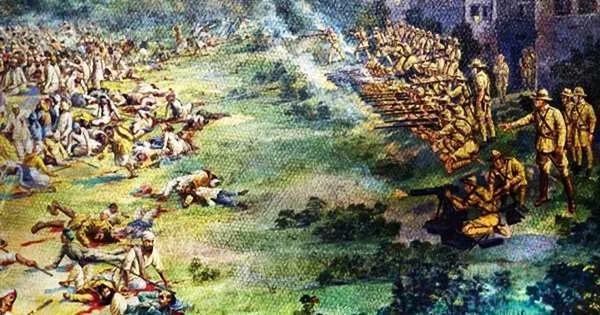
The Context of the Jallianwala Bagh Massacre
The massacre at Jallianwala Bagh stands as one of the most chilling indictments of British colonial rule and exploitative policy in world history. However, the events of that day were the culmination of a long, complex history that necessitates an understanding of the British arrival in India.The Arrival of the British
The cunning British, who would rule the subcontinent for nearly two centuries, first arrived as simple traders. On August 24, 1608, they set up camp in Surat. From these mercantile origins, their true intent gradually eclipsed their business interests. At the time, India was globally renowned for its immense wealth, particularly its spices, which were in high demand. Because Arab traders dominated these routes, Europeans were forced to pay exorbitant premiums. Seeking a solution, Christopher Columbus set out to find a new sea route to India. Although he missed his mark and landed in the Bahamas, he justified his error by misidentifying the territory as part of the Indian subcontinent and labeling its inhabitants "Red Indians"—a region that later came to be known as the West Indies. This was the first step in Europe’s obsession with India. While Columbus failed, the Portuguese navigator Vasco da Gama successfully charted a sea route. In 1498, he became the first European to complete the maritime journey to Calicut, effectively bridging Europe and the East. Da Gama’s discovery was a turning point for global imperialism, paving the way for a long-term Portuguese colonial presence in Asia. It was this same maritime logic that facilitated the British arrival via the East India Company in the 17th century. Although the Portuguese arrived earlier, they lacked the systemic leverage the British would eventually exert.The East India Company Regime
The East India Company received trading concessions from Emperor Jahangir in 1613, beginning with spices and expanding into silk, cotton, indigo, tea, and opium. Initially, they maintained a facade of commerce while systematically acquiring land. They established their first factory in Surat, soon followed by outposts in Calcutta, Bombay, and Madras. Their focus drifted from profit to political hegemony. British interference in Indian governance became overt in 1698, when they acquired the land rights to Sutanuti, Kalikata, and Gobindapur, laying the foundation for the city of Calcutta. By 1700, they had constructed the famous Fort William. They began manipulating local politics, capitalizing on the fragmented nature of India’s small, warring princely states. The most significant seismic shift occurred in 1757 with the defeat of Nawab Siraj-ud-Daulah of Bengal at the hands of Robert Clive. Following the Battle of Buxar in 1764, the British solidified their grip. The victory at Plassey marked the beginning of their de facto rule. Robert Clive was appointed Governor of Bengal in 1765, and through the forced collection of *Diwani* rights from the Mughal Emperor Shah Alam, the British began extracting revenue from Bengal, Bihar, and Orissa. Following the Anglo-Mysore Wars (1766–1799) and the Anglo-Maratha Wars (1772–1818), the Company established its rule over most of the region south of the Sutlej River. This introduced a new feudal order where the Company controlled administration, revenue, and expenditure, paving the way for unchecked plunder. In 1770, a severe drought triggered the Great Bengal Famine, or the "Chhiattarer Manwantar," which claimed millions of lives. The Company’s rapacity eventually crippled the region, leading to a massive shortfall in anticipated revenue. Debt began to mount; the Company owed 1.5 million pounds to the British Crown and 1 million in unpaid taxes. By 1773, the British government was forced to bail out the bankrupt Company. Under the Permanent Settlement of 1793, introduced by Lord Cornwallis, the Company operated purely on profit-driven motives. Through the commercialization of agriculture (1765), the Regulating Act (1773), the introduction of "Free Trade" (1813), and the systemic destruction of the textile industry, the Indian economy was tethered to British interests. By the mid-19th century, even the British Parliament faced internal opposition against the Company’s unchecked anarchy.The Sepoy Mutiny, 1857
The first major organized movement against the East India Company’s discriminatory rule was the 1857 Mutiny, often regarded as India’s first war of independence. Leaders like Nana Saheb, Tantia Tope, Rani Lakshmibai, and Bahadur Shah Zafar led the uprising, which began at the Meerut cantonment and spread rapidly to Delhi, Agra, Kanpur, Gwalior, and Lucknow. The Company required direct military assistance from the British government to suppress the revolt. After a year of chaos, the British replaced the Company’s forces with official Crown soldiers to regain control. The last Mughal Emperor, Bahadur Shah Zafar, was exiled to Burma, and his children were executed, effectively ending the Mughal dynasty. The British victory in July 1858 marked the end of the revolt and the beginning of direct imperial rule.British Crown Rule
In 1858, the British Parliament passed the Government of India Act, officially stripping the East India Company of its authority and transferring control directly to the British Crown. This formal imperial rule lasted until 1947, characterized by the "Divide and Rule" policy and recurring famines that decimated millions.World War I
The British maintained power by exploiting sectarian and regional divisions. By the 1850s, they had achieved dominance across the Indian subcontinent. Their rule was cemented by Indian collaborators—power-hungry landlords such as Shivaji Rao Scindia, Jai Chand, Raja Ranbir Singh, Mir Jafar, and Raja Bahadur Jiban Lal—who ensured British hegemony to protect their own petty fiefdoms. These local agents enforced harsh tax collection and fueled communal tensions to prevent unified resistance.Is the USA a Leading Terrorist State?
Though the sun of independence had set on the fields of Plassey, Bengal and Punjab remained hotbeds of resistance. By the early 20th century, the desire for autonomy had become a national aspiration, formalized by the founding of the Indian National Congress in 1885. Initially, the Congress sought only autonomy under British rule, but the British dismissed these claims, arguing that "India was not yet ready for self-governance." As infrastructure—railways, telegraphs, and factories—spread, so too did the idea of nationalism. The outbreak of World War I saw Western powers partitioning global territories, leading to further political and economic crises. Initially, Indians were reluctant to participate in the war, particularly as Britain was at war with the Ottoman Empire. However, Gandhi and others eventually supported the war effort, swayed by promises of post-war self-governance. India contributed vast resources, arms, and millions of soldiers to the British war effort. Yet, post-war, these promises were broken. Soldiers were discharged, inflation soared, and a devastating influenza pandemic claimed nearly ten million lives. Discontent turned into open defiance.The Ghadar Conspiracy and the Defence of India Act, 1915
Bengal and Punjab, always the vanguard of anti-colonialism, felt the betrayal most acutely. Between 1914 and 1917, a revolutionary plot, the Ghadar conspiracy, emerged with the support of the Ghadar Party in America and Canada, the Berlin Committee in Germany, and local Indian cells. The plan was to ignite a revolt in Punjab that would spread to Bengal and, eventually, to international fronts. British intelligence uncovered the conspiracy, leading to mass arrests. Fearful of insurrection, the British government passed a series of draconian laws: the Foreigners Ordinance (1914), the Ingress into India Ordinance (1914), and the Defence of India Act (1915). These laws suspended civil and political liberties, leading to numerous executions and incarcerations.How Sikkim became a part of India?
The Defence of India Act was the most severe, mirroring Britain's "Defence of the Realm" law. It allowed for preventive detention, trial without jury, and the censorship of speech and movement. Its indiscriminate use against perceived revolutionaries only served to radicalize the populace further.The Rowlatt Act, 1919
In 1918, in response to the growing agitation, the British government formed the Rowlatt Committee, chaired by Sidney Rowlatt, to investigate links between Indian nationalists, Bolshevik Russia, and German interests. Based on their recommendations, the "Anarchical and Revolutionary Crimes Act" was passed on March 18, 1919. Commonly known as the Rowlatt Act, it was effectively a permanent extension of the 1915 Defence of India Act. The act allowed for arbitrary arrest, disappearance, and trials without evidence. It sparked widespread protest. Prominent figures like Bal Gangadhar Tilak, Bipin Chandra Pal, Mohammad Ali Jinnah, and Annie Besant condemned the law. Mohammad Ali Jinnah resigned in protest, writing to the Viceroy: *"I tender my resignation, as I feel that under the prevailing circumstances, it is my duty to protest against the passing of this bill, which no civilized government should enact during times of peace."* Mahatma Gandhi organized a non-violent *Satyagraha* movement, calling for a nationwide *hartal* (strike) and day-long fasting on March 30, later shifted to April 6. However, the message of the date change did not reach Amritsar in time, where the strike took place on March 30. Local leaders Dr. Satyapal and Dr. Saifuddin Kitchlew were subsequently barred from public speaking. [Timeline component logic omitted/preserved]The Massacre at Jallianwala Bagh
Despite the imposition of martial law, people gathered in massive numbers at Jallianwala Bagh for the Vaisakhi fair and the scheduled rally. By noon, the administration had dispersed the fair, but this only pushed the crowd into the Bagh. Colonel Dyer, having learned of the assembly, returned to his barracks to prepare. Dyer arrived with a force of 100 soldiers—25 Gurkhas, 25 Sikhs, Pathans, and Baluchis—armed with .303 Lee-Enfield rifles. He also brought two armored vehicles equipped with machine guns, which were too wide to enter the narrow alleys of the Bagh. The choice of troops was tactical; he selected ethnic groups he deemed most loyal to the British. Without warning or any order to disperse, Dyer commanded his men to fire upon the unarmed crowd. The firing continued for ten minutes, until ammunition ran low. The troops discharged 1,650 rounds. Hundreds were killed instantly. Others died while trying to escape the enclosure, and many more were suffocated under the weight of the dying or drowned in the central well. It was an act of unmitigated barbarity. *“Once the Gurkhas had left, I went to look for my uncle-in-law’s son. Bodies were strewn everywhere. I estimate I saw about 1,500 corpses. Near the well, there were piles of bodies twelve layers deep,”* recalled **Mohammad Ismail**. *“I went to the well to fetch water, only to find it filled with corpses,”* said **Sardar Pratap Singh**. *“I could hear the cries of the wounded, begging for water in the dark.”*The Toll
The exact death toll remains unknown. Dyer, indifferent to the suffering, had left the scene once his ammunition was spent. Later, before the Hunter Commission, he confessed that had his armored vehicles been able to enter, he would have used machine guns on the crowd. Official reports varied wildly—from the government’s initial 301 to Bihar leader Hasan Imam’s claim of 941, while others estimated up to 1,800. The Hunter Commission later officially identified 379 victims, though this is widely considered a gross underestimation.The Aftermath
News of the massacre was suppressed until December 1919. When the truth finally reached the global stage, it unmasked the brutality of British "civilization." Rabindranath Tagore renounced his knighthood in protest, and Hakim Ajmal Khan returned his 'Kaiser-i-Hind' medal. The repression continued with the Gujranwala massacre, where British forces used aerial bombardment against demonstrators. Colonel Dyer also imposed a cruel order in Amritsar: Indians were forced to crawl on all fours through the street where a female missionary, Marcella Sherwood, had been assaulted. He decreed that since British women were "like goddesses," Indians should show their devotion by crawling before them.British Parliamentary Response
While many in the colonial establishment supported Dyer, leaders like Winston Churchill and former Prime Minister H.H. Asquith condemned the massacre. Churchill labeled it "monstrous," while Asquith called it "one of the most heinous, atrocious, and terrifying outrages in our entire history."The Hunter Commission
The Hunter Commission, formed in October 1919, eventually found that while there was no conspiracy to overthrow British rule in Punjab, Colonel Dyer had acted with excessive force and had abused his power. However, due to the support of high-ranking officials, he was never formally punished.The End of the Butcher of Amritsar
Dyer eventually died in 1927. Before his death, he remarked to his daughter-in-law: *"I do not want to get well. Many say I did the right thing in Amritsar; others say I was wrong. I only want to die and ask God whether I was right or wrong."*Retribution: Udham Singh
The true architect of the massacre, Lieutenant Governor Michael O'Dwyer, was assassinated twenty-one years later by Udham Singh, an orphan who had survived the massacre. Singh traveled to London and shot O'Dwyer at a meeting in the Caxton Hall. *“I did it because I had a grudge against him. He deserved it. He was the real culprit. He wanted to crush the spirit of my people, so I crushed him,”* Singh declared before the court. He was hanged on July 31, 1940. While Gandhi criticized the violence of the act, Jawaharlal Nehru later honored Udham Singh with the title *Shaheed-i-Azam*.Today, the walls of Jallianwala Bagh still bear the scars of the bullets that ended hundreds of lives—a haunting monument to the cost of resistance against empire.“For me, the battlefields of France and Amritsar are one and the same. To this day, women silence their children by whispering the name of General Dyer.”
— Nigel Collett, The Butcher of Amritsar: General Reginald Dyer