
The history of French colonialism in Africa spans nearly a century and a half, leaving an indelible imprint across the continent's political institutions, economic structures, and cultural identities. Although direct metropolitan rule formally collapsed during the independence wave of the early 1960s, France's structural influence over its former possessions has endured through an intricate web of political patronage, monetary dependency, and military interventions.
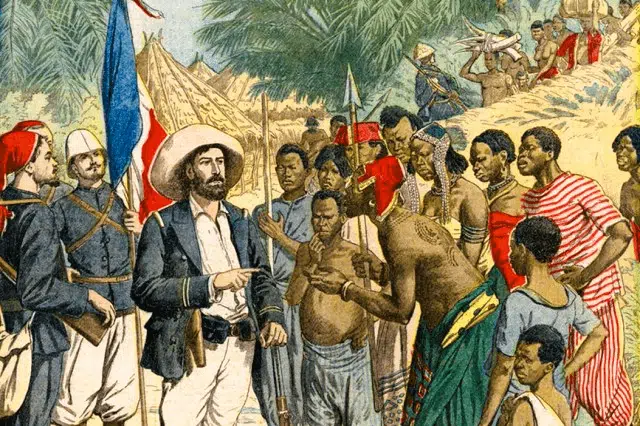
From the violent conquest of Ottoman Algiers in 1830 to the consolidation of French West Africa (AOF) and French Equatorial Africa (AEF), French imperialism was rationalized under the self-serving doctrine of the mission civilisatrice (civilizing mission). Yet beneath this paternalistic rhetoric lay systemic expropriation of fertile lands, forced labor, cultural erasure, and violent pacification.
Historical Trajectory: Conquest, Assimilation, and the Berlin Conference
Following the 1884–1885 Berlin Conference, French expansion accelerated across the Maghreb, the Sahel, and the Gulf of Guinea. By 1930, the French colonial empire enveloped millions of square kilometers, governing over thirty million African subjects under the draconian legal regime of the Code de l'Indigénat. This legal apparatus denied basic citizenship rights to indigenous populations while subjecting them to arbitrary taxation, forced conscription, and summary physical punishment.
A retrospective of European historiography reveals that, while the continent languished in the medieval depths of superstition, squalor, and intellectual stagnation, the Iberian Peninsula served as a luminous beacon of civilization. It was within this crucible that the Muslim architects of the region forged the enduring, multifaceted heritage of Al-Andalus.
Unlike the British model of "indirect rule"—which ostensibly governed through preserved traditional chieftaincies—the French colonial administration pursued a doctrine of direct administrative centralization and cultural assimilation. A minuscule indigenous elite (the évolués) were permitted French citizenship on condition of abandoning their indigenous legal status, language, and cultural heritage, creating deeply alienated administrative castes in nascent African states.
America's Blackwater: Mercenary Armies and the Terrorization of the Global South
Françafrique: The Architecture of Neocolonial Dominion
The formal granting of political independence in 1960 did not dismantle French hegemony; rather, it inaugurated the subterranean system known as Françafrique. Coined by Félix Houphouët-Boigny of Ivory Coast and later popularized critically by economist François-Xavier Verschave, the term describes a clandestine nexus of Franco-African political, economic, and intelligence networks that guaranteed French access to strategic natural resources in exchange for metropolitan military protection for authoritarian client regimes.
Publish Your Research & Critical Analysis on MaroonPaper
Contribute in-depth essays on law, political philosophy, economics, and geopolitics to an intellectual readership.
The linchpin of this postcolonial architecture includes:
- The CFA Franc Monetary Mechanism: Established in 1945, the West African and Central African CFA francs were pegged first to the French franc and subsequently to the euro. Operating under mandatory reserve deposits in the French Treasury, this monetary arrangement deprived sovereign African nations of autonomous monetary policy while facilitating capital flight back to Paris.
- Strategic Resource Monopolies: Secret bilateral defense and economic agreements granted French multinational corporations (such as TotalEnergies, Areva/Orano, and Bolloré) preferential concessionary rights over uranium in Niger, petroleum in Gabon, and bauxite in Guinea.
- Direct Military Prepositioning: Permanent French garrisons stationed in Dakar, Abidjan, Libreville, and Djibouti enabled Paris to execute over fifty unilateral military interventions across Francophone Africa between 1960 and 2020, orchestrating coups or propping up favored dictators.
Military Overreach and the Collapse of Operation Barkhane in the Sahel
In 2013, France deployed forces under Operation Serval (subsequently expanded into Operation Barkhane in 2014) to halt jihadist advances across Mali, Niger, Burkina Faso, and Chad. While initially welcomed, the protracted presence of 5,100 French troops failed to contain asymmetric insurgencies, instead exacerbating communal conflicts and civilian displacement.
Widely recognized as one of the world's inaugural written constitutions, the Charter of Medina serves as a seminal historical document, establishing foundational precedents for the Islamic state, religious pluralism, and the architecture of social cohesion.
Popular frustration erupted in a wave of anti-French mobilizations across Bamako, Niamey, and Ouagadougou. Military juntas seized power in Mali, Burkina Faso, and Niger, expelling French diplomats and troops while pivoting toward alternative security partnerships with Moscow and the Wagner Group. In late 2022 and 2023, President Emmanuel Macron was compelled to announce the formal termination of Operation Barkhane and a dramatic retreat of French forces from the Sahel.
Case Study: Guinea and the Price of Anti-Colonial Defiance
The modern political trajectory of Guinea underscores the generational cost of defying French hegemony. In the historic 1958 constitutional referendum, while other colonies voted to remain within the French Community, Guinean leader Ahmed Sékou Touré famously declared: "We prefer poverty in liberty to riches in slavery."
In response to Guinea voting "Non," the French administration executed brutal economic sabotage: withdrawing administrators overnight, dismantling civil infrastructure, destroying medical supplies, and flooding the nascent Guinean economy with forged banknotes via French intelligence's Operation Persil. This structural isolation entrenched authoritarian security governance under Sékou Touré, casting a long shadow that precipitated decades of institutional volatility, including the 2021 military coup against Alpha Condé.
Conclusion: Toward Genuine Sovereign Emancipation
The historic retreat of French forces from the Sahel signals the twilight of Françafrique. Across the continent, a dynamic generation of African youth, intellectuals, and civic movements is repudiating postcolonial tutelage, demanding monetary sovereignty through the abolition of the CFA franc, curricular decolonization, and equitable multilateral partnerships. Decolonization was never an event completed in the 1960s; it remains an ongoing, vital struggle for authentic political and economic liberation across Africa.