
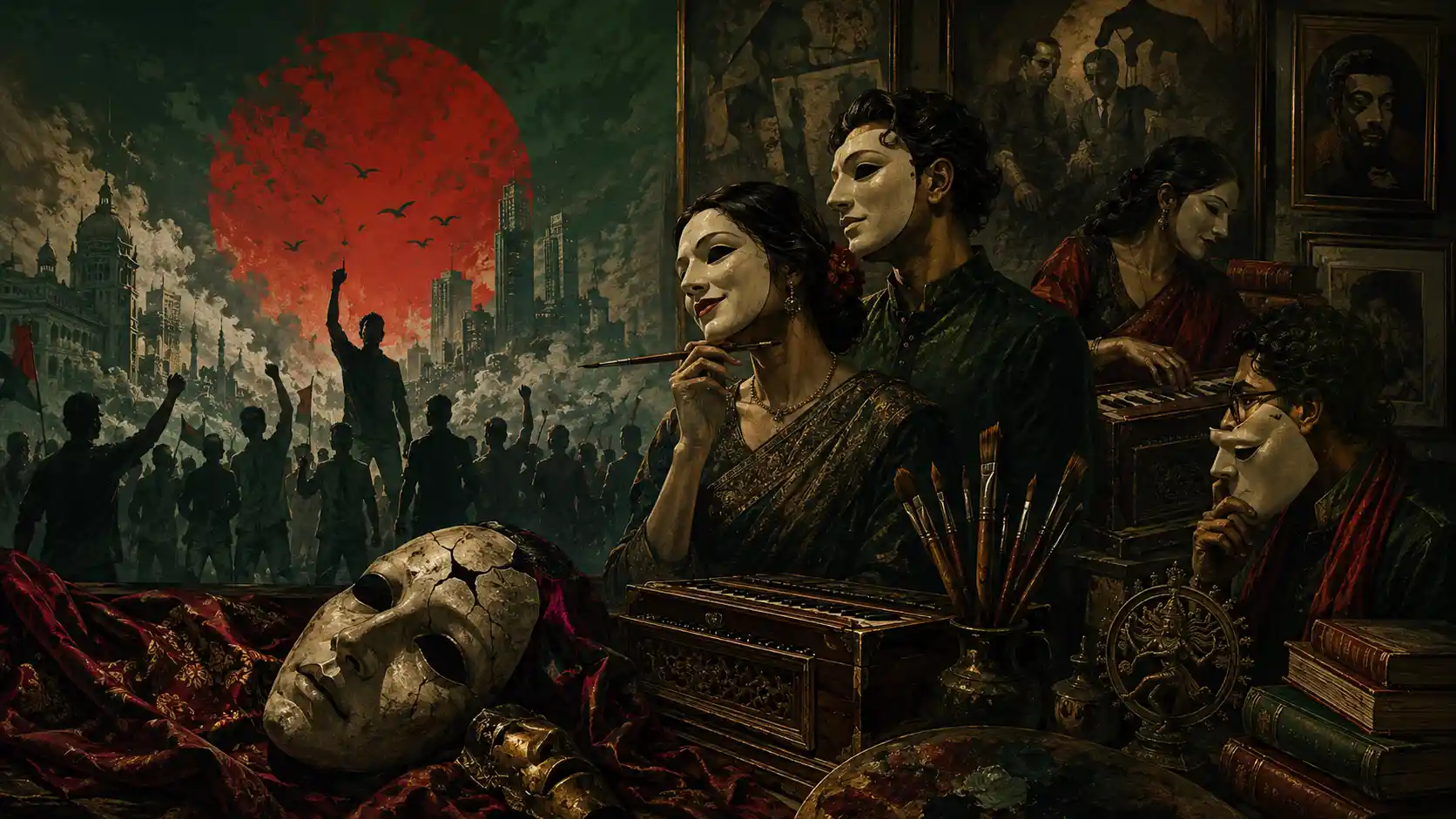
In almost every civilized society, individuals who dedicate their lives to literature, philosophy, music, and painting tend to possess an empathetic and reflective sensibility. The foundational premise of poetry, fiction, symphony, and visual art is to elevate consciousness beyond transactional self-interest and material calculation into an expansive realm of human dignity.
Yet in our country, one encounters a peculiar, organized species: the cultural fascist. In July 2024, when the fascist Awami League regime was systematically butchering children, adolescents, and university students in the streets, the regime's cultural wing celebrated the slaughter with open jubilation.
Consider the archetype: a cultural figure who, for fifteen years under autocracy, began every morning by posting photographs of blooming flowers on Facebook, shared Rabindra Sangeet before an afternoon siesta, toured contemporary art galleries at dusk, and curated evening reading lists of celebrated literature. A man whose public persona was an altar to refined aesthetic elegance transformed, in the heat of July, into an unabashed apologist for state-sponsored murder.
How a psyche steeped for thirty, forty, or fifty years in arts and letters degenerates into a cheerleader for political cannibalism deserves forensic psychoanalytic inquiry.
A prerequisite of modernity is egalitarianism. The July Revolution sought an equitable society. Yet in its aftermath, an unhealthy rat race to fabricate 'bonedi' aristocratic pedigree has resurfaced, exposing the identity crisis plaguing both progressive and religious classes.
Whatever rhetorical agility and literary eloquence these figures cultivated in their youth was weaponized in the aftermath of July to malign the revolutionary youth—their intellectual children and younger siblings.
The essence of genuine artistic practice is to dissolve parochialism and nurture magnanimity. Yet the petty, collective malice displayed by these cultural apparatchiks across social media feeds, newspaper columns, and television talk shows has hollowed out five decades of institutional cultural pride.
During the July uprising, young women and men from disparate walks of life, bearing diverse lifestyles and beliefs, united under the singular moral banner of human dignity and liberation. In response, this aging cultural establishment relentlessly disseminated venom and sectarian division in an attempt to fracture that unity.
Publish Your Research & Critical Analysis on MaroonPaper
Contribute in-depth essays on law, political philosophy, economics, and geopolitics to an intellectual readership.
While an authentic, emergent generation of writers, musicians, filmmakers, and actors marched on the barricades, the senior cultural establishment attempted to dismiss and degrade them with patronizing labels.
Most tellingly, following the collapse of the Indian-backed autocracy and Sheikh Hasina's flight to New Delhi, the domestic cultural wing mobilized identical propaganda strategies, rhetorical cadences, and talking points as India's state-aligned broadcast media. A syndicate riddled with hundreds of ethical compromises worked furiously to find a single moral flaw among the July revolutionaries.
Signed on August 7, 2026 between Saudi Arabia, Türkiye, and Pakistan, the Mecca Joint Defense Pact stipulates that an armed attack on one member shall be deemed an attack on all. For Bangladesh—confronting border casualties, unilateral riparian diversions, and transit imbalances—a collective deterrence architecture restores sovereign bargaining leverage.
Every historic revolution requires time to restore institutional equilibrium. Rebuilding is particularly arduous given how thoroughly the fallen regime subverted state institutions: turning law enforcement into a partisan militia, ruling through sectarian division, institutionalizing state plunder as the sole metric of success, and converting the republic into a torture chamber of enforced disappearances, secret detention facilities (Aynaghar), and mass arrests. The psychological trauma and ethical collapse inflicted on society require patience and profound structural regeneration.
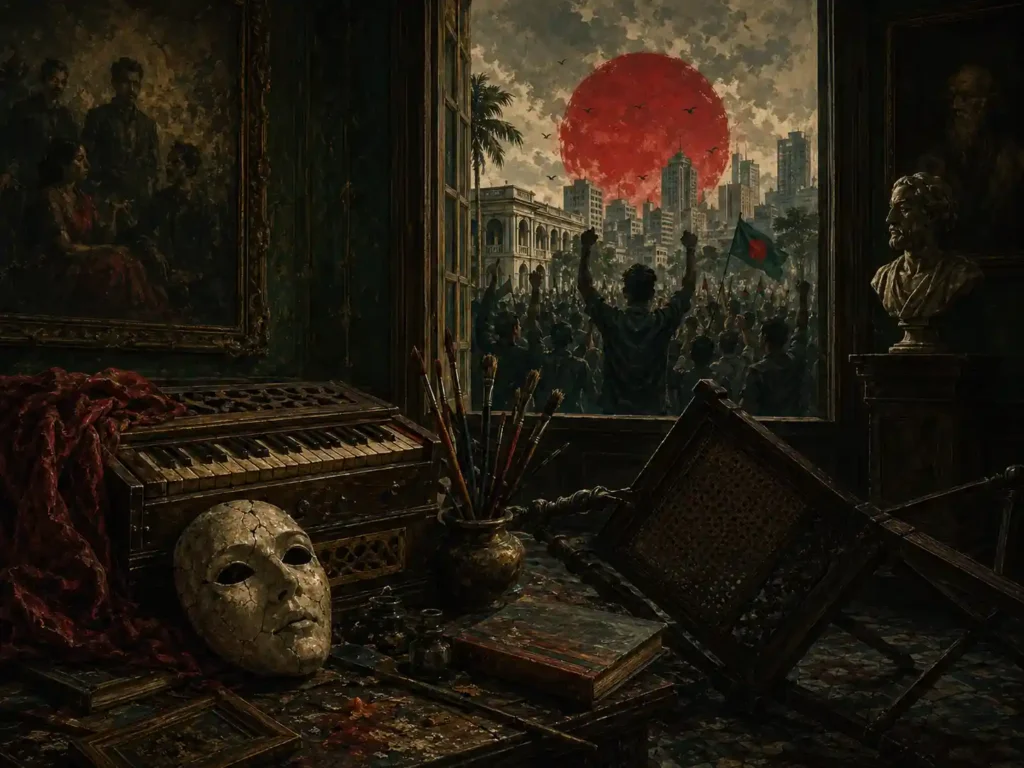
Yet on the evening of August 5, 2024, the very intellectual figures who had defended crimes against humanity rebranded themselves overnight as the "conscience of the nation." In broadcast studios, they began performing contortions of moral equivalence, chanting the refrain—in lockstep with foreign media—that the fallen tyranny was somehow preferable.
The vulgar vitriol spewed by these cultural figures has laid bare their moral bankruptcy. Senior cultural figures who spent a decade quietly validating cyber-lynching mobs on social media have now discarded their masks, operating as the attack dogs of a disgraced status quo.
When the banquets at the prime minister's palace ended, when the subservient press conferences ceased, and when the luxurious party circuits dissolved, all that remained was the empty dressing room, the tinsel, and the discarded wig. Awakening to discover that their ocean of patronage has dried up, they are driven by a frantic urge to sabotage the new dawn.
And that bitter hangover of despair spills out into the digital gutters as raw, unvarnished malice.