
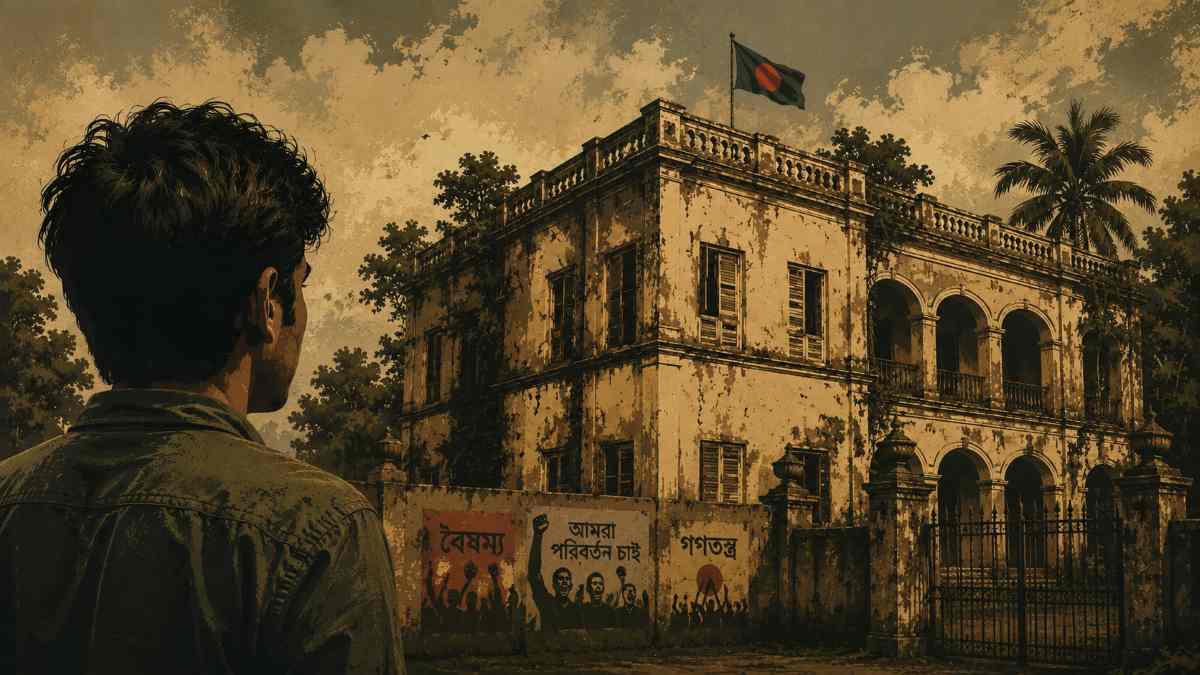
The foremost prerequisite of being a truly modern human being is egalitarian thought. In the post-colonial era, Western societies remained at the forefront of human civilization because they learned from historical catastrophes and enshrined human equality above pedigree. Even where economic equality remains elusive, cultivating mental egalitarianism serves as the primary benchmark of civilizational maturity.
In contrast, contemporary South Asia remains culturally antiquated because it has internalized the skeleton of the Hindu caste hierarchy. Societies across Bangladesh, India, and Pakistan are still locked in an obsessive pursuit to project themselves as high-born social elites.
The core aspiration of the July Revolution was a society free from systemic discrimination. From that rupture, one hoped that even if material equality took generations to achieve, psychological egalitarianism might finally take root. Yet in the post-revolution landscape, that very rat race to brandish synthetic aristocratic lineage—what Bengalis call 'bonediyana'—has aggressively restarted.
Having been schooled in world literature, I have had the opportunity to objectively observe the historical evolution of both Bangladesh's 'progressive' class and its 'religious' class. Bangladesh's progressive elite drew its entire inspiration from Indian Brahminism, while its religious orthodoxy drew inspiration from Saudi Arabian Ashraf feudalism. Consequently, the progressives sought cultural refinement from Indian Hindutva aesthetics, while the religious class modeled their social habits on Saudi Salafism. Constrained by a deficient grasp of English, their comprehension of genuine global cosmopolitanism remains pitifully narrow.
Bangladesh is geographically compact, which makes the social trajectories of its upwardly mobile classes remarkably transparent. Life is fleeting; yet rather than living authentically, countless individuals waste their existence in the hollow rat race of manufacturing aristocratic pedigree.
Having been influenced at an early age by Shamsur Rahman's poem 'Oikantik Srenihin' (Intrinsically Classless) and having discovered truly egalitarian models in world literature, this labored race for Bengali pseudo-aristocracy has always appeared profoundly tragicomic. Studying the nouveau riche—the Philistines—of the post-Industrial Revolution in English literature offers the perfect lens to decipher the behavior of Bangladesh's newly minted oligarchs during its era of runaway corruption.
In most civilizations, practitioners of the arts cultivate empathy and expansive humanism. In Bangladesh, an entrenched cultural elite cheered state atrocities during the July Revolution, before weaponizing their literary platforms to undermine democratic renewal.
Young men and women who endured acute financial destitution during their university years often emerge, upon securing a sliver of professional stability, as self-appointed arbiters of high-minded progressive culture on Facebook.
In European societies, working-class students take pride in financing their own studies through honest labor. They cherish the struggle, and once they achieve professional success, they harbor no desperate urge to feign feudal nobility. In Bangladesh, however, those who struggle through university turn aristocratic pretension into their single existential objective.
European youth consume the masterpieces of the Renaissance and Enlightenment; they wander through galleries of classical sculpture and painting; they immerse themselves in symphony and avant-garde cinema. Yet this cultural literacy does not metastasize into social arrogance. They do not brandish self-congratulatory 'liberal' labels or sneer at working citizens. In Bangladesh, by contrast, digesting two books or attending a single art exhibition instantly transforms people into pompous pseudo-aristocrats who look down upon others with utter disdain.
A European listening to Beethoven does not imagine himself a scion of Beethoven's noble household. But in Dhaka, a student listening to Rabindra Sangeet instantly imagines himself an heir to the Tagore estate of Jorasanko. After watching a Christopher Nolan film—whether they comprehend the narrative or not—they chant Nolan's name incessantly on social media to manufacture an aura of intellectual superiority.
The ethos of living as an equal among peers—an elementary pillar of modern civil society—is virtually absent in Bangladesh. Mainstream institutions churn out profiles celebrating hyper-competitive achievers, egging on a ruthless social sprint. A prominent media establishment, painstakingly built through years of struggle, styled itself after the Jorasanko Tagore salon, with its founder aspiring to play Derozio in a self-styled 'Bengal Renaissance 2.0'.
Publish Your Research & Critical Analysis on MaroonPaper
Contribute in-depth essays on law, political philosophy, economics, and geopolitics to an intellectual readership.
Following the July Revolution, that same media powerhouse appointed itself the sculptor of revolutionary pedigree, seeking out 'refined' archetypes among young revolutionaries to canonize as the new elite. Much like a school headmaster selecting the fairest-complexioned child to present flowers to visiting dignitaries, this curation favored those whose diction echoed the elite lexicon of the Kolkata Renaissance, grooming them into tomorrow's institutional deities.
The established, dignified families across rural Bangladesh did not migrate en masse to Dhaka in search of fast fortune; it was predominantly the desperate, struggling classes who arrived. Leveraging political shifts, land grabs, and regime patronage, this emergent class swiftly dressed itself in aristocratic garb. Much as British colonial peons, orderlies, and court clerks transformed overnight into titled zamindars under the Permanent Settlement, successive generations during the Pakistan and Bangladesh eras used sycophancy to the corridors of power to masquerade as old money.
Because the first generation cannot pull off this aristocratic theater convincingly, the second generation attends university, reads a handful of English paperbacks, listens to Tagore songs, and marches between Shahbagh and the Central Shaheed Minar as custodians of refined progressivism.
Others secure lucrative government posts. Those adept at corruption build lavish mansions on subsidized state plots and play the role of feudal lords. Meanwhile, the progeny of lower-ranking bureaucrats residing in cramped government quarters overcompensate for financial insecurity through cultural arrogance. They take a few vocal lessons at Chhayanaut, practice dramatic elocution, teach their rural husbands 'modern manners', and spend their days lecturing social media on how to be genuinely progressive.
When these desperate theatrics still fail to cement their status as untouchable elites, they resort to derogatory labeling and public contempt to secure their imagined perch. Previously, their weapon of choice was branding people as 'khet' (peasant). Having arrived in Dhaka landless and eventually securing a tiny flat, denigrating agrarian labor became their ticket to modernity—a mindset directly inherited from British imperialism, where unemployed Englishmen shipped to the colonies abused the native populace as crude peasants.
Signed on August 7, 2026 between Saudi Arabia, Türkiye, and Pakistan, the Mecca Joint Defense Pact stipulates that an armed attack on one member shall be deemed an attack on all. For Bangladesh—confronting border casualties, unilateral riparian diversions, and transit imbalances—a collective deterrence architecture restores sovereign bargaining leverage.
Since the early 1990s, cultural consortiums acting as ideological extensions of India trained lower-middle-class youth in the art of aristocratic signaling. To be recognized as cultured, one had to attend religious festivals with secular fanfare, but practicing Muslim prayers was deemed uncouth. To be a champion of 'non-communal spirit', one had to sneer at Muslim identity. Celebrating Diwali at the Fine Arts faculty was lauded as secular enlightenment; but if an ordinary youth wore a skullcap or kept a beard, he was reflexively labeled a militant. This borrowed Indian dogma became the trademark of Bangladesh's pseudo-progressive aristocracy.
Meanwhile, the Indian military unreservedly integrates Hindu rituals into its daily exercises—scattering vermilion from helicopters during operations and breaking coconuts before space launches. Yet when a Bangladeshi army chief kept a beard after performing Hajj, the Indian media erupted in hysteria, proclaiming that the Bangladesh military had turned fundamentalist.
Under the fallen fascist regime, progressive leftist figures who spent years browbeating the public on secular virtues fled to India after the July Revolution, openly boasting on social media about joining Hindutva outfits like the Bajrang Dal. These very hypocrites had previously dismissed the bloodied faces of student protesters as 'tomato ketchup theater'.
Inevitably, this Hindutva-modeled elitism sparked an equally aggressive counter-reaction: an aristocratic school of self-righteous Islamism. Proponents of this camp strut about pretending to be heirs to the Ottoman Caliphate or masquerading as Gulf sheikhs, dispensing nonstop moral policing across Facebook. Born to quiet, devout parents, the sons now act as chief executive officers of Islam, declaring their mission to 'reclaim' faith in a country that is ninety percent Muslim. They lecture women on their wardrobes and pronounce anyone who sympathizes with Iran against Western-Israeli aggression as an apostate.
A girl whose mother wore a traditional sari or shalwar kameez will dismiss those garments as un-Islamic, adopting head-to-toe foreign garb while refusing to photograph herself for a national identity card. Yet across the Arab world, particularly in Saudi Arabia, women's autonomy over dress has made unprecedented strides, with women excelling in academia, industry, aviation, cinema, and space exploration. Even in Iran, state dress policing was dealt a historic blow following popular uprisings. Yet in Bangladesh, moral police far more draconian than those in Riyadh or Tehran now roam the digital commons.
Examine both the Hindutva-styled progressives and the fundamentalist moralists, and their shared condition becomes painfully apparent: both suffer from acute crises of identity. The pseudo-progressive renders dissenters killable by branding them as anti-liberation jihadists destined for Pakistan; the religious zealot renders dissenters killable by branding them as atheists destined for India. Both originated from landless, uprooted demographics. Having secured a plot or an apartment through opportunistic compromises, each now fancies themselves the sole rightful proprietor of the republic.
Instead of clawing for supremacy and manufacturing hollow pedigree, these factions must learn the basic art of living as ordinary citizens among equals. Once the underlying inferiority complex is dismantled, the comical urge to play the aristocrat evaporates. Being a citizen of Bangladesh is noble enough. There is neither virtue nor survival in clinging to these fragile, divisive toys of elite pedigree.