
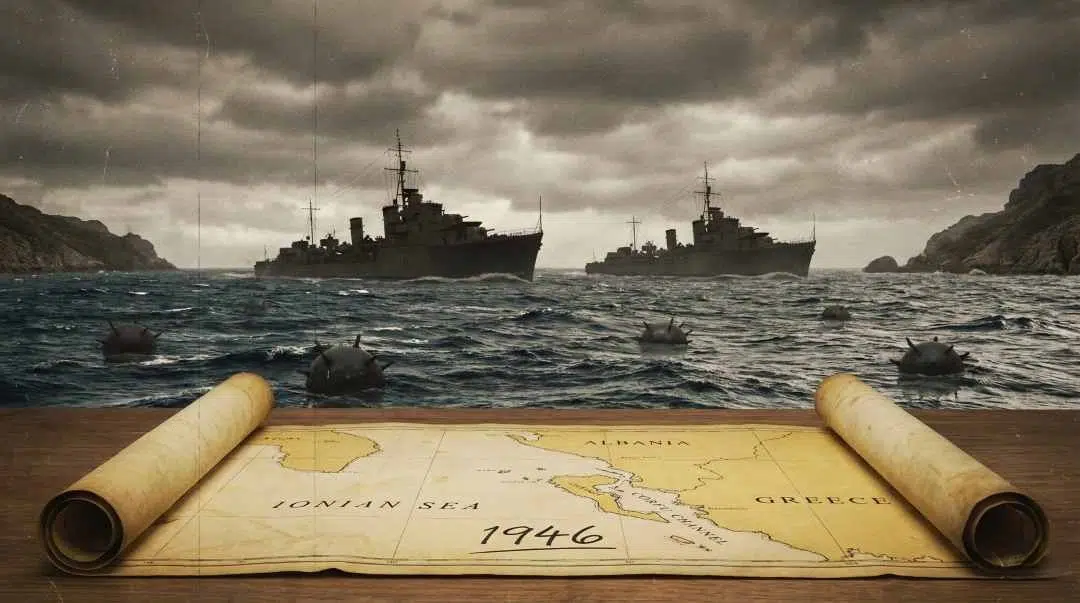
In the jurisprudence of public international law, certain landmark judgments construct the foundational architecture for entire legal regimes. The Corfu Channel Case (United Kingdom v. Albania, 1949) is preeminent among them. It was the inaugural contentious case adjudicated by the International Court of Justice (ICJ) following its establishment under the United Nations Charter in 1945.
The ICJ's judgment remains a decisive precedent governing the law of the sea, specifically regarding the right of "innocent passage" through international straits during peacetime and the inviolability of territorial sovereignty. This article provides a comprehensive legal analysis of the dispute, the arguments presented, and the enduring principles articulated by the Court.
Key Takeaways
- Historic Significance: The inaugural contentious ruling delivered by the International Court of Justice.
- The Incident: Detonation of naval mines in Albanian territorial waters in 1946, severely damaging British warships and causing significant casualties.
- Freedom of Navigation: Affirmed the customary right of innocent passage for warships through international straits during peacetime without prior authorization.
- State Responsibility: Established the bedrock rule that every sovereign state is obligated not to allow knowingly its territory to be used for acts contrary to the rights of other states (sic utere tuo ut alienum non laedas).
- Prohibition of Unilateral Intervention: Declared Britain's unilateral minesweeping operation ("Operation Retail") a violation of Albanian sovereignty.
Facts of the Case
The conflict erupted immediately after the conclusion of the Second World War in the North Corfu Channel—a narrow maritime strait between the Greek island of Corfu and the Albanian mainland. The sequence unfolded in three distinct phases:
Signed on August 7, 2026 between Saudi Arabia, Türkiye, and Pakistan, the Mecca Joint Defense Pact stipulates that an armed attack on one member shall be deemed an attack on all. For Bangladesh—confronting border casualties, unilateral riparian diversions, and transit imbalances—a collective deterrence architecture restores sovereign bargaining leverage.
1. May 15, 1946: Two British Royal Navy cruisers, HMS Orion and HMS Superb, transited the Corfu Channel and were fired upon by Albanian coastal artillery batteries. Tirana asserted that foreign warships could not traverse its territorial waters without prior diplomatic authorization.
2. October 22, 1946: To test Albanian intentions and assert freedom of navigation, the Royal Navy dispatched four warships (cruisers and destroyers). While passing through Albanian territorial waters, the destroyers HMS Saumarez and HMS Volage struck submerged naval moored mines. The explosions inflicted catastrophic damage, killing 44 British sailors and injuring 42 others.
3. November 12–13, 1946: In response, the British Admiralty executed a unilateral minesweeping sweep codenamed "Operation Retail" within Albanian waters without Tirana's consent, retrieving 22 German-manufactured moored mines to preserve evidence for judicial adjudication.
Publish Your Research & Critical Analysis on MaroonPaper
Contribute in-depth essays on law, political philosophy, economics, and geopolitics to an intellectual readership.
The United Kingdom referred the dispute to the United Nations Security Council, which recommended that both parties submit the dispute to the ICJ under Article 36 of the Court's Statute.
Legal Issues Before the Court
The Special Agreement (Compromis) submitted to the Court presented two primary questions:
While post-WWII Germany and Italy were systematically de-Nazified, dismantling the fascist machinery in post-July Bangladesh has encountered fierce resistance. Backed by India's regional hegemony and an entrenched cultural fifth column, reactionary networks are working tirelessly to subvert the democratic breakthrough.
- Albanian Responsibility: Is Albania responsible under international law for the explosions of October 22, 1946, and is there any duty to pay compensation to the United Kingdom?
- Breach of Sovereignty by the UK: Did the actions of the Royal Navy on October 22, and subsequently during Operation Retail in November 1946, violate the national sovereignty of Albania?
The Historic Judgment of the ICJ (April 9, 1949)
1. On State Responsibility and the Standard of Proof
The Court held Albania internationally responsible for the explosions and resultant casualties. While direct proof establishing that Albanian authorities had laid the mines was absent (with evidence suggesting Yugoslav naval involvement), the Court accepted circumstantial evidence (prima facie evidence):
- Exclusive Territorial Control: A state within whose territory an illegal act occurs cannot simply evade responsibility when it exercises exclusive physical control over the littoral waters. The proximity of coastal lookout posts made it impossible for a major minelaying operation to occur without Tirana's knowledge.
- Duty to Warn: The Court articulated the universal doctrine of "elementary considerations of humanity", which obligates a sovereign state to notify international shipping of known maritime perils in its waters. Albania's failure to warn approaching British vessels constituted a grave breach of international responsibility.
2. Innocent Passage of Warships
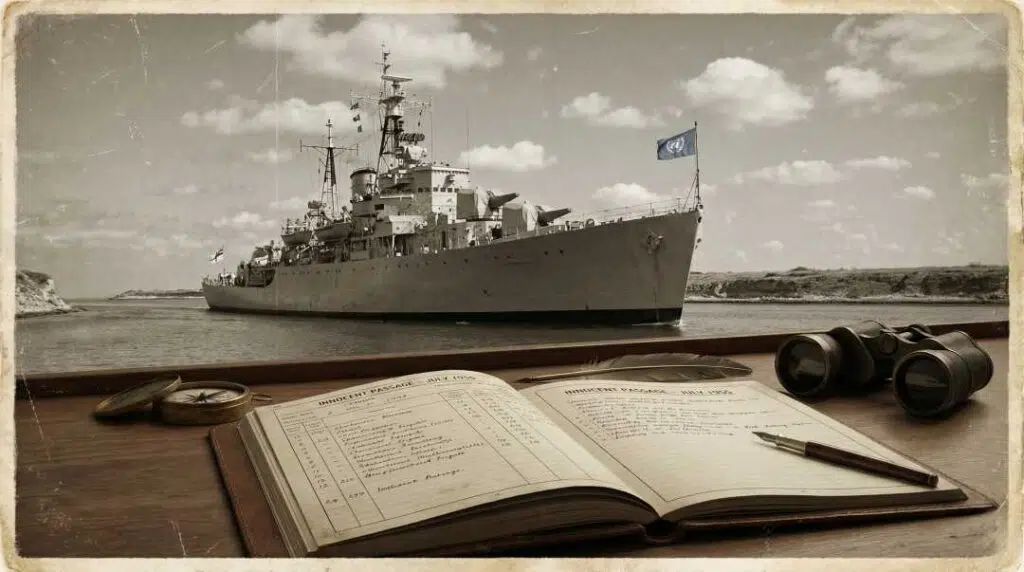
Albania argued that foreign naval vessels require prior diplomatic permission to navigate territorial waters. The Court categorically rejected this contention:
- Customary Rule: The Court held that states possess a customary right in peacetime to send warships through international straits connecting two parts of the high seas without requiring prior authorization from the coastal state, provided the passage is innocent.
- Status of the Passage: Despite the British vessels assuming a defensive posture, the Court ruled that the passage on October 22 was innocent and did not violate Albanian sovereignty.
3. Operation Retail and the Rejection of Self-Help
Conversely, the Court ruled unequivocally against the United Kingdom regarding Operation Retail, determining that unilateral minesweeping constituted an unlawful violation of Albanian sovereignty:
- Rejection of Unilateral Intervention: Britain defended its entry into Albanian waters on grounds of self-protection and securing judicial evidence. The Court rejected this doctrine of "self-help," famously ruling that such intervention is the manifestation of a policy of force, which cannot find a place in international law. Respect for territorial sovereignty remains an essential foundation of international relations.
Comparative Matrix: Claims and Holdings
| Legal Issue | United Kingdom Argument | Albania Argument | ICJ Holding |
| Responsibility for Explosions | Albania laid or colluded in laying the mines and is liable. | No direct evidence of Albanian laying; no awareness of minelaying. | Albania liable; circumstantial evidence proves knowledge and failure in duty to warn. |
| Innocent Passage of Warships | Warships possess an unconditional right of innocent passage through straits. | Warships require prior authorization from coastal authorities. | Warships possess the right of innocent passage in international straits during peacetime. |
| Operation Retail (Minesweeping) | Lawful self-help to secure evidence and remove danger. | Unlawful armed invasion of sovereign waters. | Unlawful; constitutes an impermissible violation of Albanian sovereignty. |
Frequently Asked Questions (FAQ)
1. Which fundamental principle of state responsibility was forged in this case?
2. Did Albania pay the awarded compensation?
3. How did the judgment shape modern maritime law?
Conclusion
The Corfu Channel Case is not merely a Cold War historical episode; it is the cornerstone of modern international adjudication. By balancing the freedom of international navigation against the sanctity of territorial sovereignty, and by proscribing gunboat diplomacy disguised as evidence collection, the ICJ established an enduring jurisprudential benchmark that continues to govern contemporary maritime disputes from the South China Sea to the Strait of Hormuz.