
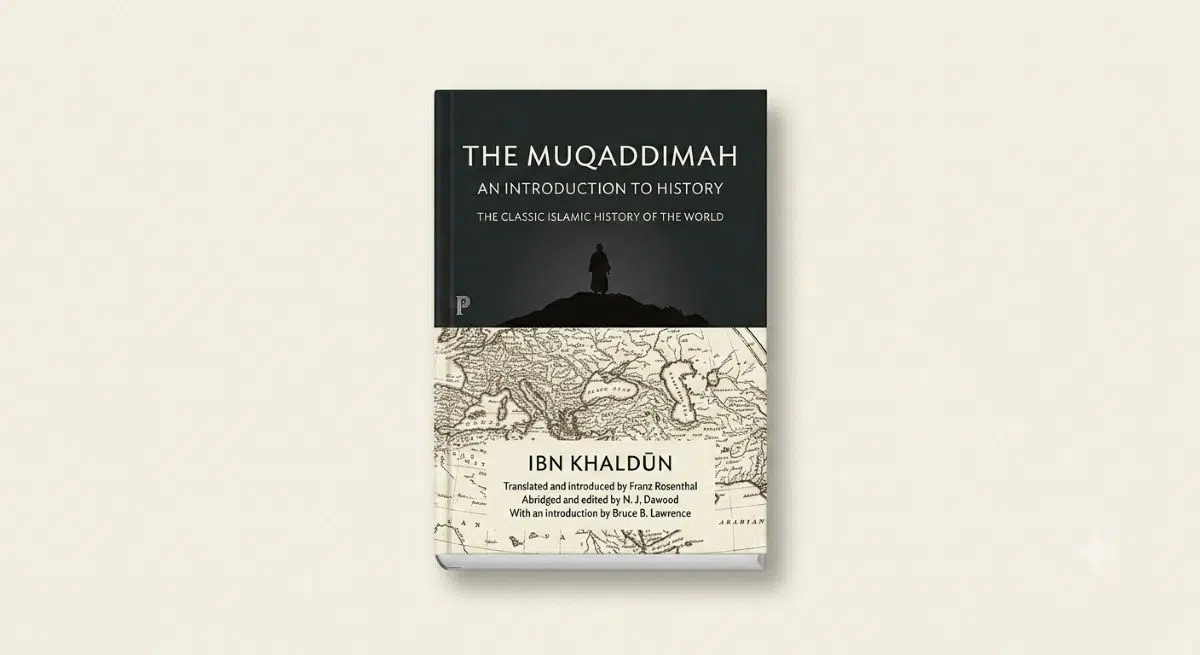
Is history merely a chronicle of the past?
We typically consume history as a sequence of events: the date a monarch ascended the throne, the victor of a particular war, or the duration of a specific empire. Historical study is often confined to these data points.
However, one fundamental question is rarely posed.
Why does a state become powerful?
More importantly—
Why does that same state eventually decline?
Is history simply the result of human choices, or are there latent principles within society that repeat themselves across generations?
In the fourteenth century, a North African judge, diplomat, and thinker set out to uncover these very answers. His name was Abu Zayd Abd al-Rahman ibn Khaldun.
He did not write biographies of kings. Instead, he sought the underlying rules governing history.
The product of this endeavor is the Muqaddimah.
Today, nearly six and a half centuries later, the book stands as more than just a seminal work of Islamic history; it remains profoundly relevant to political science, sociology, economics, and the broader study of civilization. The British historian Arnold Toynbee described Ibn Khaldun as one of the greatest intellects in the philosophy of history. In his words, the Muqaddimah "is undoubtedly the greatest work of its kind." (Toynbee, A Study of History)
This is why treating the Muqaddimah merely as a history book is a mistake. It is, in essence, a framework of thought—a lens through which history can be viewed anew.
[mp_book_box]Who was Ibn Khaldun?
To grasp the writing of any thinker, one must understand the life they led.
Ibn Khaldun was not merely a writer.
He was a judge, an administrator, a teacher, a diplomat, and a political advisor. He served under various rulers in North Africa and Andalusia. He held high office at times, and at others, he suffered imprisonment as a victim of political intrigue.
In short, he did not learn the realities of power from books; he witnessed them firsthand.
How a dynasty rises to power, how it is weakened by internal strife, and how it is eventually defeated by a new force—all of this was part of his direct experience.
It is this lived experience that distinguishes his work.
He did not wish simply to chronicle history. He aimed to identify the rules behind the repetition of historical cycles.
What is the Muqaddimah actually about?
Upon hearing the title, many might assume it is a book on Islamic history.
That is not the case.
Others might label it a work of political philosophy, but even that is incomplete.
At its simplest, the Muqaddimah is an analysis of how human societies form, how states are established, and why civilizations rise and fall.
Ibn Khaldun did not view history as a mere record of the past. He sought the causal relationships embedded within it.
He asked—
- Why do people unite?
- Why are states created?
- Why does power become centralized?
- How does prosperity arise?
- Why does luxury weaken strength?
- Why does a successful state ultimately trend toward collapse?
In seeking answers to these questions, he considered society, economics, politics, culture, religion, geography, and human behavior as a unified whole.
In modern terms, he adopted an interdisciplinary approach, long before such a term existed.
Why should this book still be read today?
The primary reason to read this book is that it teaches you to ask new questions rather than simply absorbing new information.
An empire collapsed; that is history.
But why did it collapse?
This question is the focal point of the Muqaddimah.
Similarly, when a state becomes economically weak, Ibn Khaldun does not look solely at tax rates or the decisions of a ruler. He analyzes the relationship between social cohesion, leadership, morality, productivity, and the fundamental character of the state.
This is why the book is effective not just for understanding the past, but for analyzing the present.
If you are interested in the modern state, international politics, economics, or the long-term changes of civilization, this book will not provide pre-packaged answers. Instead, it offers a framework of thought that allows you to interpret many events for yourself.
How to read history: Ibn Khaldun's first lesson
We often make a mistake when reading history books.
We assume that because an event is written in a book, it must be true.
Ibn Khaldun directly challenged this notion.
According to him, the historian’s task is not merely to collect events, but to verify their veracity.
In the fourteenth century, this was a profoundly bold position.
Most historical texts of that era were descriptions of kings, wars, and dynastic successions. Writers often took information from previous books without testing whether the data was realistic.
Ibn Khaldun asked—
Do people always write the truth?
His answer was no.
People make mistakes. They may exaggerate for political purposes. They may alter history to please a ruler.
Therefore, to read history, one must not blindly believe the author. One must evaluate whether the event was realistically possible.
This is where his thought aligns with modern historiography.
Just as a contemporary researcher verifies claims using documents, archaeological evidence, economic data, or multiple sources, Ibn Khaldun advocated for the same mentality in his time. The methods differed, but the foundation of thought remained the same: critical inquiry over blind faith.
In history, reality is more important than raw numbers
Ibn Khaldun provides a simple example.
Suppose a historian writes that a small desert kingdom went to war with one million soldiers.
The question is: is this realistic?
Who would provide food for one million soldiers?
How would their logistics be managed?
Could the technology and economy of that time support an army of that size?
If the answer is no, then the information should not be accepted simply because it is written in a book.
This logic remains equally relevant today.
In the modern era, countless pieces of information circulate on social media every day. Many stories are shared by thousands. But being popular is not the same as being true.
Ibn Khaldun never saw Facebook or X (formerly Twitter), but the principles of information verification he established are strikingly applicable in today's digital age.
The most famous concept of the Muqaddimah: Asabiyyah
If one must remember only a single concept from the Muqaddimah, it would be Asabiyyah.
The Arabic word Asabiyyah does not translate easily into other languages.
Some call it social cohesion.
Others call it group solidarity.
Others call it collective consciousness.
All three translations are partially true, but none fully capture the breadth of the term.
In the simplest terms—
Asabiyyah is a social force that teaches people to prioritize a larger goal over their personal interests.
Just as members of a family stand by one another, a tribe, a nation, or a state becomes strong only when its members possess mutual trust, a sense of responsibility, and a capacity for self-sacrifice.
According to Ibn Khaldun, this invisible force is the true foundation of state-building.
A strong society, not a strong army
We often assume that a state's strength depends on its military, wealth, or technology.
Ibn Khaldun argues that while these are important, they are merely consequences.
The root cause lies elsewhere.
If a society is united from within, it can defeat a great power even with limited resources.
But if the trust within society decays, leadership weakens, and everyone is preoccupied with their own narrow interests, even vast wealth cannot save the state in the long run.
He did not write this observation as a mere theory; he reached this conclusion by observing the rise and fall of various dynasties across North Africa, Arabia, and Andalusia.
Why does a new force defeat an old empire?
According to Ibn Khaldun, a new force possesses a significant advantage.
They typically possess a stronger Asabiyyah.
They are accustomed to a rigorous lifestyle.
Their objectives are clear.
Allegiance to leadership is comparably higher.
Conversely, in an empire that has enjoyed prosperity for many years, the picture gradually changes.
Competition for power increases.
Luxury grows.
State expenditures rise.
Central leadership weakens.
Social cohesion declines.
Consequently, that empire can be defeated by a comparatively small but united force arriving from the outside.
To Ibn Khaldun, this is no accident; it is a recurring social process.
Examples of Asabiyyah in the modern world
Asabiyyah is not limited to the tribal societies of the Middle Ages.
The concept is still visible in various spheres today.
Consider a new startup.
The founder and initial employees usually work toward the same goal. Despite limited resources, they work long hours, take risks, and sacrifice their personal interests for the institution.
As the company grows, the situation may change.
New layers of management are created.
Internal politics begin.
The unity surrounding the shared goal begins to weaken.
Not every institution travels this path, but in many, this shift is clearly observable.
The same question can be asked of the state.
Do a nation's citizens consider themselves part of a shared future?
Or have they divided into small interest groups?
In the language of Ibn Khaldun, the answers to these questions determine the long-term strength of the state.
Is Asabiyyah synonymous with nationalism?
No.
There is an important distinction here.
Nationalism can be a political ideology.
Asabiyyah is a social reality.
A state may produce impassioned nationalist rhetoric, but if there is no trust, justice, and cooperation among the citizens, genuine social cohesion is never forged.
Signed on August 7, 2026 between Saudi Arabia, Türkiye, and Pakistan, the Mecca Joint Defense Pact stipulates that an armed attack on one member shall be deemed an attack on all. For Bangladesh—confronting border casualties, unilateral riparian diversions, and transit imbalances—a collective deterrence architecture restores sovereign bargaining leverage.
Conversely, in a society where nationalism is not loudly promoted, mutual trust, cooperation, and collective responsibility can still be strong.
Ibn Khaldun emphasizes the latter.
For him, the sustainability of a state depends not on how loudly people chant slogans, but on whether they stand by one another during times of crisis.
The rise and fall of civilizations: Ibn Khaldun’s most discussed theory
Can a civilization last forever?
Looking at history, the answer is clear: No.
Egypt, Rome, the Abbasid Caliphate, the Mongol Empire, the Ottoman Empire, or the British Empire—each was, at one point, the most powerful force of its era. Yet, ultimately, none proved permanent.
Ibn Khaldun’s question was different.
Is this merely a coincidence?
Or are there characteristics inherent within civilization that gradually create the path to its own collapse?
One of the most famous sections of the Muqaddimah addresses this very question.
Civilizations do not die; they gradually transform
According to Ibn Khaldun, the life of a state or civilization can be compared to the life of a human being.
Just as a human is born, grows, matures, reaches old age, and eventually passes away—a similar, long-term cycle exists for civilizations.
He never claimed that every state would collapse at the same time or in the same manner.
Rather, his point was that the social force—the Asabiyyah—that creates a state begins to weaken over time.
This change does not occur abruptly.
It happens gradually, generation after generation.
Phase One: Struggle and Establishment
Almost all new states begin with a crisis.
A rebellion against an existing rule.
Or the rise of a new group.
During this period, people typically possess a strong sense of Asabiyyah.
Their resources may be meager.
But their objective is clear.
There is trust in leadership.
Collective success becomes more important than personal gain.
In this phase, the foundation of the new state is built.
Phase Two: Stability and Expansion
After establishing power, the state gradually organizes itself.
Administration is established.
Laws are enacted.
The economy expands.
Education, trade, and culture flourish.
This is typically the most productive period of a state.
We see this phase in many successful empires throughout history.
Phase Three: Prosperity and Luxury
This is where Ibn Khaldun’s analysis becomes most compelling.
He argues that prosperity itself is not the problem.
The problem begins when prosperity causes people to forget the memory of the struggle.
The new generation is born into a state where security, wealth, and comfort are taken for granted.
They have not seen the hardships through which the state was founded.
Consequently, the spirit of self-sacrifice gradually diminishes.
State expenditure begins to climb.
Maintaining power becomes the primary goal.
This is where the erosion of Asabiyyah begins.
Phase Four: Weakness
When social cohesion weakens, its impact is felt everywhere.
Political divisions increase.
Corruption appears in the administration.
Allegiance is valued over competence.
The state grows in size but becomes ineffective.
Expenditure increases to maintain military strength.
The burden of taxation on the people also rises.
At this stage, the state may still appear powerful to outsiders.
But the internal foundation has already begun to rot.
Phase Five: Collapse
According to Ibn Khaldun, collapse is usually the final event.
The real decay began much earlier.
When a state finally realizes its own weakness, it is often too late.
A new force emerges.
They possess more vigor.
More social cohesion.
Greater capacity for self-sacrifice.
Consequently, even the old, seemingly powerful state can be defeated by them.
Thus, one cycle in history ends, and another begins.
Why does the state increase taxes?
An astonishing observation in the Muqaddimah concerns economics.
Ibn Khaldun noted that as a state grows, its expenses also rise rapidly.
Royal palaces.
Administration.
Military forces.
The lifestyle of the elite class.
To sustain all of this, the government requires more money.
What is the easiest solution?
Increasing taxes.
But here he offers a vital warning.
Publish Your Research & Critical Analysis on MaroonPaper
Contribute in-depth essays on law, political philosophy, economics, and geopolitics to an intellectual readership.
If taxes reach a level where people lose interest in production, the state's revenue may actually decline in the long run.
This observation bears a striking resemblance to modern economic debates surrounding taxation.
However, one must remember that the economy of a modern state is far more complex than that of the Middle Ages. Therefore, Ibn Khaldun’s ideas should be viewed not as a direct manual for policymaking, but as a profound historical insight.
Did Ibn Khaldun predict the future?
Many writers claim that Ibn Khaldun predicted the future of all empires.
This claim is an exaggeration.
He did not make prophecies.
He identified a pattern or a recurring tendency.
This distinction is important.
He did not say that every state would collapse at a specific time.
Rather, he said that when a state begins to lose the core social force of its founding, its long-term stability is put at risk.
This is an analytical model, not a prediction.
This theory in the light of the modern world
While reading Ibn Khaldun’s model, many readers might find various historical examples coming to mind.
The Roman Empire.
The Ottoman Empire.
The Soviet Union.
The British Empire.
Others might even think of large corporations, political parties, or modern states.
While these comparisons are intriguing, caution is necessary.
Ibn Khaldun’s theory was not designed to explain any specific modern state.
Instead, it is a framework for analysis.
A framework that teaches us to ask questions such as—
- Is the cohesion within our institutions still as strong as it once was?
- Is leadership still being developed based on merit?
- Has prosperity turned into complacency?
- Do people still believe in a shared objective?
The answers to these questions are where the true value of his thought lies.
Where does wealth come from? Ibn Khaldun's thoughts on economics
Reading the Muqaddimah, one point becomes quickly apparent.
Ibn Khaldun thinks about economics as deeply as he thinks about the state.
This is surprising, as in the fourteenth century, economics was not viewed as a separate discipline. Economics, politics, and society were discussed as one integrated whole.
Yet, some of his observations are so profound that they align with the economic thought of the centuries that followed.
The source of wealth is not tax, but human labor
One of Ibn Khaldun’s most important assertions is—
A state does not become wealthy by collecting taxes. A state becomes wealthy when its people produce.
This statement may seem obvious to us today.
But in his time, it was a radical departure from conventional thought.
He argued that wealth is created through human labor, skill, trade, agriculture, industry, and production.
The state may collect a portion of that production as tax.
But the state itself is not the source of wealth.
This distinction is crucial.
Many rulers believe that more revenue equals more prosperity.
Ibn Khaldun argues that if the productive capacity of the people weakens, revenue will also diminish in the long run.
What is the work of the state?
Ibn Khaldun was not anti-state.
Nor was he a proponent of unlimited state power.
In his view, the primary tasks of the state are—
- To ensure security
- To establish justice
- To protect the environment for trade
- To maintain social order
When these tasks are accomplished correctly, people will invest, trade, farm, and increase production.
Consequently, the state will grow strong.
Conversely, if the state itself becomes the primary competitor for the wealth of the people, economic activity will be harmed.
Does increasing taxes always increase revenue?
This question remains a subject of political debate to this day.
Ibn Khaldun’s answer was nuanced.
He did not say that taxes must always be kept low.
Rather, he said—
We need a tax system that does not stifle the interest in production.
In a new state, tax rates are usually low.
People are encouraged to work.
Trade increases.
Consequently, even with a low tax rate, total revenue can increase.
But as the state becomes increasingly expensive, tax rates also climb.
At a certain point, people lose the interest to produce.
Some downsize their businesses.
Others reduce their investments.
Some stop production entirely.
As a result, even with high tax rates, revenue does not increase as expected.
This observation has resurfaced in the discussions of many subsequent economists.
However, one caution is necessary: Modern economics is far more complex than medieval economics. Today’s states invest heavily in education, health, infrastructure, social security, and technology. Therefore, Ibn Khaldun’s observation should be viewed as an important historical concept for understanding economic incentives, rather than a direct formula for tax policy.
Why is luxury an economic problem?
Ibn Khaldun criticized luxury.
Some readers might assume he was advocating against personal indulgence.
In reality, that is not the point.
His concern was the character of the state.
When a ruling class adopts luxury as a normal lifestyle, their expenditures rise rapidly.
To meet those expenses, new taxes are imposed.
The administration expands.
The royal court becomes more expensive.
As a result, the tendency toward resource transfer replaces production.
This can weaken the economy in the long run.
While post-WWII Germany and Italy were systematically de-Nazified, dismantling the fascist machinery in post-July Bangladesh has encountered fierce resistance. Backed by India's regional hegemony and an entrenched cultural fifth column, reactionary networks are working tirelessly to subvert the democratic breakthrough.
Here, he is not preaching morality.
He is explaining an economic relationship.
Read more: George Orwell's Animal Farm and the Tyrannical Rule of Hasina
His view on the dignity of labor
The importance of labor appears repeatedly in Ibn Khaldun’s writing.
In his view, it is human labor that creates value.
The farmer, the craftsman, the merchant, or the builder—every productive person in society contributes to the wealth of the state.
This is a remarkable observation for medieval political thought.
Many rulers viewed their wealth as a consequence of their own personal power.
Ibn Khaldun argues that the true strength of a state lies in the productivity of its people.
Where does it align with modern economics?
While reading the Muqaddimah, one may often feel that Ibn Khaldun grasped certain modern economic concepts long ago.
It is important to remember one thing: he did not have the modern economic data, statistics, or mathematical analysis of Adam Smith or John Maynard Keynes.
Yet, on fundamental questions, his thought is surprisingly mature.
For example—
- Production is the primary source of wealth.
- Economic incentives influence human behavior.
- Excessive taxation can discourage economic activity.
- A safe and justice-based environment is essential for business.
These concepts remain a vital part of economic discourse today.
This is the greatest strength of the book. The uniqueness of the Muqaddimah does not lie in providing all the answers for modern economics.
Rather, its uniqueness is this—
A historian did not view the state, society, and the economy as separate issues.
He understood that these three influence one another.
If the state is weak, the economy is harmed.
If the economy is weak, social cohesion diminishes.
If social cohesion is weak, the state cannot survive.
This capacity to understand these interrelationships is what keeps the book relevant today.
The Muqaddimah in today's world: A medieval book, or still relevant?
The ultimate test of a classic book is not its age.
The question is—
Does the book still help us think in new ways?
If the answer is yes, then the book is not merely a historical document; it is a living intellectual asset.
The Muqaddimah is one of those rare books.
Because the book teaches you a method of thinking, rather than just teaching you the events of a specific era.
And good methods of thinking never grow old.
How does one view the modern state after reading this book?
After reading Ibn Khaldun’s theory, many readers quickly begin searching for parallels with the modern world.
This is natural.
However, a word of caution is necessary.
It is not correct to force every modern state into his theory.
Instead, it is more productive to use his concepts as a framework for generating questions.
For example—
- Are the institutions of a state still functioning effectively?
- Is leadership becoming too personality-driven?
- Is the state more focused on consumption than on production?
- Is mutual trust within society increasing or decreasing?
- Do the people view the state as their own institution, or as an external power?
In seeking answers to these questions, the Muqaddimah finds new meaning.
Not just the state, but institutions can be understood
Ibn Khaldun wrote about the state.
But his concepts often provide food for thought regarding large institutions, businesses, or organizations.
Consider a small organization.
In the beginning, the founder and team members work toward the same goal.
Everyone's contribution is visible.
Decisions are made quickly.
The division of responsibility is clear.
As the organization grows, new layers are created.
Administrative complexity increases.
Communication slows down.
At some point, the sense of purpose within the organization can weaken.
This does not happen to every organization.
However, Ibn Khaldun’s analysis teaches us to at least ask this question—
Has the institution maintained the strength it had during its founding?
This is why researchers like Franz Rosenthal, Ernest Gellner, and Robert Irwin, who study business and leadership, read his work with such keen interest.
The importance of the book for the Bangladeshi reader
In Bangladesh, discussions about history are often trapped in two extremes.
On one side is emotion.
On the other is political positioning.
Consequently, there is debate over historical events, but very little discussion on the methods of understanding history itself.
The Muqaddimah is different in this regard.
The book does not attempt to prove the superiority of any specific nation or state.
Instead, it asks—
What social force sustains the state?
What habits weaken the state?
Why does the same mistake repeat itself in history?
For the Bangladeshi reader, the greatest value of the book likely lies right here.
It does not offer pre-packaged political decisions.
It teaches you to ask good questions.
And in a democratic society, the ability to ask good questions is often more important than having ready-made answers.
The limitations of the book
Like any classic, the Muqaddimah has its limitations.
Not acknowledging them would be a disservice to the work.
First, the book is based on the experience of the medieval world.
The realities of today’s nation-states, global economy, digital technology, or international institutions did not exist then.
Second, much of his analysis is observation-based.
He did not have at his disposal the extensive statistics, field research, or experimental methods of modern sociology.
Third, he often took dynasty-centric state systems as the foundation for his analysis.
The complexities of modern democratic states go beyond that framework.
However, these limitations do not diminish the importance of the book.
Rather, they remind us that the purpose of reading a classic is not to find every answer, but to build a foundation for thought.
Who should read this book?
The Muqaddimah may not be equally suitable for all readers.
If you are looking for a history book to read through quickly, this is likely not for you.
But if you—
- Want to understand the underlying causes of history,
- Want to know how a state is formed,
- Are interested in the long-term changes of civilization,
- Want to understand politics, society, and economics together,
- Or love to read about the history of ideas,
Then the Muqaddimah should certainly be on your reading list.
The book must be read slowly.
You have to pause and think in many places.
Sometimes, it may even be necessary to read the same section twice.
My evaluation
To call the Muqaddimah merely an "important book of Islamic history" would be to undervalue it.
Conversely, calling it the "most modern book" would be an exaggeration.
To me, the greatest strength of this book lies elsewhere.
Ibn Khaldun dared to question history at a time when most historians were merely recording events.
He did not separate the state from the economy.
He did not separate the economy from society.
He did not separate society from culture.
This integrated perspective kept him ahead of many thinkers of his time.
Perhaps this is the greatest reason to read the book today.
It does not teach you what to think.
It teaches you how to think.
Final thoughts
History books typically introduce us to the past.
The Muqaddimah does much more than that.
It forces us to view our own present through a new lens.
Why is a state successful?
Why does it fail?
What force brings people together?
Why does that force eventually fade away?
Perhaps there are no simple answers to these questions.
But without good questions, no good answers can be born.
Many of the questions Ibn Khaldun asked six and a half centuries ago remain before us today.
Perhaps that is why the Muqaddimah is not just an old book.
It is a book that every new generation must read again.