
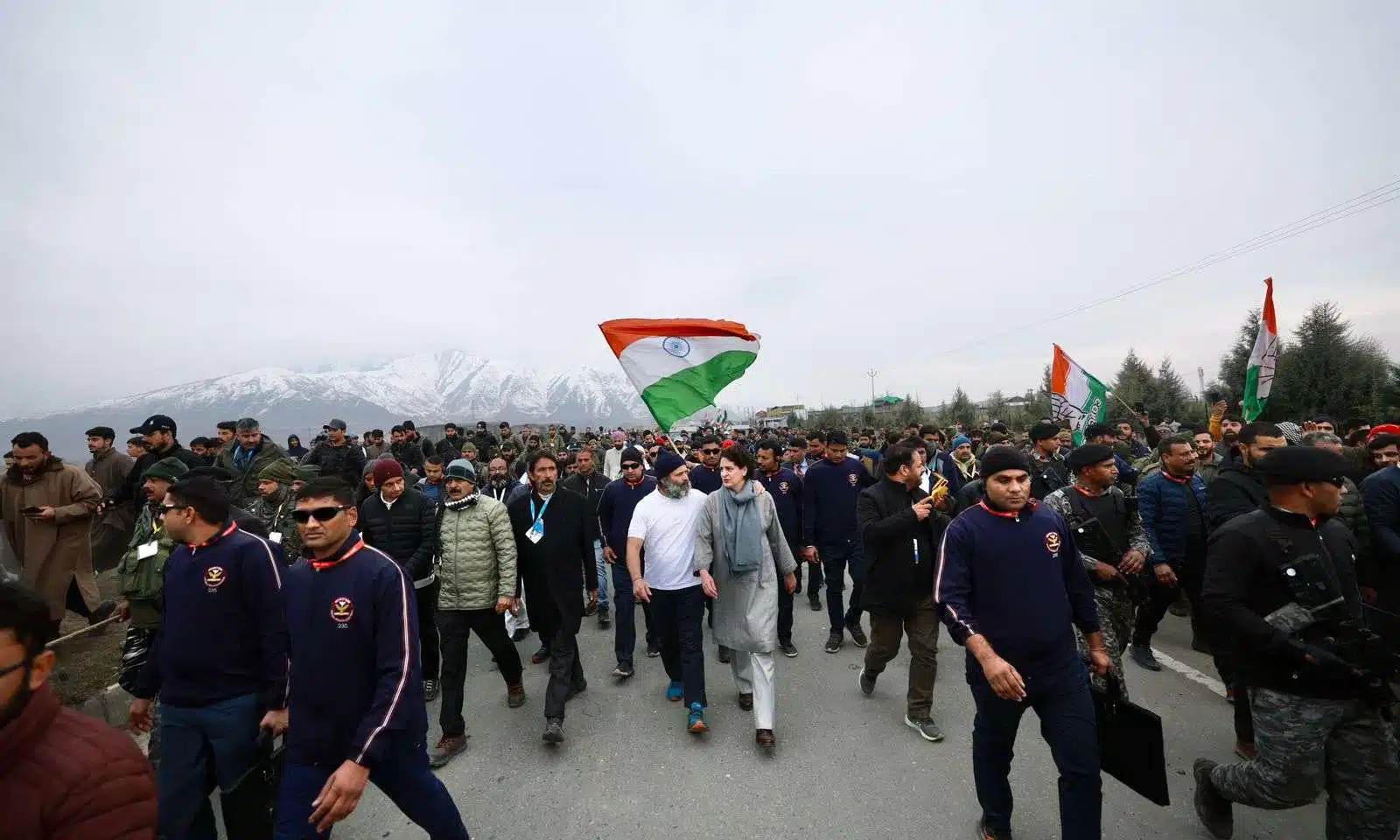
In contemporary Indian politics, the accelerated rise of majoritarian nationalism, communal polarization, and media capture has fundamentally strained the republic's secular constitutional fabric. In response to this ideological hegemony, the Indian National Congress (INC) launched the Bharat Jodo Yatra ("Unite India March")—a mass public foot-march spanning 4,080 kilometers from Kanyakumari in the southern tip of the subcontinent to Srinagar in Jammu and Kashmir. Spearheaded by Rahul Gandhi, this mass mobilization sought to directly challenge the sectarian politics of the ruling Bharatiya Janata Party (BJP), resurrect civil society dialogue, and reassert India’s pluralist founding ideals.
Beyond the conventional narratives propagated by Western media, a closer inspection of the map reveals a starker reality: the perpetual instability in the Middle East serves as a backdrop to a ruthless shadow conflict over the Strait of Hormuz—the critical maritime chokepoint through which twenty percent of the world’s petroleum supply flows.
What Was the Bharat Jodo Yatra?
Traversing 12 states and two Union Territories over 146 days between September 7, 2022, and January 30, 2023, the march represented the most ambitious mass foot-march (padayatra) in post-independence Indian history. Inspired by the moral traditions of Mahatma Gandhi’s Dandi Salt March and the historic civil mobilizations against British colonialism, the Yatra sought to physically reconnect political leadership with ordinary citizens away from curated television studios and algorithmic social media polarization.

Structural Drivers Behind the March
The Yatra was inaugurated against three acute national crises:
Publish Your Research & Critical Analysis on MaroonPaper
Contribute in-depth essays on law, political philosophy, economics, and geopolitics to an intellectual readership.
- Communal and Cultural Polarization: The systematic marginalization of religious minorities, hate speech normalization, and the erosion of Nehruvian secularism under the hegemony of the Sangh Parivar.
- Economic Disparity and Unemployment: Crushing youth unemployment, historic inflation, farmer distress, and the perceived concentration of national wealth among a handful of favored oligarchic conglomerates.
- Institutional Capture and Democratic Backsliding: The weaponization of federal investigative agencies (Enforcement Directorate, CBI) against opposition figures, alongside the subservience of legacy corporate media.

Ideological Repositioning and Public Reception
The march achieved a significant perceptual transformation for Rahul Gandhi, dismantling the derogatory "Pappu" caricature curated for over a decade by the ruling party’s digital apparatus. Gandhi framed the march as an act of moral resistance: "Nafrat ke bazaar mein, mohabbat ki dukaan khol raha hoon" ("In this market of hatred, I am opening a shop of love").
The volatility currently defining Middle Eastern statecraft is anchored by the convergence of the intractable Palestinian crisis and the Abraham Accords—a transformative diplomatic framework that continues to reshape the regional architecture.
The ruling BJP dismissed the initiative as a political stunt aimed at rehabilitating a declining dynastic brand, arguing that India was already fundamentally united under the constitutional leadership of Prime Minister Narendra Modi. Nevertheless, the Yatra drew vast spontaneous participation from civil society groups, intellectuals, farmers, and artistic figures who had previously maintained distance from party politics.
Conclusion
While the Bharat Jodo Yatra did not instantly dismantle the formidable electoral apparatus of the BJP, it decisively demonstrated that an alternative moral and political narrative remains viable in the world's most populous democracy. By reclaiming the public square and centering secular brotherhood over communal division, the Yatra altered the psychological dynamic of Indian opposition politics, underscoring that the battle for India’s soul will be contested on its streets and within its constitutional conscience.