The 1763 Treaty of Paris: A Pivot Point in Global History
Rakibul Islam
•February 20, 2024•5 min read
The 1763 Treaty of Paris stands as a seminal diplomatic watershed, effectively terminating the Seven Years' War among France, Spain, and Great Britain—a global conflagration that fundamentally reshaped the geopolitical landscape of the major European powers and their respective colonial dominions.
The Treaty of Paris of 1763 served as a seminal accord, bringing to a close the Seven Years' War—a global conflagration that pitted the preeminent European powers and their colonial outposts against one another. The treaty fundamentally redrew the world map, precipitating a structural shift in the global balance of power. In this article, we shall examine the provenance of the 1763 treaty, its core provisions, its long-term repercussions, and the manner in which it redirected the course of history.
The Context and Belligerents of the 1763 Treaty of Paris
The conflict, known in North America as the French and Indian War, was part of the broader Seven Years' War fought between France, Spain, and Great Britain. Hostilities erupted in 1754 as a result of clashing colonial ambitions in North America and India. The theater of war rapidly expanded to encompass Europe, Africa, Asia, and the Caribbean. The Treaty of Paris, signed on February 10, 1763, formally concluded the protracted struggle between France and Great Britain for control of the North American continent.
The Treaty of Paris of 1763 was a landmark agreement that ended the Seven Years' War between France, Spain, and Great Britain.
The primary signatories of the 1763 Treaty of Paris were Great Britain, France, Spain, and Portugal—the latter having been involved as a British ally. The agreement was brokered by diplomats from the respective nations in Paris, France.
Key Provisions of the Treaty of Paris
The treaty was defined by four primary provisions:
1. Territorial Realignments
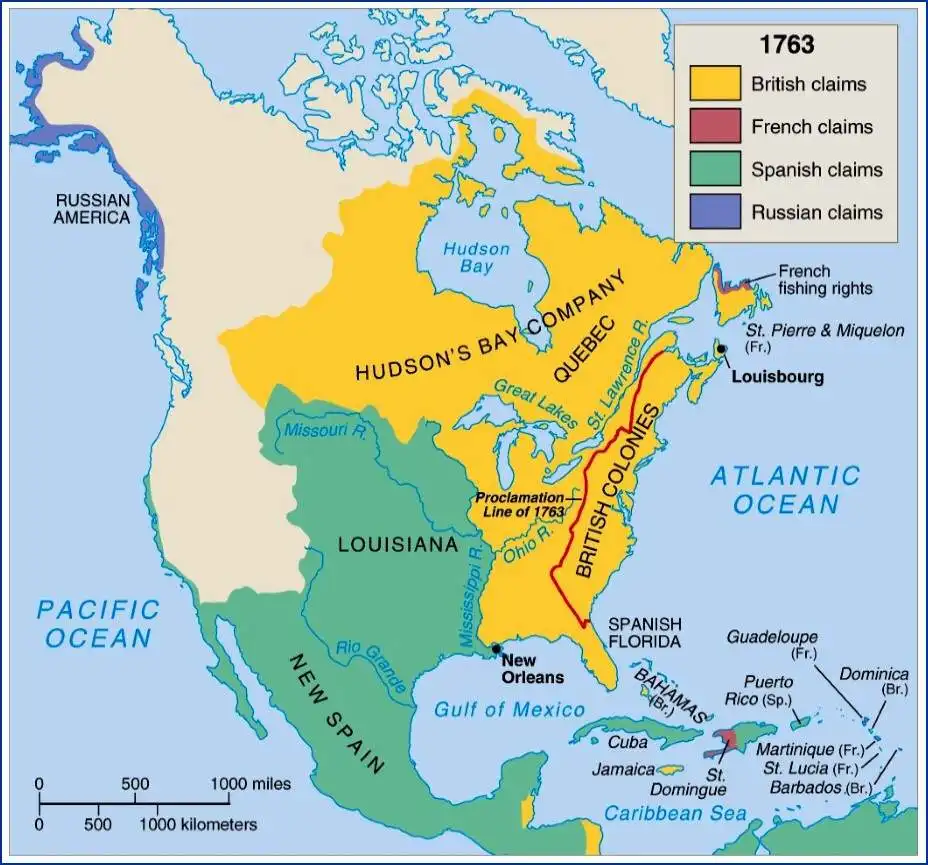
The treaty exacted heavy territorial losses upon France. Under its terms, France was compelled to cede virtually all of its North American holdings east of the Mississippi River—with the notable exception of New Orleans and its immediate environs. Consequently, Britain secured undisputed control over Canada and the vast territory spanning the Appalachian Mountains to the Mississippi River. Britain also acquired French territories in India, consolidating its imperial reach in Asia. France, however, retained New Orleans and several Caribbean holdings, including Saint-Domingue (modern-day Haiti), Guadeloupe, Martinique, Marie-Galante, and Désirade.
Territorial claims of the parties involved in the 1763 Treaty of Paris. Image: AminoApps.com
2. The Caribbean Exchange
To compensate for its losses in North America and Asia, France reclaimed certain Caribbean colonies from Britain. In exchange for Saint Lucia, Britain returned Guadeloupe, Martinique, Marie-Galante, and Désirade—territories that had been seized by the British in 1756. These islands remained critical nodes for the production of sugar and other tropical commodities.
Spain, having entered the war as a French ally, was among the defeated parties. It was forced to cede East and West Florida to Britain, effectively stripping Spain of its North American foothold. However, Spain was permitted to reclaim Havana and Manila, which had been occupied by the British during the conflict. Furthermore, as compensation, Spain received Louisiana (including New Orleans) from France, granting it control over a vast expanse of territory west of the Mississippi.
4. Evacuation and Restitution
The treaty mandated that French forces evacuate the German territories of Hanover, Hesse, and Brunswick, which had been occupied during the war. These regions were aligned with Britain and Prussia, the other major belligerents. Additionally, the treaty included provisions for the restoration of any property or rights seized or violated by the warring parties throughout the duration of the conflict.
Impact and Legacy
The Treaty of Paris left an indelible mark on global geopolitics, colonization, and commerce. By establishing Britain as the dominant colonial power in both North America and India—while relegating France to a diminished role—the treaty set the stage for the American Revolution. In its efforts to recover the immense financial costs of the war, Britain imposed new tax regimes and administrative constraints on its colonies, sparking resistance among colonists that would eventually culminate in open rebellion against British rule.
The treaty also altered the trajectory of European and global history. It weakened French influence in Europe while bolstering the status of Prussia as a formidable rival to Austria. Furthermore, the treaty ignited dissatisfaction among Native American tribes who had allied with France, and it significantly influenced the development of Canada as a bilingual and multicultural nation.
In the realms of global diplomacy and international law, the 1763 treaty remains a landmark. It stands as one of the first examples of a multilateral peace agreement predicated on the competing interests of multiple sovereign parties. It established core tenets that remain salient today, including the recognition of national sovereignty, the principle of territorial integrity, and mutual state recognition.
Conclusion
The Treaty of Paris of 1763 stands as a pivotal moment in world history, ending a long and profligate war and reshaping the global landscape. Its implications for international politics, colonialism, trade, culture, and law are profound. The treaty inaugurated a new era of challenges and transformations for the nations involved. Above all, it serves as an enduring testament to the power of diplomacy in resolving systemic conflicts and fostering collaboration among nations with vastly divergent interests and worldviews.
Share this intellectual discourse
Help expand constructive dialogues on global affairs, law, and politics.
Rakibul Islam
Author & Contributor, MaroonPaper
Contributing insightful research and analytical essays on law, politics, history, and international affairs for MaroonPaper.