
The History of the Israeli-Palestinian Conflict
The Origins of Zionism
The history of Palestine is as profound as the history of the Abrahamic faiths themselves—though it does not conform to the narratives propagated by modern Israeli occupiers. The theological ideals propagated by the Prophet Musa (Moses) are distinct from the political ideology of modern Zionism. Historically, the region known as Palestine has served as the cradle for numerous civilizations—including the Egyptians, Canaanites, Israelites, Babylonians, Persians, Greeks, Romans, and Byzantines. Owing to its profound religious and historical significance, the region remains of paramount importance to Jews, Christians, and Muslims alike.
Those who cite Zionism to justify the occupation of Palestine were, in many instances, arrivals from Europe, where they had faced systemic persecution and expulsion in the late 19th century. As European anti-Semitism intensified, the impulse to relocate these displaced populations elsewhere became a geopolitical project. To address the "Jewish Question," the Austro-Hungarian journalist and writer Theodor Herzl codified the movement known as Zionism. In his 1896 work, *Der Judenstaat* (The Jewish State), Herzl articulated the vision of a national homeland where Jews could reside independently. The term "Zion" refers to Jerusalem, and the movement sought the return of Jews to what was framed as their ancestral homeland—a response to the pogroms and rising anti-Semitism in Eastern Europe, particularly Russia.


Rewriting the History of the Peace Process
Initially, Palestine was not the exclusive focus for a Jewish state; other regions were considered. In 1903, the Sixth Zionist Congress debated the "Uganda Scheme," which proposed the establishment of a Jewish settlement in East Africa. However, this proposal was rejected by those who insisted that the movement’s ideology necessitated a return to Palestine. Other territories, including Argentina, Canada, and parts of the United States, were also briefly considered as back-up plans, though Zionists remained fixated on Palestine as their long-term goal.
To analyze the history of the Israel-Palestine conflict, we shall divide the timeline into several critical epochs: the late 19th century, the early 20th century, the mid-20th century, the late 20th century, and the early 21st century.
The Late 19th Century
The late 19th and early 20th centuries were periods of significant transformation and upheaval in Palestine.
The First Aliyah (1881–1903)
This period marked the first wave of Jewish immigration to Palestine, triggered by pogroms and anti-Semitic violence in Europe. Between 25,000 and 35,000 Jewish immigrants arrived during this time.
Theodor Herzl and the Zionist Congress (1897)
Organized by Theodor Herzl in Basel, Switzerland, the first Zionist Congress laid the foundation for the political movement, with the ultimate objective of creating a sovereign state for the Jewish people.
Ottoman Rule and the Tanzimat Reforms
Palestine had been under Ottoman rule since 1517. In the 19th century, the Ottoman government implemented the *Tanzimat* reforms, which aimed to modernize the empire and ensure its stability. While designed to unify the state, these reforms often unintentionally exacerbated sectarian tensions among the empire's diverse ethnic and religious communities.
Early 20th Century
The Second Aliyah (1904–1914)
A second, more substantial wave of Jewish immigration brought approximately 40,000 settlers to Palestine. These immigrants established agricultural cooperatives and began the process of urbanization.
The Young Turk Revolution (1908)
The Young Turk Revolution was a pivotal moment in Ottoman history, aiming to establish a constitutional government. The movement initially sparked hopes for greater autonomy and equality among the various ethnic and religious groups within the empire.
The Balfour Declaration (1917)
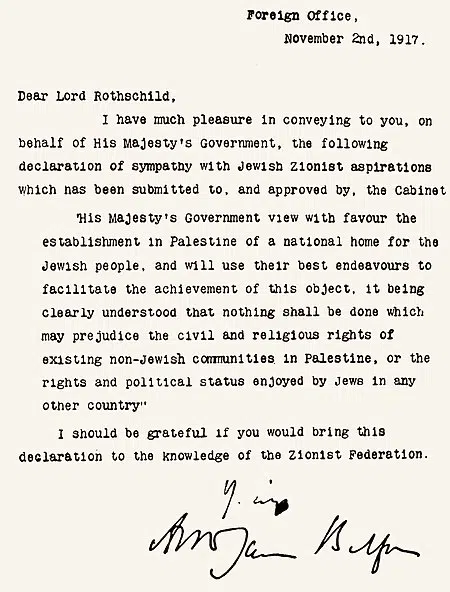
The Balfour Declaration was a formal statement issued by the British government during World War I in support of the Zionist movement. On November 2, 1917, British Foreign Secretary Arthur James Balfour wrote to Baron Rothschild, leader of the British Jewish community. The document expressed support for the establishment of a "national home for the Jewish people" in Palestine, while simultaneously claiming to protect the rights of existing non-Jewish communities. This declaration is widely considered a primary catalyst for the subsequent conflict.
A retrospective of European historiography reveals that, while the continent languished in the medieval depths of superstition, squalor, and intellectual stagnation, the Iberian Peninsula served as a luminous beacon of civilization. It was within this crucible that the Muslim architects of the region forged the enduring, multifaceted heritage of Al-Andalus.
The British Mandate (1920)
The British Mandate was an authorization granted by the League of Nations for British control over Palestine. Established on July 24, 1920, it remained in effect until the declaration of the State of Israel on May 14, 1948. Through a High Commissioner based in London, the British administration actively encouraged Jewish immigration, which dramatically increased tensions between the Arab and Jewish communities and catalyzed widespread violence.
Mid-20th Century
The mid-20th century was defined by profound geopolitical shifts. Britain facilitated the influx of displaced European Jews into Palestine, while Zionist organizations established agricultural *kibbutzim* and *moshavim* on purchased land. As the demographic balance shifted, Palestinian resentment deepened, leading to the following historical events:
The Arab Revolt (1936–1939)
Palestinian Arabs rose in revolt against British colonial rule and the sustained influx of Jewish immigrants. Driven by economic hardship, the systematic dispossession of land, and the perception of British administrative bias, the revolt utilized strikes, protests, and attacks on British infrastructure. The British responded with mass arrests and curfews, but the conflict only served to harden resistance against the colonial mandate.
The Peel Commission (1937)
Following the Arab Revolt, the British established the Peel Commission to investigate the root causes of the unrest. The Commission recommended the partition of Palestine into two separate states, with Jerusalem remaining under international administration. Neither side accepted these recommendations.
World War II (1939–1945)
The war exerted catastrophic pressure on Palestine. Arab leaders were divided in their allegiances, while the Nazi Holocaust in Europe created a desperate humanitarian crisis that led to increased pressure for Jewish immigration and the eventual demand for a sovereign state in Palestine.
UN Partition Plan (1947)
On November 29, 1947, the United Nations proposed a plan to divide Palestine into separate Jewish and Arab states, with Jerusalem under international control. Jewish leadership accepted the plan, but Arab leadership rejected it, paving the way for the 1948 Arab-Israeli War.
The Declaration of Israeli Independence and the 1948 War
On May 14, 1948, David Ben-Gurion declared the establishment of the State of Israel. The following day, the 1948 Arab-Israeli War began, involving Israel, Egypt, Jordan, Lebanon, and Syria. Initially, Arab forces made gains, but with American support—including armaments and aircraft—the tide turned in Israel's favor. By the war’s end in July 1949, hundreds of thousands of Palestinians had been displaced—a catastrophe they refer to as the *Nakba*.
Armistice Agreements (1949)
Armistice agreements established the "Green Line," though the West Bank and Gaza remained under Jordanian and Egyptian control, respectively.
Suez Crisis (1956)
Following Egyptian President Gamal Abdel Nasser's nationalization of the Suez Canal, Israel, Britain, and France launched a coordinated military strike against Egypt. International pressure, particularly from the U.S. and the Soviet Union, forced their withdrawal by December 1956.
Publish Your Research & Critical Analysis on MaroonPaper
Contribute in-depth essays on law, political philosophy, economics, and geopolitics to an intellectual readership.
Six-Day War (1967)
In June 1967, following a period of heightened regional tension and the mobilization of Egyptian troops, Israel launched a preemptive strike against Egypt, Syria, and Jordan. In six days, Israel decimated the Egyptian air force and captured the Sinai Peninsula, the Golan Heights, the West Bank, East Jerusalem, and the Gaza Strip.
Palestine Liberation Organization (PLO)
Founded in 1964, the PLO became the nationalist umbrella organization for the Palestinian people. Under Yasser Arafat, who assumed leadership in 1969, the organization sought the restoration of Palestinian rights and the establishment of a sovereign state.
Late 20th Century
The late 20th century witnessed significant geopolitical shifts, with recurring wars, the deepening refugee crisis, and the rise of a distinct Palestinian national identity.
Yom Kippur/Ramadan War (1973)
On October 6, 1973, an Egyptian and Syrian coalition launched a surprise attack on Israel during the Yom Kippur holiday. While Israel eventually repelled the forces and reached the outskirts of Suez, the war forced a reassessment of regional security and eventually led to diplomatic shifts.
Camp David Accords (1978)
Brokered by U.S. President Jimmy Carter, the Camp David Accords led to a peace treaty between Egypt and Israel. Egypt recovered the Sinai Peninsula and became the first Arab nation to officially recognize the State of Israel.
First Intifada (1987–1993)
The First Intifada was a grassroots uprising against the Israeli occupation of Gaza and the West Bank. Characterized by civil disobedience, protests, and guerrilla resistance, the movement was met with brutal force by the Israeli Defense Forces (IDF). In the first two years alone, thousands of Palestinian children were injured, and hundreds were killed.
Oslo Accords (1993)
The Oslo Accords established a framework for peace, leading to the creation of the Palestinian Authority (PA) and a phased withdrawal of Israeli forces from parts of the West Bank and Gaza. Israel recognized the PLO as the legitimate representative of the Palestinian people.

The 21st Century
The new century has been marked by persistent conflict, the construction of separation barriers, and intermittent cycles of extreme violence.
Widely recognized as one of the world's inaugural written constitutions, the Charter of Medina serves as a seminal historical document, establishing foundational precedents for the Islamic state, religious pluralism, and the architecture of social cohesion.
Second Intifada (2000–2005)
Triggered by Ariel Sharon’s provocative visit to the Al-Aqsa Mosque compound, the Second Intifada (or Al-Aqsa Intifada) saw a dramatic escalation in suicide bombings, armed clashes, and Israeli military incursions, further crystallizing the Palestinian struggle for identity.
The West Bank Barrier (2002)
In 2002, Israel began constructing a 708-kilometer separation barrier. While Israel frames this as a security necessity, Palestinians view it as an instrument of ethnic segregation and apartheid, as significant portions of the wall extend deep into Palestinian territory, isolating communities and disrupting economic life.
Roadmap for Peace (2003)
A multi-phase plan proposed by the "Quartet" (U.S., EU, Russia, UN) to reach a two-state solution, the Roadmap ultimately failed to materialize due to a lack of genuine implementation by either party.
Death of Yasser Arafat (2004)
After being effectively held under house arrest in Ramallah by Israeli forces, Yasser Arafat fell ill and died in Paris in 2004. Subsequent research has suggested the presence of polonium-210 in his remains, leaving a massive leadership vacuum in the Palestinian struggle.
Gaza Withdrawal (2005)
Israel unilaterally dismantled its illegal settlements in Gaza and withdrew its military, creating a power vacuum that shifted the internal political landscape.
Hamas Election Victory (2006)
Hamas won a landslide victory in the 2006 legislative elections, leading to a political schism between Hamas-governed Gaza and the Fatah-governed West Bank.
The 2006 Lebanon War
A 34-day military conflict between Israel and Hezbollah, resulting in heavy casualties and destruction in Lebanon.
Gaza Genocide/Operation Cast Lead (2008–2009)
A three-week offensive that resulted in the deaths of over 1,400 Palestinians and 13 Israelis.
Palestine's Observer Status (2012)
The UN General Assembly upgraded Palestine’s status to "non-member observer state."
The Trump Administration and Jerusalem (2017)
President Donald Trump recognized Jerusalem as the capital of Israel and announced the relocation of the U.S. embassy, a move that drew widespread international condemnation.
The Abraham Accords (2020–2021)
Several Arab nations normalized diplomatic relations with Israel, fundamentally altering regional geopolitical dynamics.
The Current State of the Conflict
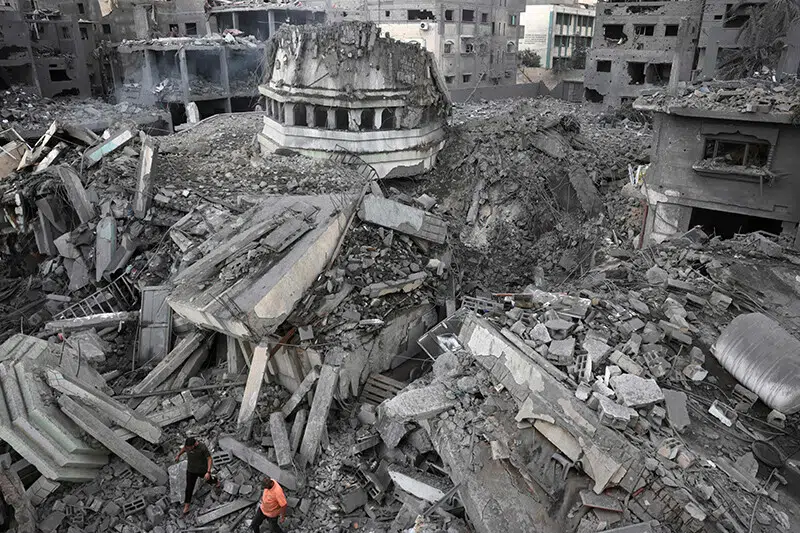
In 2021, the International Criminal Court (ICC) opened investigations into war crimes committed by both Israel and Hamas since 2014. Despite Israeli rejection of the investigation, the cycle of violence continued, culminating in the events of October 7, 2023. On that day, Hamas launched an unprecedented attack on Israel, resulting in approximately 1,200 deaths and the taking of over 240 hostages. Israel responded with a total war on Gaza, utilizing massive aerial bombardment and a ground invasion. Within the first six days, Israel dropped 6,000 bombs on the densely populated strip. Independent media reports estimate that over 17,000 people have since been killed. While the international community has called for a ceasefire, the U.S., Canada, and NATO members have provided significant military support to Israel.
After six weeks of devastating warfare, a temporary four-day ceasefire was reached, later extended, which facilitated the release of 50 women and children held by Hamas in exchange for 150 Palestinian women and children from Israeli prisons. The Israel-Palestine conflict remains one of the most complex and tragic struggles in history, with the threshold of humanitarian catastrophe long since crossed, and no clear end in sight.