Switch language / ভাষা পরিবর্তন করুন
PoliticsEnglish Edition

The Abraham Accords: Geopolitical Realignment in the Middle East and the Marginalization of the Palestinian Question
Rakibul IslamRakibul Islam
•April 9, 2025•8 min read
The Abraham Accords: Geopolitical Realignment in the Middle East and the Marginalization of the Palestinian Question

The Abraham Accords represent a multifaceted series of diplomatic agreements designed to institutionalize the normalization of relations between Israel and a coalition of Arab states, most notably the United Arab Emirates and Bahrain.

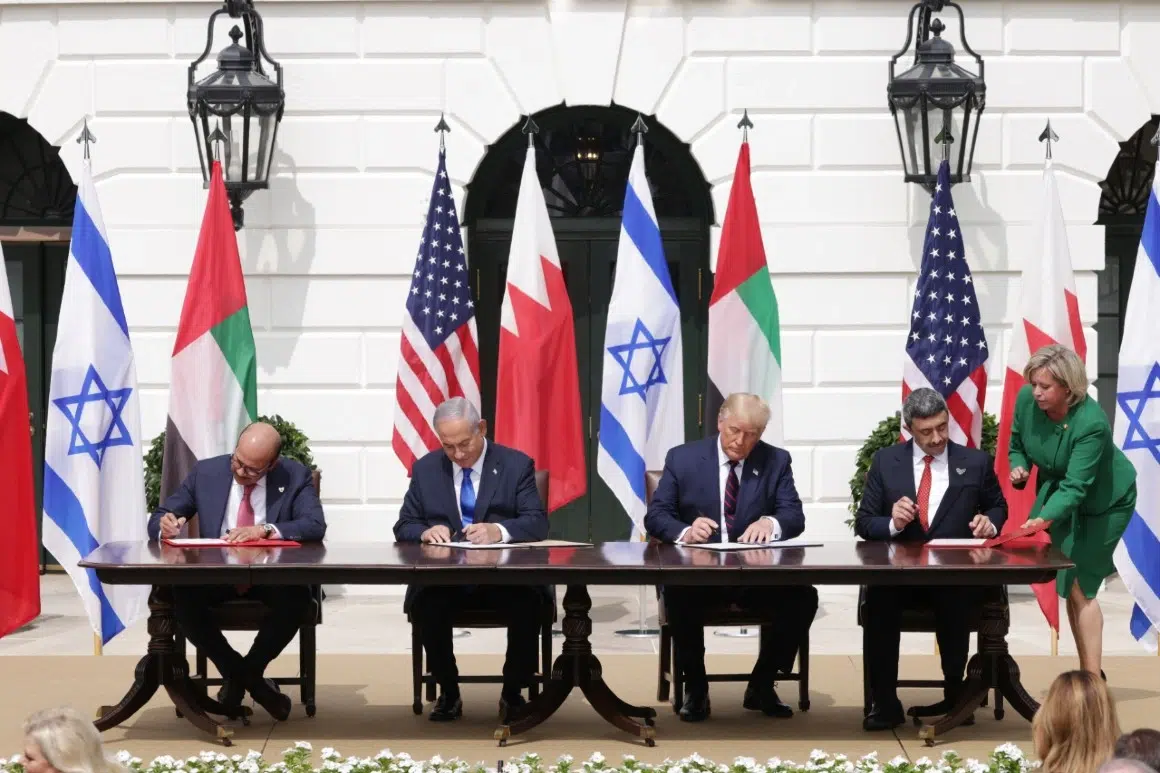
On September 15, 2020, under the mediation of U.S. President Donald Trump, a "historic peace agreement" known as the Abraham Accords was signed at the White House between Israel, the United Arab Emirates (UAE), and Bahrain. This pact ignited widespread controversy globally, particularly within the Muslim world. It represents a fundamental shift in the long-standing stance of Arab nations regarding the rights and sovereignty of the Palestinian people. Below, we examine the essence of the Abraham Accords, their core components, and their underlying strategic objectives. We will further analyze how these agreements have effectively betrayed the Palestinian cause while simultaneously reconfiguring the geopolitical balance of power in the Middle East.

What are the Abraham Accords?

The Abraham Accords represent a collection of treaties signed on September 15, 2020, at the White House, aimed at normalizing diplomatic relations between Israel and several Arab states, including the UAE and Bahrain. The name derives from the patriarch Abraham—a foundational figure shared by the "Abrahamic faiths" (Judaism, Christianity, and Islam). The process was brokered by the Trump administration. The primary objective was to normalize diplomatic and commercial relations. Officially, in exchange for the accords, Israel committed to suspending its plans for declaring sovereignty over portions of the West Bank and halted the establishment of new settlements. In return, provisions were made to enhance cooperation in investment, tourism, direct air travel, security, telecommunications, and other sectors.

Who signed the Abraham Accords?

Through the U.S.-brokered process in September 2020, four Arab nations normalized relations with Israel. These follow the precedents set by Egypt in 1979 and Jordan in 1994. The following is a list of direct signatories and indirect supporters: **Direct Signatories:** 1. **United Arab Emirates (UAE):** The first Arab nation to formally recognize Israel (August 13, 2020). 2. **Bahrain:** Signed the agreement on September 15, 2020, eleven days after the UAE. 3. **Morocco:** Signed the agreement in December 2020. 4. **Sudan:** Agreed in principle in October 2020, though formal signing was delayed due to internal political instability. **Indirect Participants and Roles:** 1. **United States:** The Trump administration served as the primary architect and broker. 2. **Saudi Arabia:** Though not a formal signatory, the kingdom signaled its tacit support by allowing the UAE and Bahrain to proceed, viewing the accords as a pragmatic step against mutual regional rivals. 3. **Egypt and Jordan:** Pre-existing peace treaties (1979 and 1994, respectively) provided the foundational regional framework for these new normalization efforts.

What are the core components of the Abraham Accords?

The accords focus primarily on diplomatic normalization, economic cooperation, security integration, and technology exchange. Behind these objectives lies a concerted desire to contain the expanding political, military, and economic influence of Iran in the Middle East.

Diplomatic Normalization

The cornerstone of the accords is the establishment of formal diplomatic relations. This includes opening embassies, exchanging ambassadors, and mutual support on international stages, providing Israel with a major opportunity to strengthen its standing in the region.

Economic Cooperation

The agreements emphasize broad cooperation in trade, investment, tourism, and technology. Both the UAE and Israel anticipate significant economic gains. Direct commercial flights have already been established to facilitate business and tourism.

Security Cooperation

Arguably the most significant facet is the security alignment against Iran. Israel and the Gulf states view Iran as a primary regional threat. By bringing these nations together, the U.S. has created a framework to coordinate a joint security front against Tehran, encompassing counter-terrorism, intelligence sharing, and military collaboration.

Technology Exchange

Israel is a global leader in high-tech industries, particularly in agriculture, water management, cybersecurity, and healthcare. The accords facilitate the export of these technologies to the Gulf. In the UAE, where water scarcity is a critical challenge, Israeli water conservation and desalination technologies are of particular value.

The Impact: A New Political Landscape and the Betrayal of Palestinians

Geopolitical Context: Iran-Turkey vs. Israel-Saudi Alignment

The Abraham Accords transcend simple diplomacy; they are driven by shifting power dynamics, regional rivalries, and the recalibration of American influence. The primary geopolitical driver is the containment of Iran. To counter Iranian influence in Iraq, Syria, Lebanon, and Yemen, Gulf states and Israel have sought to form a formidable coalition. For the U.S., these accords serve to maintain regional influence even while potentially reducing direct military presence. This polarization has effectively split the Middle East: on one side, an Israel-Gulf-U.S. axis, and on the other, an Iran-Turkey alignment and their associated proxies. While Turkey cooperates strategically with Iran, it simultaneously maintains significant trade with Israel. | Israel-Saudi Axis | Iran-Turkey Axis | | :--- | :--- | | U.S.-backed: Israel, Saudi Arabia, UAE, Bahrain, Egypt, Morocco, Jordan | Grassroots/Ideology-backed: Iran, Turkey, Syria, Qatar, Yemen, Hezbollah, Hamas | | Militarily, technologically, and economically powerful | Active in military operations and proxy conflicts | | Ignores Palestinian statehood | Advocates for independent Palestine |

Betrayal of Palestinians: A "Stab in the Back"

The most glaring indictment of the Abraham Accords is the complete disregard for Palestinian interests. Palestinian leader Mahmoud Abbas famously described the deal as a "stab in the back." In 2002, the Arab League proposed the "Arab Peace Initiative," which conditioned normalization with Israel on its withdrawal from all territories occupied since 1967 and the establishment of a sovereign Palestinian state. The Abraham Accords effectively abandoned this consensus, de-prioritizing the Palestinian issue in favor of individual state interests. Despite promises to halt settlement expansion, Israeli Prime Minister Benjamin Netanyahu confirmed within 24 hours of the signing that Israel would not relinquish its territorial ambitions in the West Bank. This demonstrates that Israel viewed the accords as a vehicle for normalization rather than a pathway toward a just resolution for Palestinians. The results have been devastating. Since the onset of these agreements, and particularly following the events of October 7, 2023, the Israel-Palestine war has resulted in over 62,614 Palestinian deaths and the displacement of nearly 2 million people. Throughout this, the signatory nations have maintained their commercial ties, which have grown by over 300%.

Business Interests vs. Human Rights: Petrodollars Over Blood

The primary drivers of these accords are economic and security-based. * **UAE:** Has purchased NSO Group’s Pegasus spyware. Trade with Israel exceeded $10 billion by 2023, 70% of which is concentrated in cyber-security and military tech. Despite a blocked F-35 purchase, the UAE continues to invest heavily in Israeli startups and collaborates on infrastructure projects in the West Bank. * **Bahrain:** Has purchased $500 million in Israeli solar tech and utilized Israeli drones for regional security, alongside large-scale water projects with Israeli firms like IDE Technologies. * **Saudi Arabia:** While not a signatory, the kingdom has maintained covert oil trade. Recent reports suggest significant investment in Israeli energy startups like StoreDot and collaboration on "Iron Dome" technologies, leading Crown Prince Mohammed bin Salman to state that normalization is a "matter of time." * **Sudan:** Used the accords as leverage to be removed from the U.S. list of "state sponsors of terrorism," gaining access to World Bank and IMF loans. * **Morocco:** Gained U.S. recognition of its claim over Western Sahara in exchange for normalization, leading to a massive influx of Israeli tourism and agricultural tech imports. In conclusion, the Abraham Accords prove that in international relations, the calculus of power and profit often overrides morality and justice. While Western powers and participating Arab leaders herald this as a milestone for peace, the reality on the ground—characterized by the displacement and death of millions of Palestinians—suggests a far more cynical agenda. The pursuit of "normalization" has left the Palestinian cause more isolated than ever, casting a long, dark shadow over the promise of regional stability.

Share this intellectual discourse

Help expand constructive dialogues on global affairs, law, and politics.

Rakibul Islam

Rakibul Islam

Author & Contributor, MaroonPaper

Contributing insightful research and analytical essays on law, politics, history, and international affairs for MaroonPaper.

Stay Connected with MaroonPaper

Subscribe to receive selected intellectual essays, critical commentaries, and translations directly in your inbox.

No spam, ever. Unsubscribe at any time.