
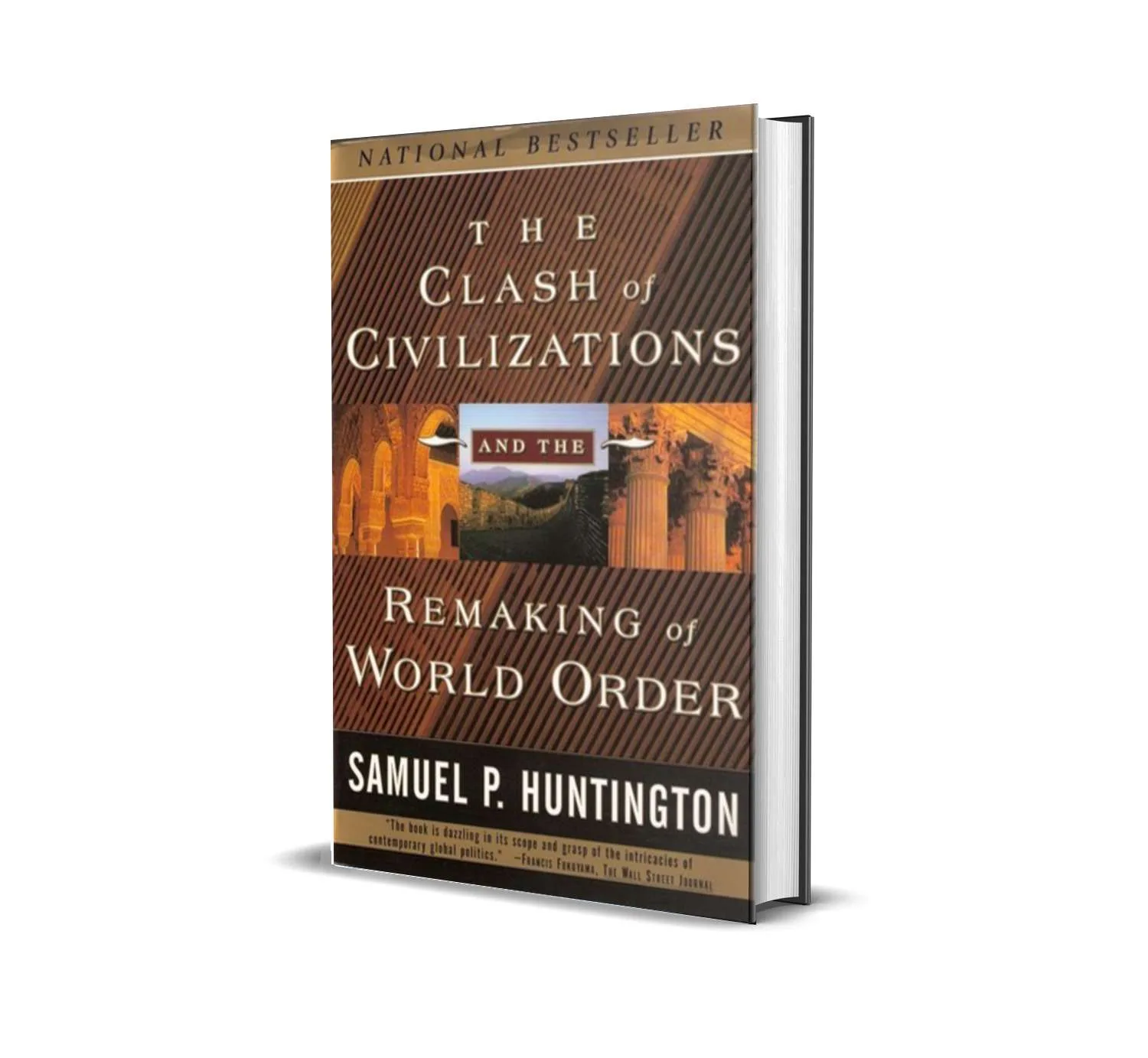
The Clash of Civilizations
As geopolitical friction intensifies between the West and the Islamic world, between the United States and China, and across multi-polar alliances, understanding civilizational fault lines has never been more imperative. Huntington argued that in the post-Cold War era, wars would be fought not over competing secular ideologies, but along cultural and religious frontiers.
Originally published in 1996 by Simon & Schuster, expanding upon his provocative 1993 Foreign Affairs essay, the volume triggered instant academic and geopolitical debates across both hemispheres, becoming an enduring international bestseller.
Read also: A Diary of a Young Girl: Journey of Survival and Perseverance in Nazi-Occupied Holland
An Overview of the Clash Thesis
Huntington argued that humanity is grouped into distinct major civilizations, each anchored by distinct religious ethics, traditions, and historical memories. He identified nine primary civilizational spheres: Western, Latin American, African, Islamic, Sinic (Chinese), Hindu, Orthodox, Buddhist, and Japanese. With the ideological struggle of the Cold War extinguished, Huntington asserted that cultural identities would become the primary axis of loyalty and conflict.
Rather than converging into a universal liberal-democratic culture—as Francis Fukuyama famously hypothesized in The End of History—Huntington posited that non-Western societies were modernizing without Westernizing. Modernization was accompanied by an assertive cultural renaissance, empowering regional powers to challenge Western dominance.
A structural analysis of the narrative arc and archetypal characters within George Orwell’s Animal Farm reveals striking, quintessential parallels to the authoritarian governance of Sheikh Hasina.
The West vs. Islam
Huntington offered a blunt critique of Western foreign policy and militarism in the Muslim world. He observed that the most volatile fault line exists between Western civilization and the Islamic sphere, rooted in centuries of theological rivalry, imperial conquests, and geopolitical contention.
He noted that American and NATO military interventions across the Middle East exacerbated tensions rather than resolving them. Huntington cautioned that Western universalism—the assumption that Western institutional models, human rights definitions, and consumerism should apply universally—is perceived by other civilizations as aggressive imperialism.
“The West won the world not by the superiority of its ideas or values or religion, but rather by its superiority in applying organized violence. Westerners often forget this fact; non-Westerners never do.”
Submit Writing →Contributors Wanted • Write for MaroonPaperPublish Your Research & Critical Analysis on MaroonPaper
Contribute in-depth essays on law, political philosophy, economics, and geopolitics to an intellectual readership.
— Samuel P. Huntington, The Clash of Civilizations
Rather than attempting to remold the Islamic world in its own image, Huntington counselled that Western policymakers must accept the multipolar reality and respect civilizational autonomy. Mutual coexistence, he argued, requires an explicit recognition of cultural boundaries and restraint from military interventions.
The Rise of China and the Multipolar Order
Beyond the Islamic world, Huntington identified the resurgence of Confucian/Sinic civilization as a decisive structural challenge to Western hegemony. He predicted that China's economic ascent would inevitably translate into regional assertion, setting up structural friction with Washington across the Asia-Pacific.
On Palestine by Noam Chomsky and Ilan Pappe, begins by meticulously deconstructing the narrative surrounding the conflict’s genesis.
He cautioned that a global world order can only survive if core states respect the internal spheres of influence of other civilizations. Attempting to enforce Western primacy across non-Western civilizations would trigger catastrophic civilizational warfare.
Limitations and Critical Appraisals
Despite its diagnostic brilliance, Huntington's thesis has faced substantial academic criticism. Critics like Edward Said argued that Huntington's typology commits the fallacy of civilizational essentialism—homogenizing deeply diverse societies into monolithic blocs while ignoring immense internal contestation within Islam, the West, or Asia.
Furthermore, structural realists point out that material economic interests, territorial disputes, and nation-state rivalries remain far more decisive than religious brotherhood. The Iran-Iraq War and Arab-Israeli diplomatic treaties demonstrate that states frequently align across civilizational boundaries based on cold geopolitical calculations.
America's Blackwater: How Private Military Corporations Terrorize the World
Contemporary Relevance and Verdict
Decades after its publication, The Clash of Civilizations and the Remaking of World Order remains indispensable reading. In an era marked by the war on terror, NATO's standoff with Russia, rising Sino-American strategic competition, and the crisis of Western liberalism, Huntington's warnings against imperial hubris feel strikingly relevant. It is an essential text for students of global politics—demanding critical scrutiny, historical contextualization, and rigorous debate.
Dictatorship and Human Rights: The Ongoing Struggle for Freedom