
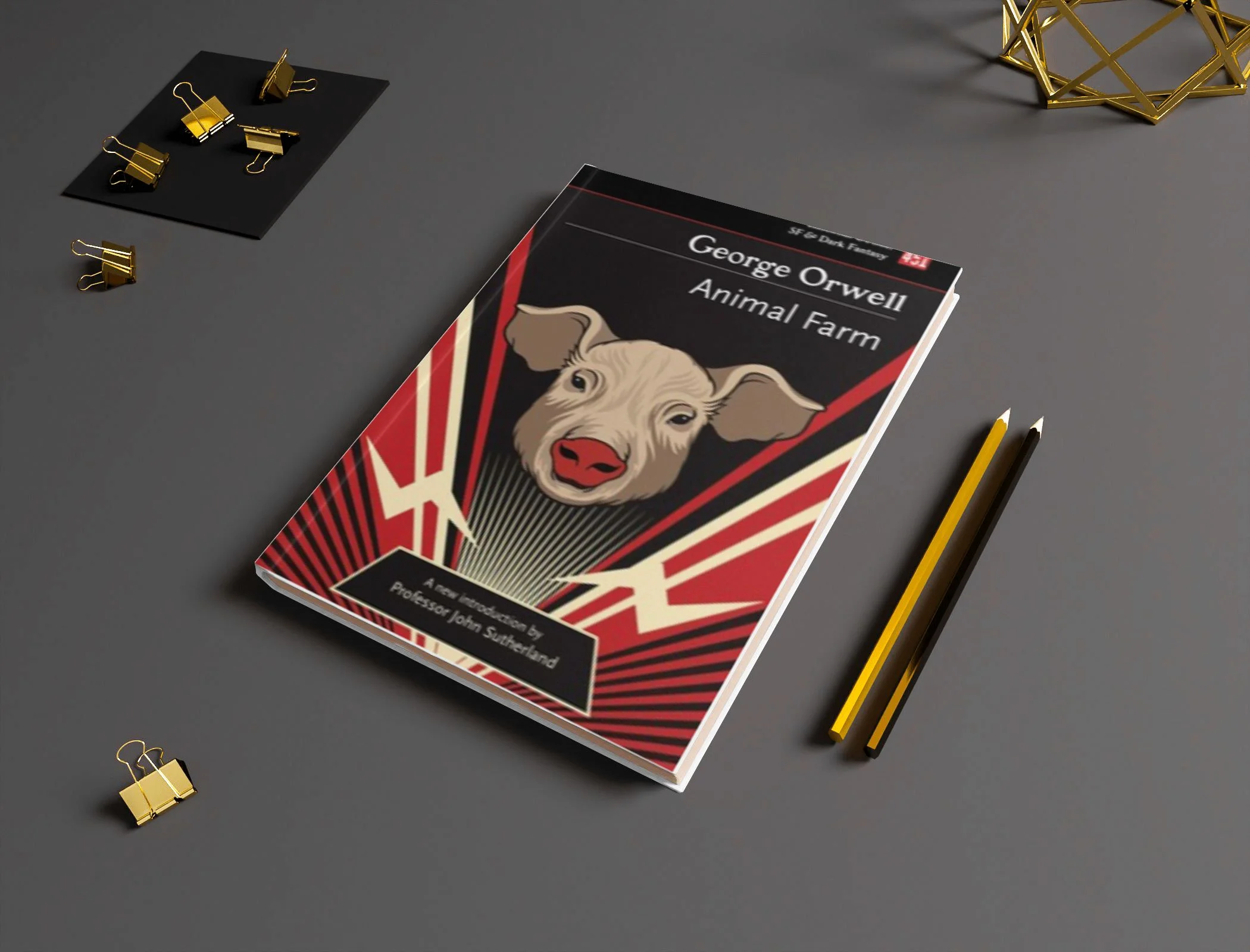
Animal Farm
George Orwell’s enduring masterpiece, Animal Farm, first published in 1945, has remained a seminal work of political literature. Beneath the veneer of a fable about a managed farm lies a scathing indictment of corrupt political systems and the exercise of raw power. It is a narrative concerning tyranny, the abuse of authority, and the inherent avarice of the ruling class. At its core, Animal Farm explores how the lofty promises of a revolution can be systematically subverted, descending into the very autocracy the movement originally sought to overthrow.
While Orwell intended his allegory to critique the Stalinist regime of the Soviet Union, the parallels between the dynamics depicted in Animal Farm and the autocratic rule of Sheikh Hasina in Bangladesh are remarkably salient. Here, we analyze Orwell’s work through the prism of contemporary reality.
A Brief Summary of George Orwell’s Animal Farm
The story begins at Mr. Jones’s Manor Farm, where the proprietor neglects and mistreats his animals. Inspired by the rhetoric of Old Major, a prize-winning boar, the animals revolt and seize control, renaming the estate "Animal Farm." They institute a new order predicated on the maxim that "all animals are equal," aiming to secure liberty and collective prosperity.
Initially, the pigs Napoleon and Snowball serve as the architects of this new egalitarian society. However, the corrupting influence of power soon drives a wedge between them. Napoleon eventually drives Snowball into exile, consolidating absolute authority for himself. Gradually, the ruling pigs emulate the very human oppressors they replaced, and the farm descends into a brutal totalitarian state.
On Palestine by Noam Chomsky and Ilan Pappe, begins by meticulously deconstructing the narrative surrounding the conflict’s genesis.
Central Themes and the State of Modern Bangladesh
The central theme of Animal Farm is the degradation of power and the resulting systemic exploitation. Orwell’s critique of Soviet totalitarianism serves as a cautionary tale—a reminder that revolutions often devour their own children. Nearly a century later, this narrative resonates profoundly within the borders of Bangladesh.
Under Sheikh Hasina’s tenure, the Awami League maintained a grip on power for nearly fifteen years, beginning in 2009. Although they ascended to power with promises of democracy, development, and social welfare, the administration gradually morphed into an autocratic regime. The concentration of authority, the suppression of dissent, the erosion of freedom of speech, and the persecution of opposition figures are features that mirror the rule of Orwell’s Napoleon.
Character Analysis
Napoleon (The Archetype of Sheikh Hasina)
In Animal Farm, Napoleon begins as a revolutionary but eventually monopolizes power, rewriting the rules of the farm to serve his own ends. The other animals are reduced to a state of subjugation. Similarly, while Hasina’s early terms emphasized progress, her administration eventually centralized power, strangling the independence of democratic institutions. Political opposition was obstructed and legally sidelined.
Publish Your Research & Critical Analysis on MaroonPaper
Contribute in-depth essays on law, political philosophy, economics, and geopolitics to an intellectual readership.
Electoral integrity under Hasina’s regime—most notably in the contentious polls of 2014, 2018, and 2023—became increasingly questioned, mirroring the staged dynamics of Napoleon’s administration. By weaponizing the bureaucracy and security apparatus to maintain power rather than safeguarding the franchise, the regime exhibited blatant autocratic tendencies.
Much like the animals who initially supported Napoleon only to realize they were being exploited, many Bangladeshi citizens initially placed their faith in Hasina’s promises of development, only to see democracy eroded. Ultimately, following a mass student-led uprising, the dictator Hasina was forced to flee to India on August 5th.
Snowball (The Opposition)
Snowball represents the idealistic opposition, committed to plans for the farm's genuine advancement. In the Bangladeshi context, the political opposition—notably the BNP and its leader Khaleda Zia—occupied a similar role, suffering systemic suppression and incarceration, a fate comparable to Snowball’s exile.
An in-depth critical analysis of Leo Tolstoy's 1877 masterpiece 'Anna Karenina', exploring the psychological dialectic between Anna's destructive passion and Levin's spiritual quest for existential truth.
Boxer (The Public)
Boxer is the quintessential laborer, defined by blind loyalty and a commitment to hard work. He serves as an allegory for the common Bangladeshi citizen, who initially supported Hasina’s regime, contributing significantly to the nation's progress. Yet, like Boxer, the public was ultimately discarded. Just as Napoleon sold Boxer to the knacker, Hasina’s administration frequently prioritized the interests of the elite and foreign powers over the welfare of the citizenry.
Control Over Media and Judiciary
In the novella, the pig Squealer serves as the propagandist, legitimizing the regime through misinformation. Similarly, under Hasina, press freedom was severely curtailed. Journalists and media houses critical of the administration faced relentless harassment and litigation. Furthermore, the politicization of the judiciary stripped citizens of the recourse to justice.
Personal Liberty and Tyranny
Orwell masterfully illustrates how regimes utilize terror to dissolve personal autonomy. In both Animal Farm and the Hasina-era, dissent was met with brutal repression. Human rights organizations have long documented the use of enforced disappearances and extrajudicial killings to maintain control.
Economic Development and Social Inequality
The pigs enriched themselves while the other animals suffered in squalor. While the Hasina government touted economic development and infrastructure projects, these gains largely accrued to the ruling class. As the Prime Minister and her cohort enjoyed immense prosperity, widening wealth inequality became the hallmark of her tenure, leaving the laboring classes behind.
Literary Style and Legacy
Orwell’s prose is deceptive in its simplicity; it is an accessible vehicle for complex political theory. By employing sharp satire, Orwell critiques the nature of greed and corruption, ensuring the novel remains a potent, cautionary text. Animal Farm serves as an essential warning: when a state ceases to serve the people and begins to exist solely for the benefit of those who wield the whip, it paves the way for the inevitable collapse of the moral and political order.