
The History of the 1972 Constitution
To understand the 1972 Constitution, one must grasp the preceding context. Following nine months of a bloody conflict, Bangladesh was liberated from occupying forces on December 16, 1971. In the wake of independence, a Constituent Assembly was formed, comprising 403 members elected during the 1970 national and provincial elections. On April 11, 1972, during the second day of the Assembly’s first session, a 34-member “Drafting Committee” was formed, chaired by Dr. Kamal Hossain. On October 12, 1972, Dr. Hossain introduced the draft as a bill. The Constitution was formally adopted by the Constituent Assembly on November 4, 1972, and entered into force on December 16.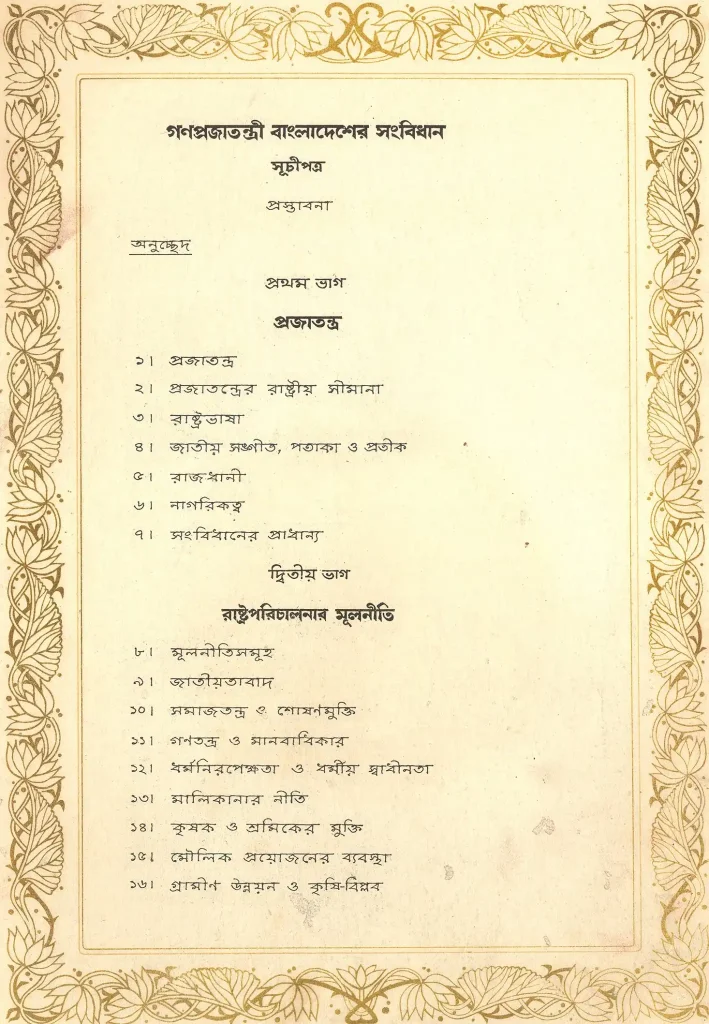
What are the Characteristics of the 1972 Constitution?
The 1972 document stands as the foundational charter of Bangladesh. Like other consequential constitutions globally, it embodies core principles that define the state’s independence and sovereignty. The following are among its most significant features:A Written Document
The Constitution of Bangladesh is a formal, written instrument detailing the framework of state governance. Adopted on November 4 and effective from December 16, 1972, this Constitution consists of a Preamble, 153 articles divided into 11 parts, and seven schedules.Constitutional Supremacy and Popular Sovereignty
The Constitution is the supreme law of Bangladesh; any law inconsistent with its provisions is, to the extent of that inconsistency, void. It vests ultimate authority in the people. State power is to be exercised according to the collective will of the citizenry, to whom the government remains strictly accountable through the mandate of the ballot box.What is a Witness? Who can testify?
Fundamental Principles of State Policy
The first part of the 1972 Constitution declares the state's fundamental objectives, which include democracy, socialism, secularism, nationalism, and the establishment of a welfare state.Parliamentary Democracy
Bangladesh adopted a parliamentary system of government, wherein the cabinet—led by the Prime Minister—exercises executive power. As the head of government, the Prime Minister wields significant authority, selecting ministers and steering national policy. While elected for a five-year term, the Prime Minister and the cabinet are tethered to the confidence of the Parliament; a loss of this confidence precipitates the dissolution of the government.Unitary Government
Recognizing the geography of Bangladesh, Article 1 defines the country as a unitary People's Republic. Under this system, central authority remains supreme, with local government bodies operating as administrative extensions of the state, exercising only such powers as delegated by the center.What is Evidence? Types and Classifications of Evidence.
Guarantee of Fundamental Rights
Part III of the 1972 Constitution guarantees 18 fundamental rights to all citizens, including personal liberty and protection, equality, freedom of expression, freedom of religion, and the right to education and property. The state is duty-bound to protect these rights, and any law inconsistent with them is void. While these rights can be restricted under specific constitutional exigencies, they remain a foundational shield for the individual.Legislature
Article 55 delineates the structure and powers of the legislature. The Jatiya Sangsad (National Parliament) is a unicameral body whose members are elected through direct universal suffrage. While originally consisting of 315 seats, the current capacity is 350.An Independent Judiciary
The 1972 Constitution guaranteed judicial independence through two primary mechanisms. First, it stipulated that the Chief Justice be appointed by the President, with other Supreme Court judges appointed in consultation with the Chief Justice; the same consultative process applied to lower-court appointments. Second, a judge could not be removed from office except by a presidential order following a resolution passed by a two-thirds majority in Parliament.What are Legal Rights? Its Essentials and Classification
The Supreme Court
The Supreme Court serves as the highest court of the land, acting as the guardian of the Constitution and the ultimate protector of fundamental rights. Its jurisdiction is divided into three spheres: original, appellate, and writ jurisdiction.A Rigid Constitution
The power to amend the Constitution resides with the Jatiya Sangsad, requiring a two-thirds majority of its members. However, the basic structural elements of the Constitution are intended to be inviolable.Principles of Ownership
Article 13 outlines the principles of ownership, stipulating that the people—via the state—are the ultimate controllers of the means of production and distribution. It recognizes three forms of ownership: state, cooperative, and private.The Nominal Presidency
While holding a prestigious position, the President is, under the 1972 Constitution, a ceremonial head of state. Elected by the Parliament for a five-year term, the President functions within the parliamentary framework, acting primarily on the advice of the executive.What is Judicial Review? How does it shape the Law and Society?